

Why Does My Dog Have Bad Breath?
The first time Barnaby's breath genuinely made me flinch, he'd just yawned straight into my face on the sofa, a warm, low note of something rotten that simply hadn't been there a month earlier. For years I'd filed "dog breath" under unavoidable, the price of admission for a slobbery Golden Retriever who chews everything he can reach. But that particular smell nagged at me, so I started paying closer attention. What I learned changed how I think about my dog's mouth entirely: the smell coming out of it isn't just unpleasant, it's information. Breath is one of the earliest and clearest signals your dog's body gives you, and learning to read it can catch trouble long before it turns serious.
Editorial note: This article is educational and written from the perspective of a dog owner, not a licensed veterinarian. If your dog's breath is accompanied by vomiting, lethargy, loss of appetite, or sudden changes in drinking habits, consult a licensed veterinarian promptly. For emergencies, contact your nearest animal hospital immediately.
- Persistent bad breath is rarely "just dog breath" in most dogs it's the first detectable sign of plaque, tartar, or developing periodontal disease.
- According to the American Veterinary Dental College, roughly 80% of dogs show signs of periodontal disease by age three, which makes it by far the most common cause of canine halitosis.
- The specific smell is diagnostic: rotting or garbage-like odours point to the mouth, while sweet/fruity or ammonia-like breath can signal diabetes or kidney failure and needs emergency care.
- Daily brushing is the single most effective thing you can do at home, but it cannot reverse tartar that has already mineralized below the gumline, that requires a professional cleaning.
- Breath changes paired with vomiting, lethargy, increased thirst, or appetite loss are systemic red flags rather than dental ones, and they warrant a prompt veterinary visit.
The Breath Signal Ladder: How urgent is your dog's bad breath?
Before you book anything or panic, I use this quick mental triage I call the Breath Signal Ladder to work out what kind of problem I'm actually dealing with. It sorts the smell from least to most urgent, so I know whether I'm looking at a brushing problem or a get-in-the-car problem.
| Rung | The smell | What it usually means | Action |
|---|---|---|---|
| Rung 1 | Stale or earthy | Normal dog breath; plaque buildup beginning | Start a daily brushing routine |
| Rung 2 | Foul, rotting, or garbage-like | Active periodontal disease or a trapped foreign object | Book a veterinary dental cleaning within 2-4 weeks |
| Rung 3 | Musty, sulfurous, or dead-animal-like | Possible liver disease or severe oral necrosis | Schedule a vet appointment within 24-48 hours |
| Rung 4 | Sweet/fruity OR ammonia/urine-like | Diabetic ketoacidosis or kidney failure | Emergency vet visit, do not wait overnight |
Treat this ladder as a starting point, not a diagnosis. It's a way to calm your own panic and decide how fast you need to act, not a substitute for a professional looking in your dog's mouth. Rungs 1 and 2 are usually things you can begin addressing at home while you arrange care, but rungs 3 and 4 are different animals entirely, a sweet, fruity, or ammonia-like smell needs a vet that same day, and a musty or sulfurous odour needs one within a day or two. When in doubt, climb the ladder cautiously and let a professional rule things out.
The most common cause: periodontal disease
If your dog's breath has gone from neutral to genuinely bad, the odds heavily favour periodontal disease as the culprit. It starts with plaque, a soft, sticky film of bacteria that forms on the teeth constantly, every single day. Left undisturbed, that plaque mineralizes into hardened tartar in as little as 48 hours, and once it's tartar, no amount of brushing will shift it. As the dental-care specialists at Oravet explain, this is exactly why daily home care matters so much: you're working inside that narrow window before the plaque turns to cement.
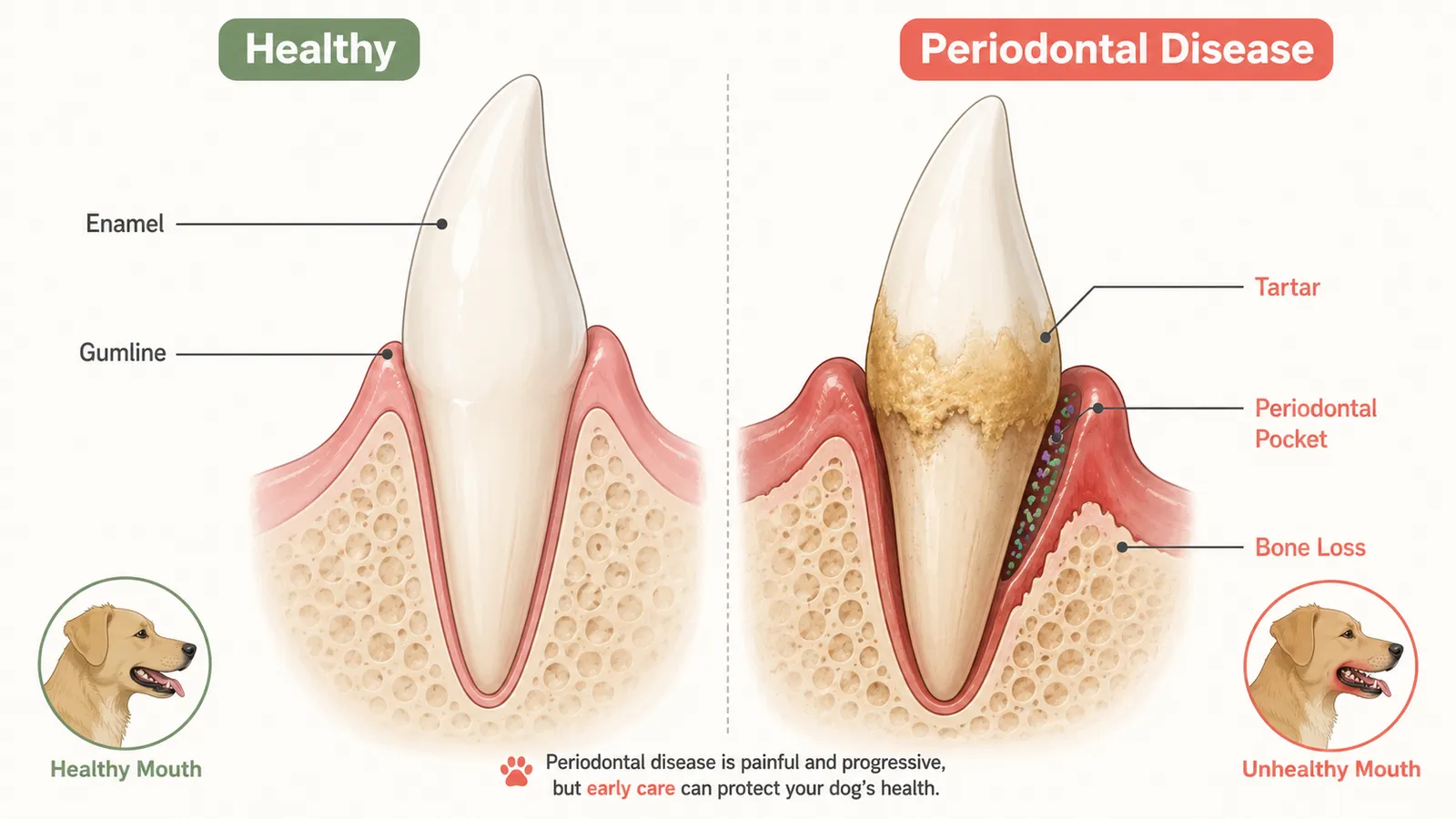
The real damage happens below the gumline, where you can't see it. Tartar creeps under the gums and creates pockets, and those pockets become a perfect home for anaerobic bacteria, microbes that thrive without oxygen and release volatile sulfur compounds as they feed. Those compounds are the rotting smell. Worse, the bacteria slowly destroy the tissue and bone anchoring the teeth, which is how untreated dental disease eventually leads to loose teeth and chronic pain. The visual warning signs to watch for are yellow-brown crust along the gumline, red or swollen gums, gums that bleed easily, and any tooth that looks discoloured or wobbly.
Here's the part I had to learn the hard way. I was brushing Barnaby's teeth and feeling smug about it, and the smell still crept back. It took his first professional cleaning for the penny to drop: brushing controls new plaque, but it does nothing for the tartar already wedged below the gumline. When the vet showed me what came off under anaesthesia, and the early pocketing on two of his back teeth that I'd had no way of seeing, I understood that home care and professional cleanings aren't competing options. They're two halves of the same job.
Diet and behaviour: what your dog eats affects how they smell
The mouth isn't the only source of bad breath. Sometimes the smell is telling you about your dog's habits and diet rather than their gums, and these causes are easy to overlook precisely because they aren't obviously "dental."
Coprophagia (stool eating)
Coprophagia is the technical name for a habit most owners find mortifying: eating faeces, whether their own, another dog's, or a cat's from the litter box. If your dog's breath has a smell that goes well beyond ordinary halitosis into something genuinely offensive, this is often the unglamorous explanation. I won't pretend it isn't unpleasant, but it helps to understand it rather than just despair at it.
Behaviourally, coprophagia can stem from boredom, anxiety, learned puppy behaviour, or simple opportunism. Medically, it sometimes signals a nutritional gap or a digestive issue where the dog isn't fully absorbing what they eat, which is a related instinct to the one behind why dogs eat grass. If it's a new and persistent habit, it's worth mentioning to your vet to rule out a malabsorption problem. If it's long-standing, management usually means prompt clean-up, supervised toilet breaks, and addressing the underlying boredom or anxiety.
Kibble vs wet food and the dental myth
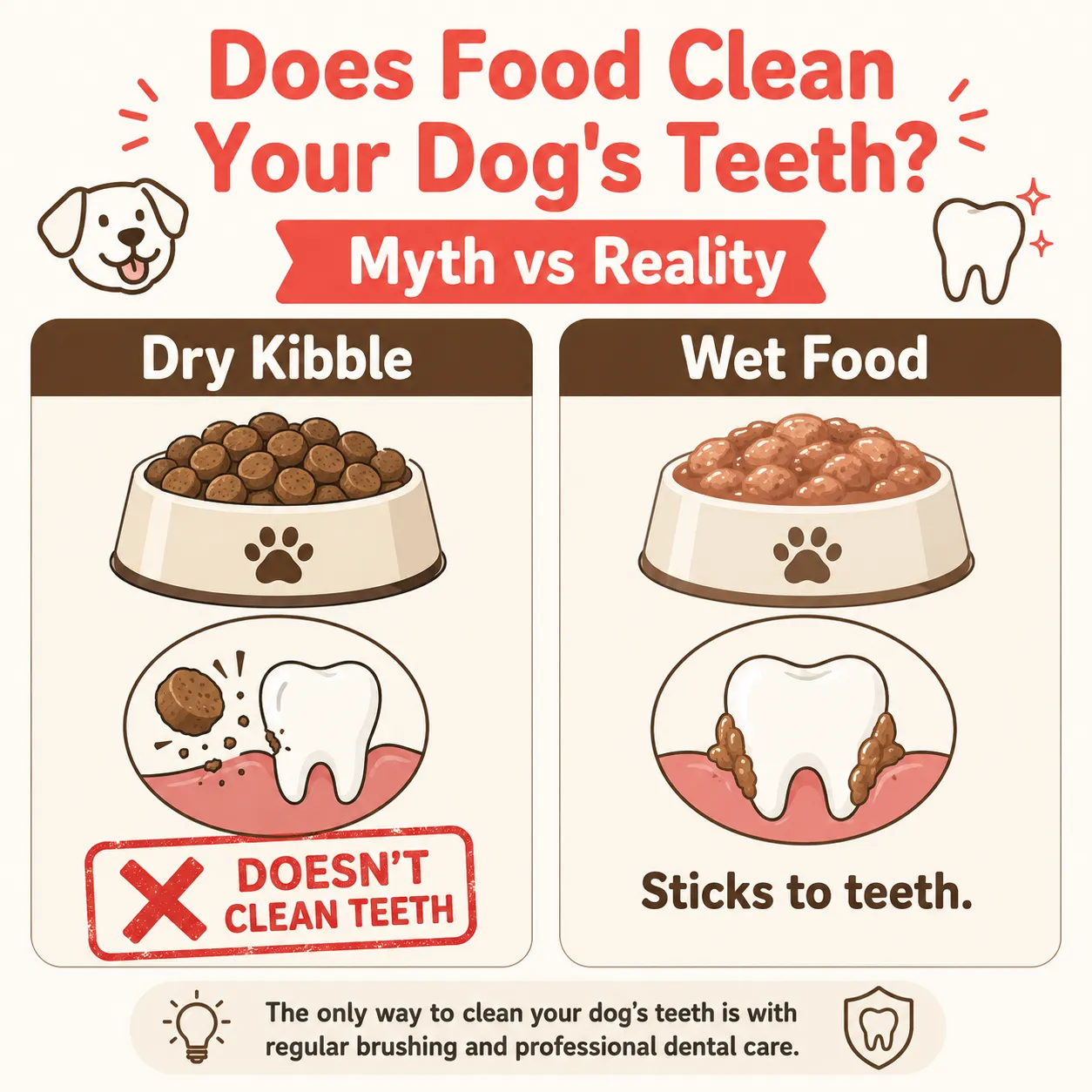
One of the most stubborn beliefs in dog care is that dry kibble "cleans" the teeth as the dog crunches it. I believed it too, for an embarrassingly long time. The logic sounds reasonable, hard food, mechanical scrubbing, but it doesn't hold up. Most kibble simply shatters into crumbs on first contact with the tooth, well above the gumline where it matters least. It makes almost no contact with the critical area just under the gums where periodontal disease actually begins.
Wet food isn't a clean win either. Its soft texture provides zero abrasive action and tends to leave more residue clinging to the teeth, which can feed plaque if oral hygiene is otherwise neglected. The honest takeaway is that no everyday food, wet or dry, replaces brushing, diet supports dental health, it doesn't deliver it. That said, food still matters for overall wellbeing, and choosing the right food for your dog's digestive system affects everything from stool quality to coat condition, which feeds back into how your dog smells generally.
Trapped foreign objects
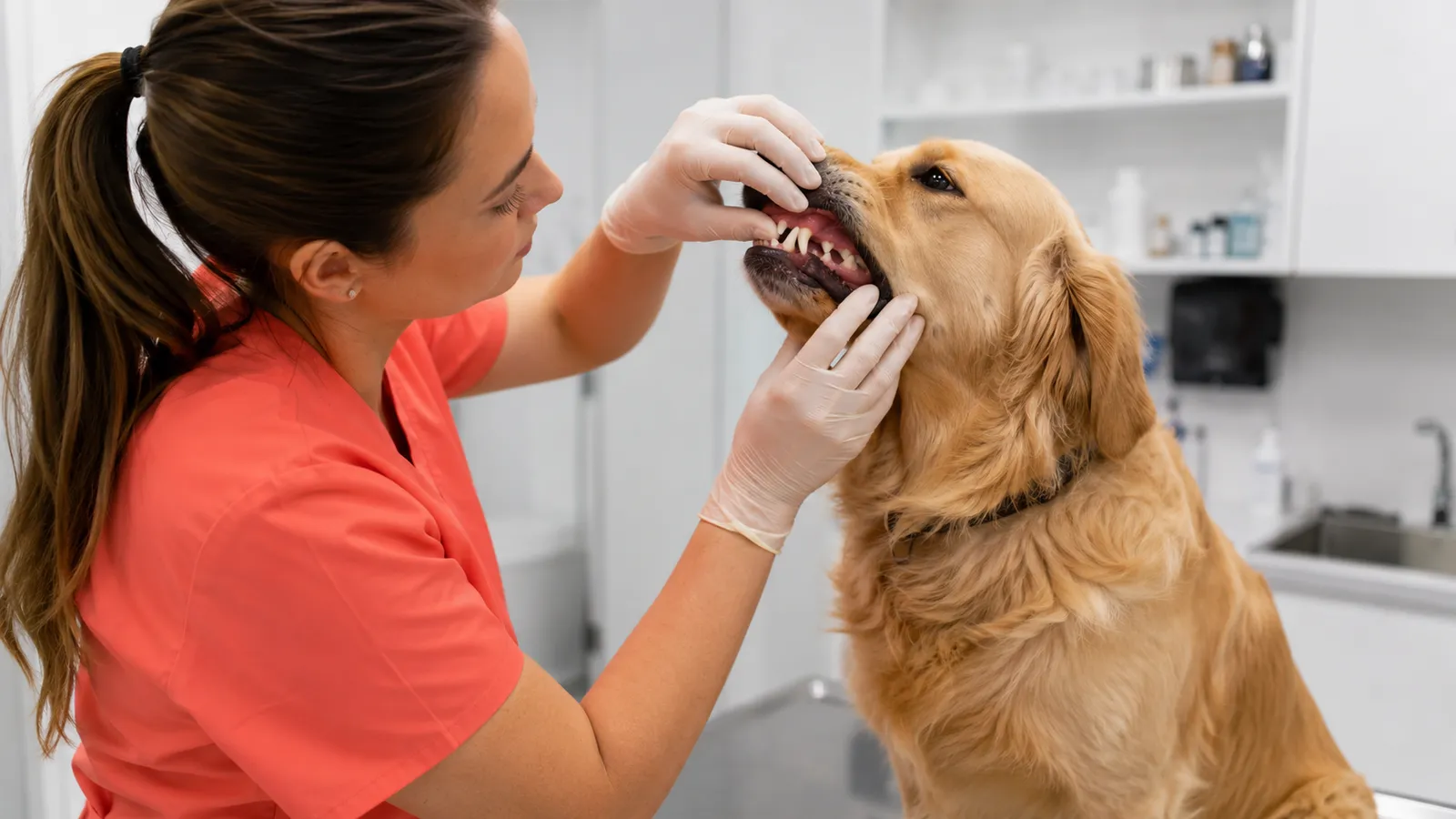
Dogs explore the world with their mouths, and sometimes the world gets stuck in there. Splinters from sticks, fragments of bone, shredded toy fibres, even a piece of food lodged between two teeth, any of these can wedge into the gumline or the roof of the mouth and sit there. At first you might notice nothing but a faint new odour.
Then the object starts to decompose. Trapped organic material rots, the surrounding tissue can become necrotic, and the result is a genuinely putrid smell that sits high on the urgency scale, this is a Rung 2 to Rung 3 situation depending on how advanced it is. If you suspect something is stuck, you can do a gentle, calm mouth inspection: lift the lips, look along the gumline and across the roof of the mouth in good light, and check for anything obviously wedged or any red, angry-looking patch. Don't force your dog's jaws or dig at anything painful. If you see something embedded, or your dog reacts with pain, that's a vet visit, not a DIY extraction.
How to freshen your dog's breath at home
Once you've ruled out the urgent stuff, most everyday bad breath responds well to consistent home care. Here's the routine that actually worked for Barnaby, in the order I'd recommend building it.
- Daily brushing, the foundation. This does the heavy lifting, but you have to use toothpaste made for dogs. Never use human toothpaste: many human formulas contain xylitol, which is highly toxic to dogs even in small amounts, plus foaming agents and fluoride they shouldn't swallow. Dog-specific enzymatic pastes are made to be swallowed and usually taste like poultry or peanut, which helps enormously.
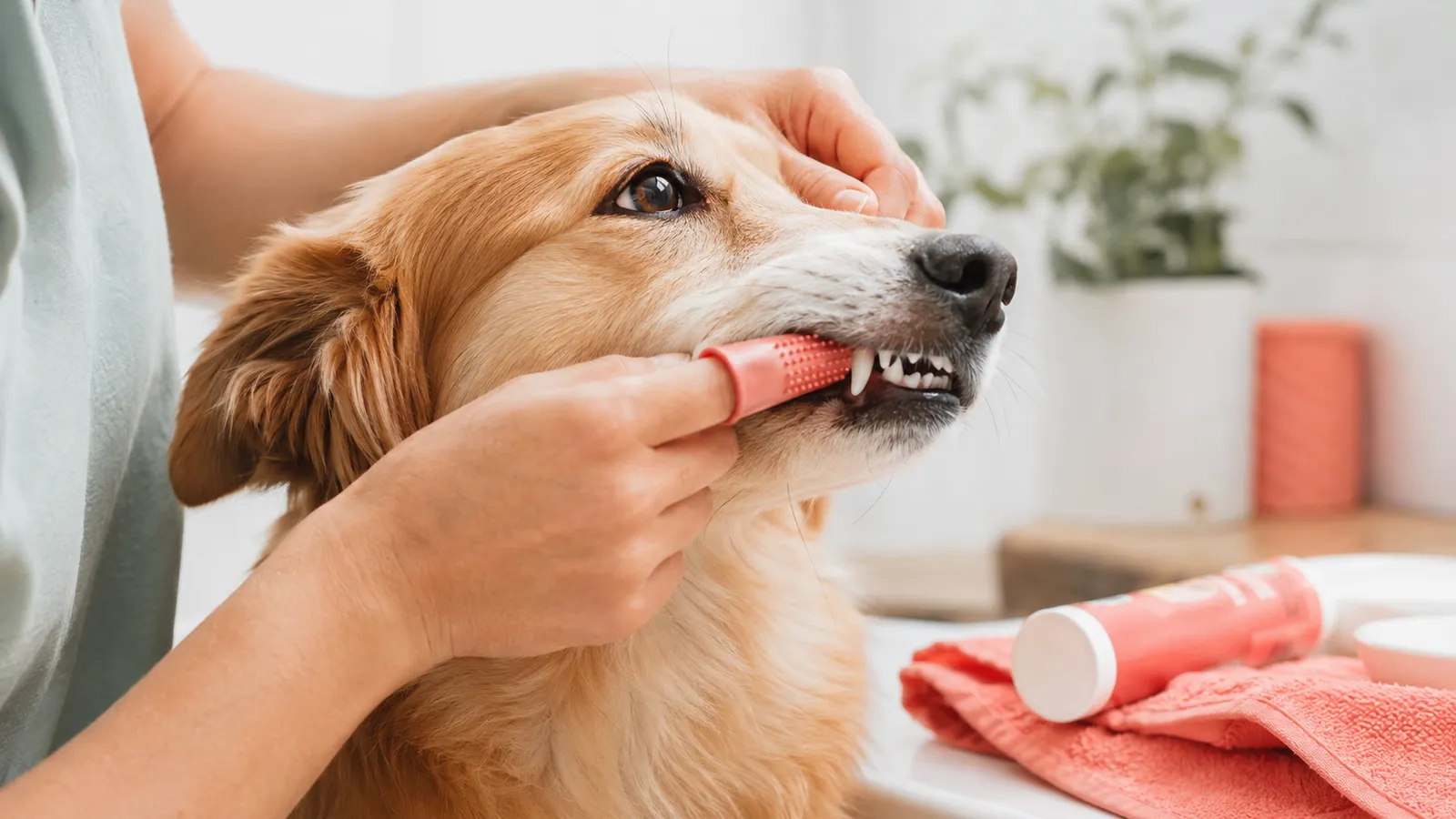
- Build the habit slowly. Here's where I have to be honest about Barnaby: the first time I came at him with a toothbrush, he treated it as a personal insult and clamped his jaw shut like a vault. What finally worked wasn't persistence with the brush, it was retreating all the way back to step zero. For a week I just let him lick a dab of dog toothpaste off my finger so he'd decide it was a treat. Then I rubbed a little along his gumline with my finger. Only after that did the finger brush appear, and finally the real bristle brush. The whole transition took about three weeks of patience, and the patience was the entire point.
- VOHC-accepted dental chews. Chews that carry the Veterinary Oral Health Council (VOHC) seal have been tested to actually reduce plaque and tartar, rather than just claiming to. Used alongside brushing, not instead of it, they significantly reduce the bacterial load in the mouth and give the back teeth some mechanical cleaning that brushing often misses.
- Regular professional cleanings. No home routine reaches below the gumline, so periodic cleanings under anaesthesia remain part of the plan for most dogs. Your vet can tell you the right interval for your individual dog based on breed, age, and how fast they accumulate tartar. If you want to get your at-home technique right between cleanings, our step-by-step guide to brushing your dog's teeth walks through the whole process in detail.
- Water additives and dental gels. For dogs who flatly refuse a brush, or for the days you're short on time, water additives and oral gels are a useful supporting layer. You add the additive to the water bowl or apply the gel to the gums, and it works on the bacteria passively throughout the day. They're a supplement, not a replacement for brushing, but for resistant dogs they meaningfully close the gap.
Decoding the smell: what each odour means for your dog's health
This is where the Breath Signal Ladder earns its keep. Once you start treating the type of smell as a clue rather than just a nuisance, you can map almost any breath odour to a likely cause and an urgency level. The table below brings it all together.
| Scent | Most likely cause | What's happening biologically | Breath Signal Ladder rung | Urgency |
|---|---|---|---|---|
| Stale, earthy | Early plaque/tartar | Bacterial biofilm forming | Rung 1 | Low, start brushing |
| Foul, rotting, garbage | Periodontal disease or foreign object | Anaerobic bacteria + VSCs | Rung 2 | Moderate, dental cleaning |
| Musty, sulfurous, dead animal | Liver disease or oral necrosis | Dimethyl sulfide accumulation | Rung 3 | Urgent, vet within 48h |
| Sweet, fruity, nail polish | Diabetic ketoacidosis (DKA) | Ketone production from fat metabolism | Rung 4 | Emergency, vet today |
| Ammonia, urine, metallic | Kidney failure (uremia) | Urea → ammonia via oral bacteria | Rung 4 | Emergency, vet today |
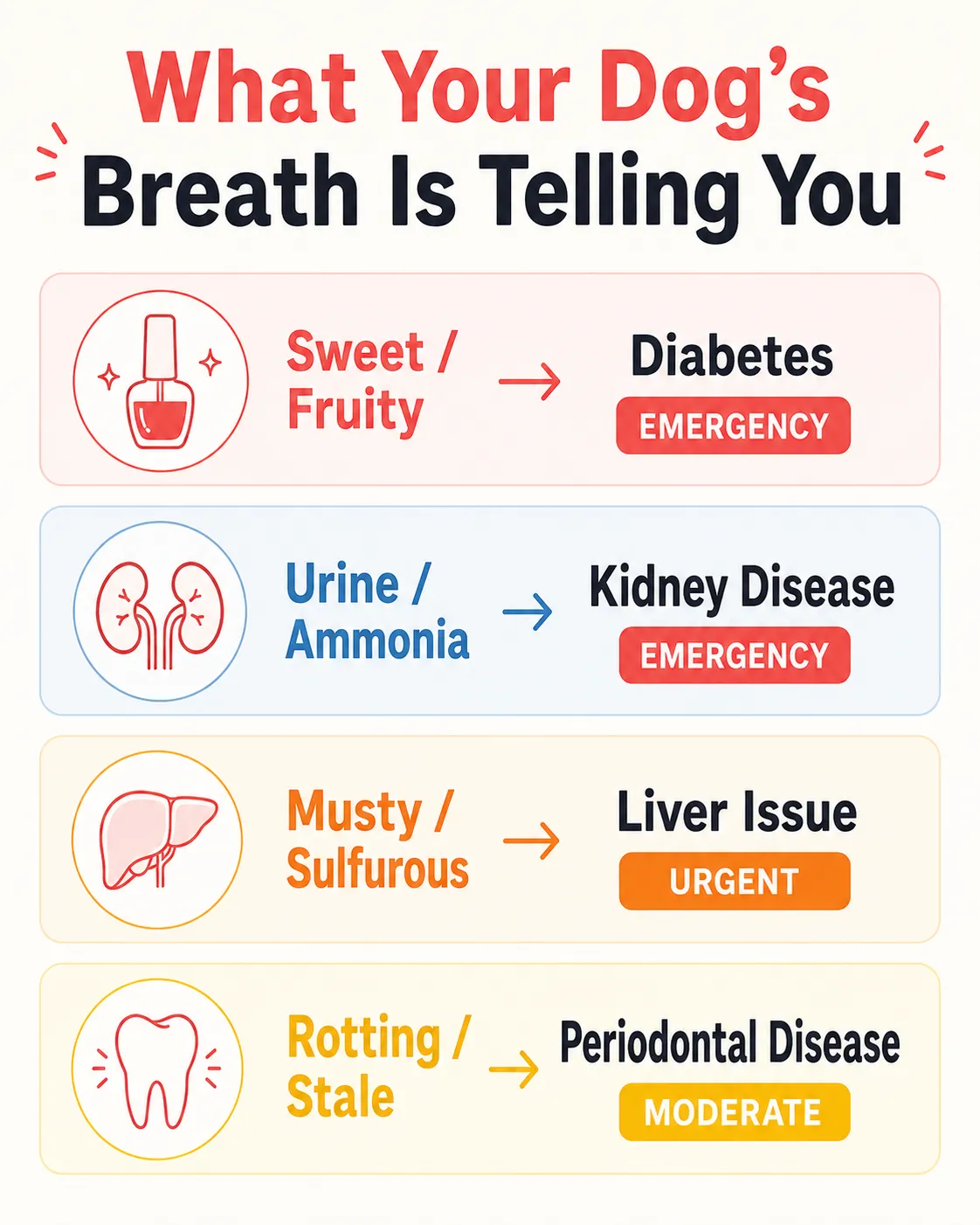
The two Rung 4 smells are the ones I never want anyone to dismiss, so let me explain what's happening underneath them, because understanding it is what makes you take it seriously. A sweet, fruity, almost nail-polish-like smell on a dog's breath is the signature of diabetic ketoacidosis. When a diabetic dog can't get glucose into its cells, the body panics and starts burning fat for fuel instead. That fat-burning produces ketones as a byproduct, and one of them, acetone, is volatile and smells exactly like fruit or nail polish remover. It's the same chemistry, and it means the body is in a metabolic crisis.
The ammonia or urine-like smell is, if anything, even more alarming once you know the mechanism. Healthy kidneys filter urea, a nitrogen waste product, out of the blood. When the kidneys fail, that urea builds up in the bloodstream instead, a state called uremia. Oral bacteria then break the circulating urea down into ammonia, which is why the breath starts to smell like a litter tray or cleaning product. The smell is essentially your dog's failing kidneys announcing themselves through their mouth. If you ever catch it, don't wait, and read up on the early signs of kidney disease in dogs so you know what else to watch for. Learning this biochemistry was genuinely sobering for me; it reframed "bad breath" from a cosmetic annoyance into something I now treat as a vital sign.
When should I take my dog to the vet for bad breath?
Most bad breath is dental and manageable. But a subset of cases is the body waving a flag, and knowing how to tell them apart is the whole game.
Systemic red flags
When bad breath arrives alongside other whole-body symptoms, you've likely moved out of dental territory and into something involving the organs. The signs to take seriously are increased thirst and urination (polydipsia), unusual lethargy, vomiting, and loss of appetite (anorexia). On their own, each can have an innocent explanation. Combined with a change in breath, they form a pattern that deserves prompt professional attention.
Appetite changes in particular are easy to rationalize away, which is a mistake. If your dog has gone off food while still drinking, the kind of pattern covered in our piece on a dog not eating but drinking water, that combination can point toward kidney or other systemic disease and shouldn't be left to "wait and see." The same goes for repeated vomiting in the morning, which can accompany the metabolic problems that also alter breath. Patterns matter more than any single symptom.
Behavioural signs of oral pain
Dogs are wired to hide pain. In the wild, showing weakness is dangerous, and that instinct survives intact in the dog sleeping on your couch. So a dog with a genuinely painful mouth often won't cry out, instead, they show you in quieter ways. According to Sunset Veterinary Clinic, the behavioural tells to watch for include dropping kibble while trying to eat, pawing at the muzzle, whimpering or wincing while chewing, chewing pointedly on one side, and suddenly avoiding favourite toys or chews.
This is the part I wish more owners took to heart, because I nearly learned it the painful way through a friend. Her older terrier had developed bad breath and started leaving his beloved tug toy untouched, and she chalked both up to him "getting old and fussy." By the time he stopped eating altogether and she took him in, he had two abscessed teeth that had been hurting him for weeks. He recovered well, but he'd been in silent pain far longer than he needed to be. That story is the reason I now treat toy avoidance and dropped food as the warning signs they are, not quirks.
Why delaying a cleaning is riskier than you think
It's tempting to put off a dental cleaning, it costs money, it involves anaesthesia, and the problem doesn't look like an emergency. But the risk of waiting goes well beyond the mouth. When periodontal disease is advanced, the inflamed, bleeding gums become an open doorway for bacteria to enter the bloodstream, a condition called bacteremia. Once circulating, those bacteria can seed and damage distant organs, the heart valves, the kidneys, and the liver are all known targets.
That's the visceral truth behind "just a dental cleaning": you're not only freshening breath, you're protecting organs that have nothing to do with teeth. The American Animal Hospital Association sets the standards for professional cleanings precisely because the procedure, done under anaesthesia, with dental X-rays to assess what's happening below the gumline, is the only way to fully address the disease. The kidney connection is real enough that it's worth understanding the early signs of kidney disease in dogs alongside your dental routine, since the two problems can travel together.
Quick answers
Can I use human toothpaste on my dog? No, never use human toothpaste on a dog. Many human formulas contain xylitol, an artificial sweetener that is highly toxic to dogs and can cause a dangerous blood-sugar crash even in tiny doses. Human toothpaste also contains foaming agents like sodium lauryl sulfate (SLS) and fluoride, none of which your dog should swallow, and dogs swallow everything you put in their mouth. Always use an enzymatic toothpaste made specifically for dogs. For context on what else to keep out of reach, see our foods and substances toxic to dogs.
Does dry food clean a dog's teeth better than wet food? Not in the way most people assume. The popular idea is that crunchy kibble scrubs the teeth clean, but standard kibble simply crumbles on contact, well above the gumline where periodontal disease actually starts. It makes almost no useful contact with the area that matters. Wet food doesn't clean teeth either, and its softness can leave more clinging residue. The honest answer: neither food type replaces brushing. Diet supports dental health, but it doesn't deliver it on its own.
How often should I brush my dog's teeth? Ideally every single day. The reason is timing: plaque begins mineralizing into hardened tartar in roughly 24 to 48 hours, and once it's tartar, brushing can't remove it. Daily brushing keeps you ahead of that window and stops new plaque from ever hardening. If daily truly isn't realistic, aim for at least three or four times a week, but understand that the gap days are when tartar gets its foothold, so the more consistent you can be, the better the payoff.
Can bad breath in dogs be cured permanently? It's more accurate to talk about management than cure. Dental-origin bad breath can be kept under control long-term with consistent home care and regular professional cleanings, but it requires ongoing commitment, it doesn't simply "go away" and stay gone on its own. If the cause is systemic, such as kidney disease, liver disease, or diabetes, the breath will only improve when the underlying condition is being properly managed medically. So the realistic, honest goal is steady management, not a one-time permanent fix.
If you want to keep building on this, we cover the rest of your dog's health in straightforward, no-jargon terms across our plain-language dog health guides, because understanding what your dog's body is telling you is the best preventive medicine there is.
Sources
- Bad Breath in Dogs: Causes and Treatment | PetMD
- Ask the Vet: Why Does My Dog Have Bad Breath? | Sunset Veterinary Clinic
- Why does my dog's breath smell so bad? | Edgewater Vets
- Bad Breath in Dogs: Causes and Prevention | Oravet
- American Veterinary Dental College (AVDC)
- Partners Veterinary, Bad Breath in Dogs