
Labrador Retriever Weight Chart by Age: What’s Normal and When to Worry
If you just weighed your Lab and the number doesn't match what a chart told you it should be, take a breath, that gap is more common than the chart makes it seem. Weight charts are built from population averages, and Labradors, more than most breeds, come in genuinely different builds: a lean field-line dog and a broad-headed show-line dog can be the same age and a healthy 15 lb apart.
I've spent a lot of time cross-checking numbers like this since I started tracking Barnaby's growth, and the single biggest shift for me was realizing the scale is only one piece of the picture. What actually tells you whether your Lab is doing fine, at 8 weeks or 8 years, is a combination of where they sit relative to their own history, how they feel under your hands, and whether any change is holding steady over weeks rather than showing up in one weigh-in.
This guide walks through what's typical at each age and body type, how to run a body condition check yourself, and exactly when a weight change is worth a call to the vet versus a few more weeks of watching.
⚠️ Editorial note: Emily Harper is not a veterinarian. This article is educational and based on trusted pet care sources. Always consult a licensed veterinarian for medical concerns about your dog.
Before you compare your Lab to a chart
- Charts show a range, not a target. A healthy Lab can sit anywhere within it, the number itself matters less than whether your dog is trending steadily in one direction.
- The first 6 months are the fastest growth window, from ~10-15 lb at 8 weeks to 45-60 lb by 6 months, then growth slows and shifts toward filling out until 18-24 months.
- Adult weight depends on line type as much as sex. A lean field-line Lab and a broader show-line Lab can both sit at 65 lb and be equally healthy.
- Genetics, neuter status, activity level, and age all explain normal variation, none of them require a feeding change on their own.
- Body Condition Score (ribs, waist, tuck) tells you more than the scale. A dog can be a "normal" weight and still be over- or under-conditioned.
- Use Scale + Shape + Trend together, and only call the vet when consistent data over 3-4 weeks, not a single weigh-in, points the same direction.
What Does a Labrador Retriever Weight Chart Actually Tell You?
A weight chart gives you a probability window, not a prescription. When I first started researching dog weight tracking through Froqel, I noticed how many Lab owners treat a chart number like a test score, something to hit or fail. That framing causes unnecessary anxiety and, sometimes, actual harm through overfeeding or underfeeding.
What the chart actually tells you is where most healthy Labradors tend to land at a given age. It's built from population data, a wide sample of dogs with different genetics, activity levels, and builds. Your individual dog may sit at the bottom of the range, the top, or slightly outside it and still be completely healthy. The chart is most useful as an early-warning system: a puppy that drops suddenly from the 60th percentile to the 10th between checkups, or an adult that gains 10 lb in two months with no diet change, is worth investigating.
It's also worth knowing that "Labrador" covers meaningful variation. Field-bred Labs, bred for agility and endurance, carry far less body mass than show-bred Labs with broader heads and heavier frames. A chart that doesn't account for this will make a lean working Lab look dangerously underweight and a stocky show Lab look perpetually obese. The sections below build in that nuance.
Labrador Weight Chart by Age: Month-by-Month Puppy Ranges
Labrador puppies grow faster in their first six months than at any other point in their lives. The table below captures that trajectory. I've added a "what's usually happening" column because the numbers mean more when you understand the biology behind them (The Labrador Site; AKC breed growth guidance).
| Age | Typical male range | Typical female range | What is usually happening |
|---|---|---|---|
| 8 weeks | 10-15 lb / 4.5-7 kg | 8-14 lb / 3.5-6.5 kg | Rapid early growth just starting; still adjusting to solid food |
| 3 months | 20-30 lb / 9-14 kg | 18-28 lb / 8-13 kg | Steepest part of the growth curve; bones and muscle mass building quickly |
| 6 months | 45-60 lb / 20-27 kg | 40-55 lb / 18-25 kg | Height often near adult level; body is still filling out laterally |
| 9 months | 55-70 lb / 25-32 kg | 50-65 lb / 23-29 kg | Chest beginning to deepen; muscle mass increasing noticeably |
| 12 months | 65-80 lb / 29-36 kg | 55-70 lb / 25-32 kg | Near adult weight; skeletal maturation and full muscling continue until 18-24 months |
Source: Weight ranges compiled from The Labrador Site, Snowy Pines White Labs growth chart data, and AKC breed guidance.
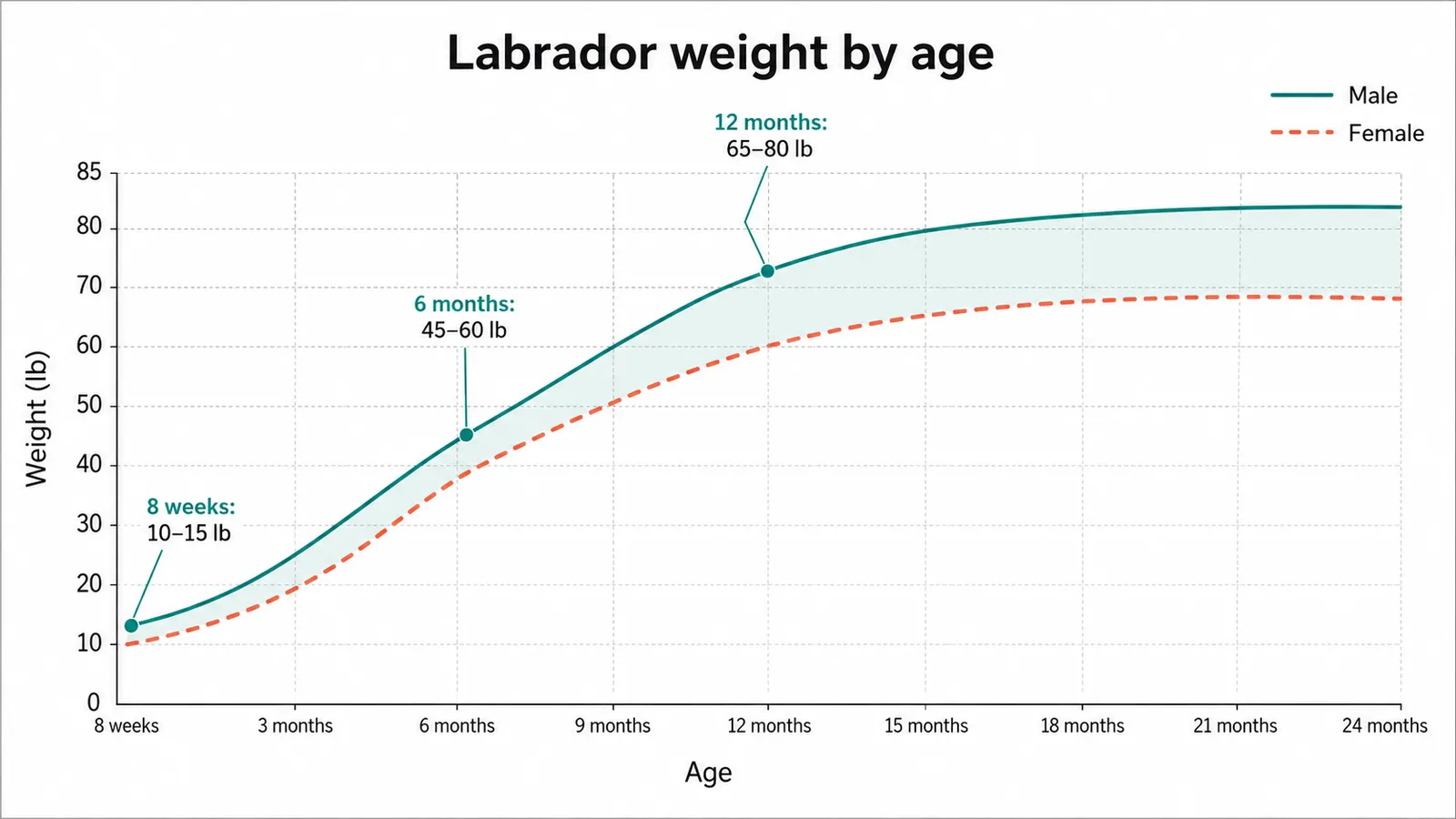
These are reference ranges, not targets. A puppy that consistently tracks below or above the range, especially if the gap widens over multiple weigh-ins, warrants a veterinary check. Do not adjust feeding amounts based on the chart alone; your vet can assess whether your puppy's growth trajectory is healthy for their individual frame.
How Much Should an Adult Labrador Weigh?
Adult weight depends heavily on the type of Lab you have. The AKC breed standard lists 65-80 lb for males and 55-70 lb for females as the formal range, but that single window papers over real structural differences between Lab lines (AKC breed standard).
The table below breaks it down by body type, because a field-line Lab at 58 lb is thriving, while a show-line Lab at 58 lb may be significantly underweight.
| Lab type | Typical healthy weight | Signs of good condition | Red flags to watch |
|---|---|---|---|
| Working / field line | Lower end of breed range; lean and athletic | Visible waist, easy rib feel under light pressure, high sustained energy | Muscle loss, ribs too prominent under light touch, sudden thinning |
| Typical family pet | Mid-range; moderate build | Waist visible from above, ribs palpable with gentle pressure | Gradual waist loss over months, softening around ribs, decreased activity tolerance |
| Broader / show line | Can sit at upper end of range without being obese | Ribs palpable under firm cover, waist still present from above | Unable to feel ribs at all with firm pressure, no waist visible from any angle |
Source: PetMD adult weight guidance; The Labrador Site line-type comparison.
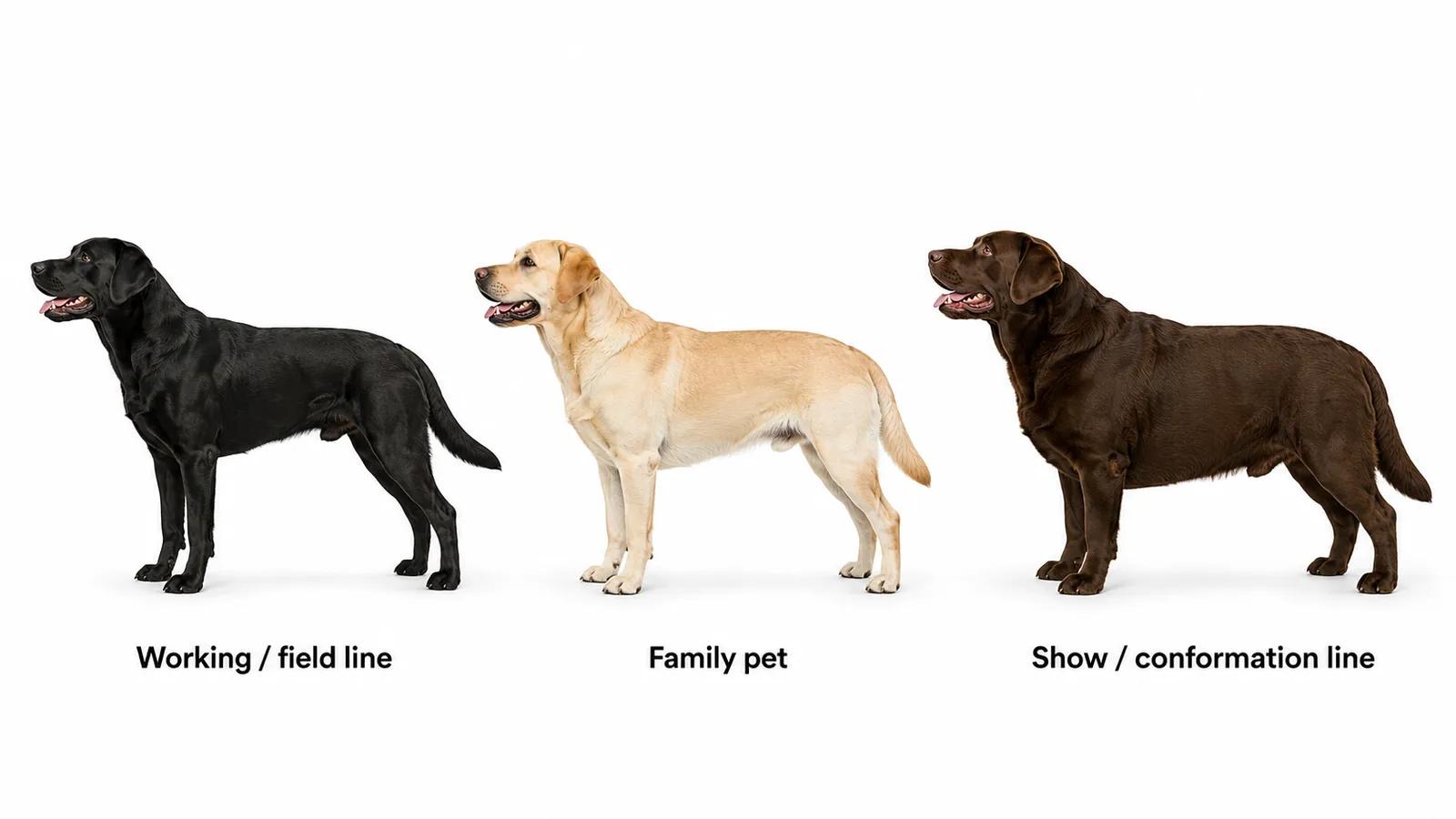
If you're unsure which category your Lab falls into, your vet or a breed-knowledgeable trainer can help you identify their line type. It matters more than most owners realize.
Why Your Lab Might Not Match the Chart Exactly
Several well-documented factors explain why a healthy Lab can sit outside the standard range, and none of them require a feeding adjustment on their own.
Genetics and parentage. The single strongest predictor of your Lab's adult weight is the size of their parents (The Labrador Site). If both parents were lean field dogs at 58-62 lb, your puppy landing at 60 lb as an adult is not a cause for concern. Ask your breeder for parent weights if you have access to that information.
Neuter or spay status. Research cited by PetMD and veterinary nutritionists consistently shows that neutered dogs have a modestly lower metabolic rate and a higher tendency toward weight gain. This doesn't mean neutered Labs are destined to be overweight, it means their caloric needs drop somewhat after the procedure and feeding amounts should be reviewed with your vet at that point.
Line type. As noted in the previous section, field-bred Labs and show-bred Labs are structurally different animals. Applying a single-line chart to both distorts the picture in both directions.
Activity level. A Lab that runs five miles a day with a jogger owner carries more lean muscle and burns more calories than a Lab with a sedentary household. Both can be healthy. The active dog may weigh more from muscle; the less-active dog may need tighter portion control to avoid fat accumulation.
Age and life stage. Senior Labs (typically 7+) often lose muscle mass even when their total body weight stays stable, a phenomenon called sarcopenia. If an older Lab's weight holds steady but their shape changes, that's worth discussing with your vet at a routine visit.
Is My Labrador Overweight or Underweight? The Body Condition Score Check
The Body Condition Score (BCS) is a standardized hands-on assessment that tells you more about your dog's actual composition than any scale reading (WSAVA Body Condition Score Guidelines). The WSAVA, the World Small Animal Veterinary Association, developed and validated a 9-point scale that vets use worldwide. A score of 4-5 out of 9 is ideal for most Labs.
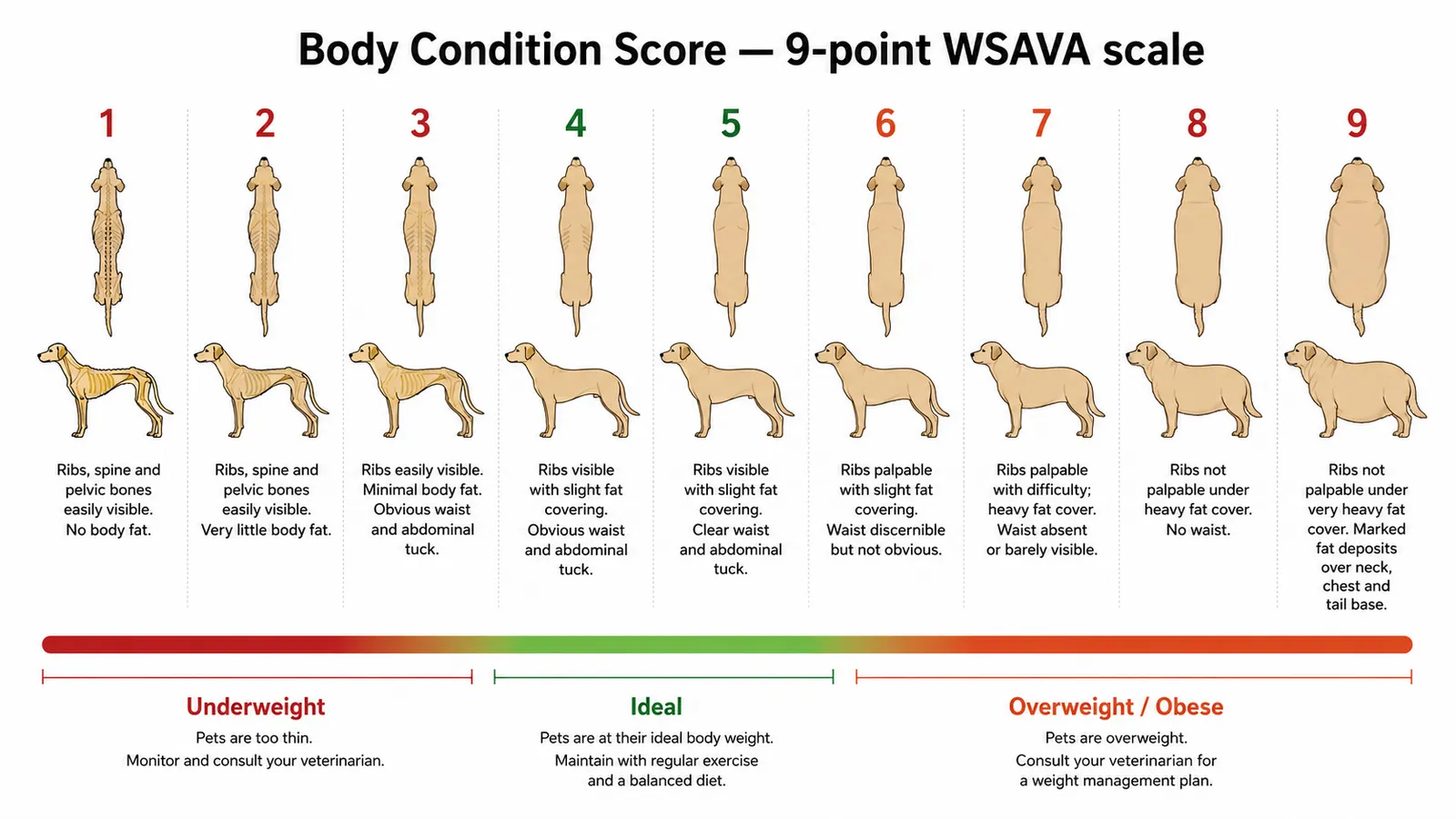
You don't need a vet visit to do a basic check. Here's how.
The hands-on rib check
Place both hands flat on your dog's ribcage, thumbs along the spine, fingers spread over the sides. Apply light pressure, about what you'd use to feel the bones of your own hand through the back of it. In a dog at ideal weight, you should feel each rib distinctly without pressing hard, with a thin layer of tissue over them. If you have to press firmly to detect anything, or can't feel ribs at all, excess fat is present. If the ribs are immediately visible without touching, or sharp to the touch with no covering, the dog is likely underweight.
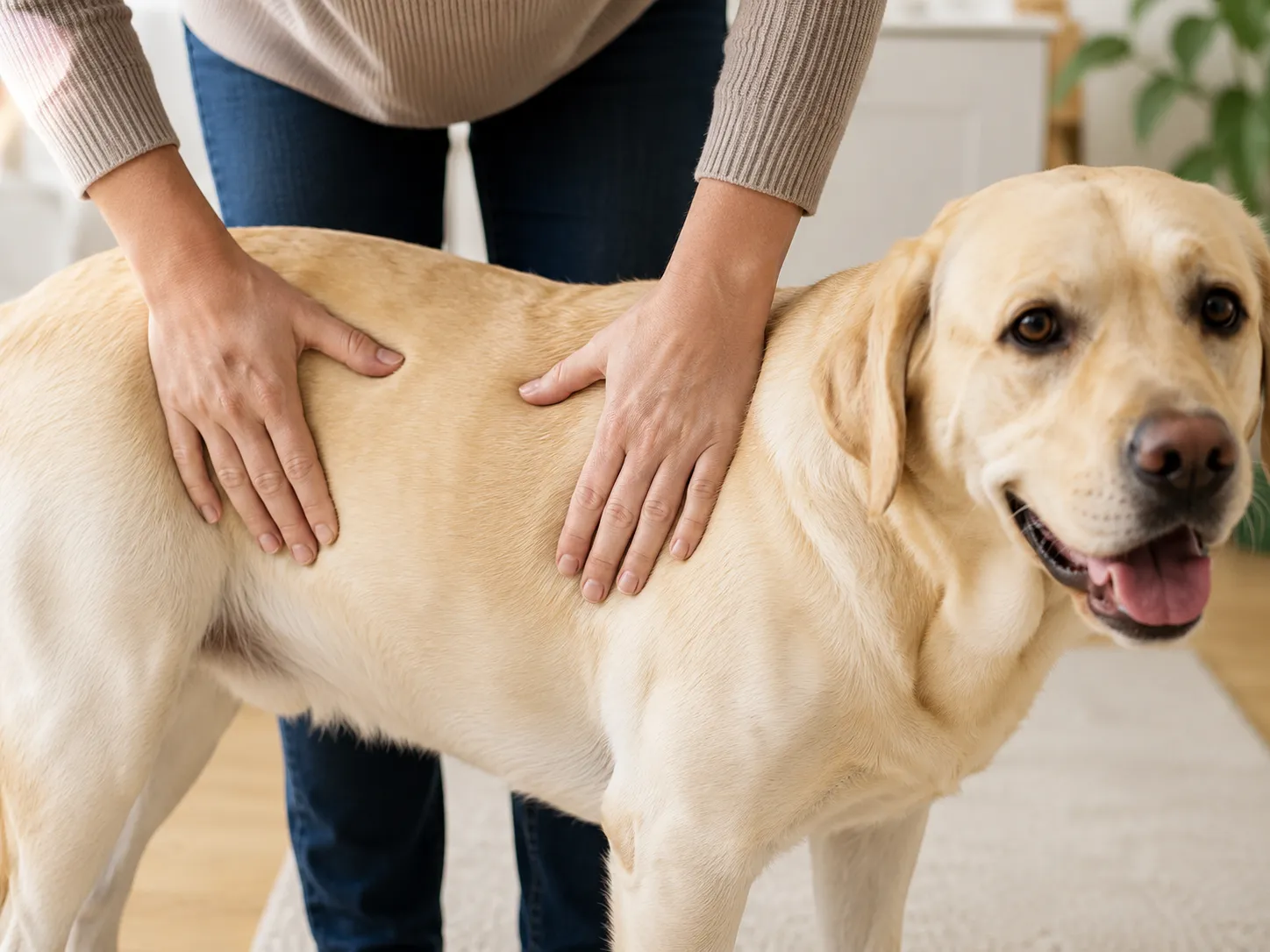
Waist check (from above)
Stand directly above your dog and look down. A healthy Lab should show a visible narrowing behind the rib cage, not dramatic, but present. If the body from shoulder to hip is a uniform rectangle, weight is likely above ideal.
Abdominal tuck (from the side)
View your dog from the side. The abdomen should tuck up slightly behind the ribs, it should not hang level with or below the bottom of the ribcage. No tuck, or a sagging belly, is a common sign of excess weight in Labs specifically, since they tend to carry fat on the underside first.
What underweight looks like
In an underweight Lab, ribs are visible without touching, the spine and hip bones are prominent, the waist tuck is extreme, and the dog may show reduced energy or dull coat. On the WSAVA scale, this falls at 1-3 out of 9 (WSAVA Body Condition Score Guidelines). Underweight Labs need a vet assessment before any feeding change, unexplained weight loss can signal parasites, metabolic disease, dental pain, or other conditions.
What overweight looks like
In an overweight Lab, ribs are difficult or impossible to feel, there is no visible waist from above, the belly hangs level or below the ribcage, and the dog may tire more quickly during exercise. On the WSAVA scale, this is 6-9 out of 9. Labs are one of the breeds most commonly identified as overweight in veterinary practice, PetMD notes that their high food motivation makes portion creep a genuine risk (PetMD).
When to Call the Vet, and What to Bring
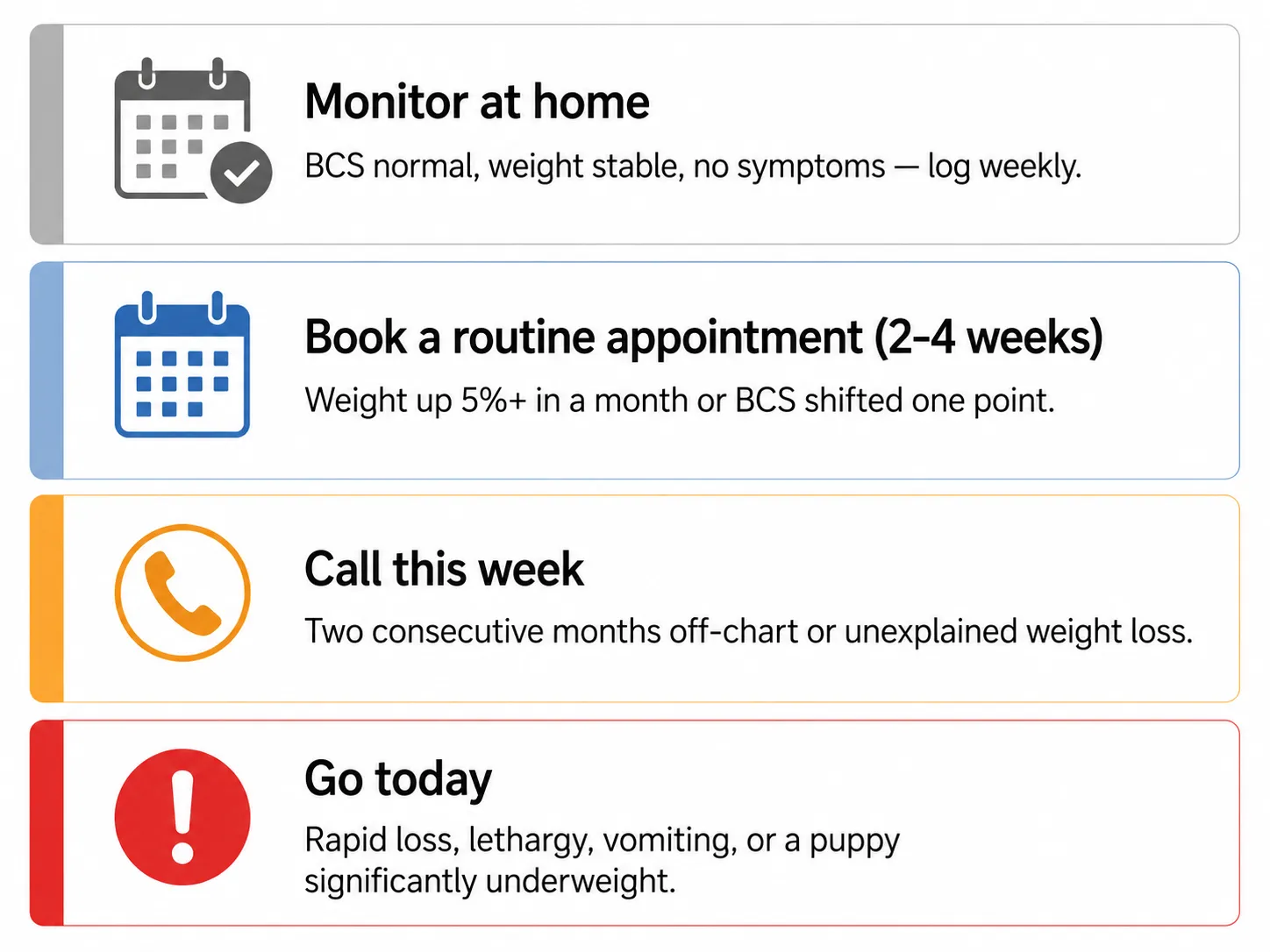
Not every weight concern needs an emergency appointment, but some do. Here's a tiered framework for deciding what to do.
1. Monitor at home (1-2 weeks) Your Lab is within a healthy BCS range (4-5/9), but you noticed they feel slightly different than last month. Weight is stable. No other symptoms. Action: weigh them weekly on the same scale at the same time of day. Log the numbers. Adjust nothing yet.
2. Book a routine appointment (within 2-4 weeks) Your Lab has gained more than 5% of body weight in under a month with no diet change, or their BCS has shifted one point in either direction. They are otherwise acting normally. Action: schedule a non-urgent vet visit and bring your weight log, a typical day's food and treat list (with brand names and amounts), and notes on any recent changes in activity or routine.
3. Book soon (within 1 week) Your puppy has tracked below or above the chart range for two or more consecutive monthly weigh-ins. Your adult Lab has lost weight noticeably despite eating normally. Action: call your vet to schedule within the week. Bring the same information as above, plus a note of any behavioral changes (lethargy, increased thirst, changes in stool).
4. Go today Your Lab has lost weight rapidly (more than 10% in a few weeks), is lethargic, vomiting, or refusing food. A puppy is significantly below their previous weight with no explanation. Action: contact your veterinarian or an emergency veterinary clinic today. Do not wait to see if it resolves.
⚠️ Weight changes in dogs can reflect underlying health conditions. A licensed veterinarian is the appropriate professional to diagnose and treat any medical cause of weight change. This article provides general guidance only.
How to Use This Chart Without Overreacting
When Barnaby was a puppy, I weighed him on the bathroom scale weekly and cross-checked every number against three different charts. Each one gave me a slightly different range, and I spent more time anxious than informed. What actually settled me down was stepping back from the single weigh-in and looking at three signals together. I've built this into a framework I now share with every Lab owner who asks through Froqel.
The 3-signal framework: Scale + Shape + Trend
| Signal | What to check | What it can miss |
|---|---|---|
| Scale | Same scale, same time of day, weekly (not daily) | Frame size, muscle vs. fat ratio, two dogs at the same weight can look completely different |
| Shape | Ribs with light pressure, waist from above, belly tuck from the side | Age-related muscle changes that don't show up in overall weight |
| Trend | 3-4 weeks of consistent data, not a single reading | One-off fluctuations from a large meal, water intake, or digestive timing |
Scale alone is unreliable because it can't distinguish between muscle and fat. A Lab who gains 2 lb of lean muscle after increasing exercise is not the same as one who gains 2 lb of fat. Use the scale as one data point.
Shape tells you what the scale can't, how weight is distributed. The rib/waist/tuck check from Section 5 is your shape assessment. Run it once a month and compare mentally to the previous month.
Trend is the corrective for both of the above. A single weigh-in that looks alarming means very little. Three to four weeks of data moving consistently in one direction means something. Before reacting to any number, high or low, collect enough data to know it's a pattern, not a fluctuation.
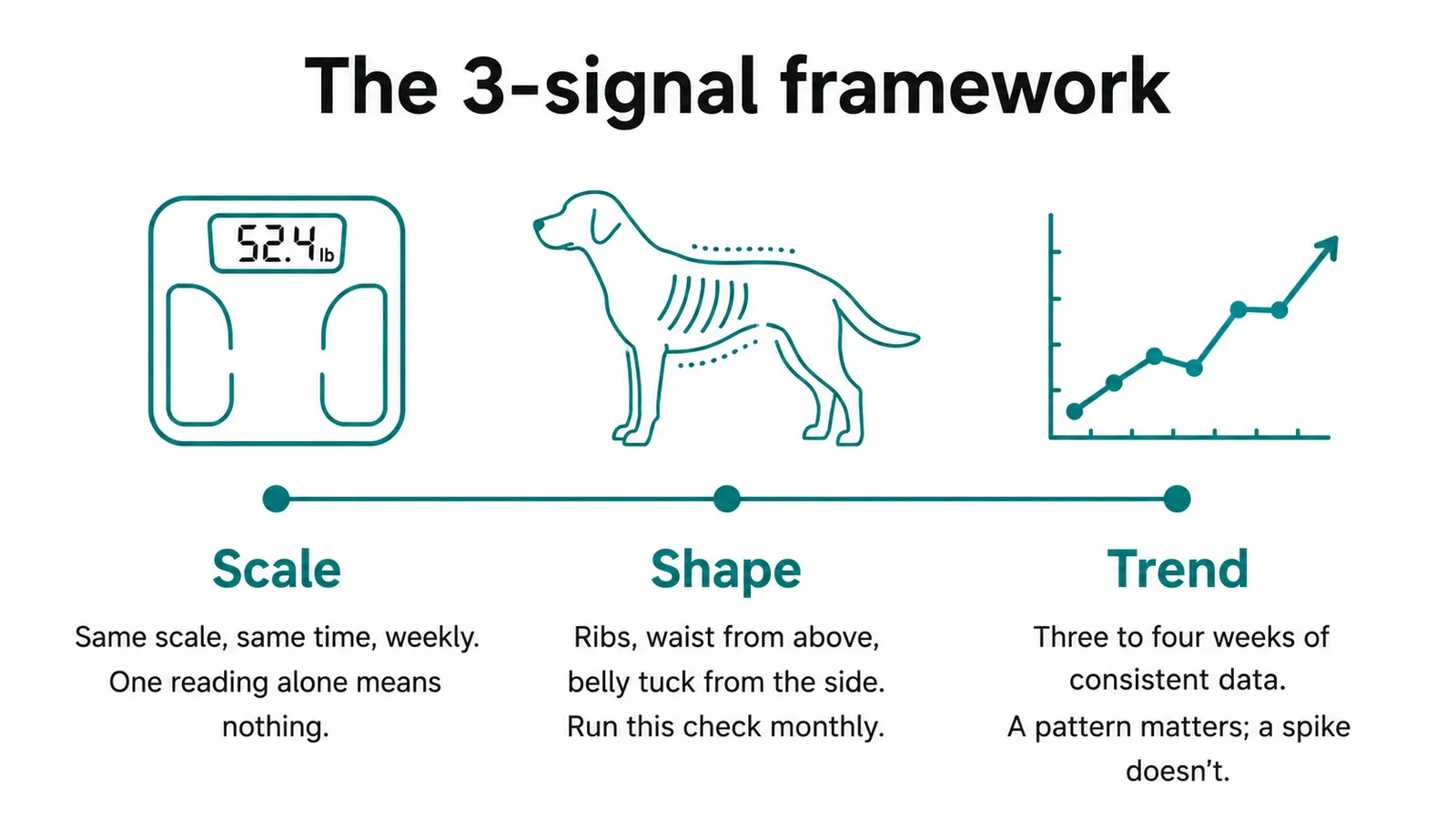
If all three signals point the same direction, the scale is rising, the waist is disappearing, and the trend has held for a month, that's when it's time to call your vet. If only the scale moved but shape and trend are stable, watch for another week before drawing conclusions.
Common questions about Lab weight
How much should a Labrador weigh by age?
At 8 weeks, most Labs weigh 8-15 lb (3.5-7 kg) depending on sex; by 6 months, 40-60 lb (18-27 kg); and by 12 months, 55-80 lb (25-36 kg) with males at the higher end. Adult Labs typically settle between 55-80 lb (25-36 kg) once fully mature at 18-24 months. These are ranges, not targets, a Lab who is at the lower end of the range with a healthy BCS of 4-5/9 is not underweight, and one at the upper end with a clearly visible waist and palpable ribs is not overweight. Body condition matters more than hitting any specific number (AKC; The Labrador Site).
When do Labrador puppies stop growing?
Most Labradors reach their adult height by 9-12 months, but continue filling out in muscle and chest depth until 18-24 months. "Filling out" means the chest deepens, the neck and shoulders thicken with muscle, and the overall silhouette shifts from the gangly adolescent look to the solid adult build Labs are known for. During this second phase, weight gain is normal and expected, it just comes from muscle rather than bone growth. Don't confuse this maturation weight with fat gain; the BCS check will tell you which is happening (The Labrador Site; Snowy Pines White Labs).
What is a healthy weight for an adult Labrador?
Healthy adult Labs typically weigh between 55-80 lb / 25-36 kg, with males usually at the higher end. Frame size and body condition matter alongside that number: a large-framed male with good muscle at 82 lb may be perfectly healthy, while a small-framed female at 72 lb may be carrying excess fat. Rather than treating any single number as the answer, use the AKC range as a starting window, then apply the BCS check to assess your individual dog (AKC breed standard; WSAVA Body Condition Score Guidelines).
Is my Labrador overweight if I can't feel their ribs?
Generally yes, if you have to press firmly to feel the ribs, or can't feel them at all, your Lab is likely carrying excess fat. The correct technique is to place both hands flat on the ribcage and apply only light pressure, roughly the firmness you'd use to feel the bones on the back of your own hand. Each rib should be individually palpable with a thin layer of tissue over it. If that's not what you find, it's worth discussing with your vet, but don't adjust food amounts on your own before that conversation, since the right caloric reduction depends on your dog's full health picture (WSAVA Body Condition Score Guidelines; PetMD).
Should male Labradors weigh more than females?
Yes, on average, male Labs typically weigh 10-15 lb more than females of the same build, due to greater muscle mass and a larger skeletal frame. The AKC standard reflects this: 65-80 lb for males versus 55-70 lb for females. That said, a large-framed female can be completely healthy above the "average female" weight, and a small-framed male may be healthy below the "average male" figure. Sex is a useful reference point, but individual frame and body condition are the more reliable guides (AKC breed standard).
Sources and further reading
- AKC, Labrador Retriever Dog Breed Information
- WSAVA Global Nutrition Committee, Body Condition Score
- The Labrador Site, Labrador Weight
- Snowy Pines White Labs, Labrador Growth Chart
- PetMD, Labrador Retriever