
How to Potty Train a Puppy: A Step-by-Step Guide
Learning how to potty train a puppy doesn't have to ruin your carpets or your sanity. The key is transition management, not magic: establish a strict feeding routine, use a properly sized crate to leverage their nesting instinct, and take them outside before their bladder reaches 75% capacity. This proactive approach prevents accidents before they can start.
What actually works
- Begin structured training between 8 and 12 weeks, which is the precise developmental window when puppies gain physiological control over their elimination muscles.
- Proactively prevent indoor accidents by taking your dog out when their bladder is only three-quarters full, rather than waiting for them to reach their physical limit.
- Be alert to the common 'double pee' phenomenon, where distractions cause a puppy to finish relieving themselves indoors shortly after going outside.
- Eliminate free-feeding in favor of fixed, scheduled mealtimes to make your puppy's digestive tract highly predictable and easier to manage.
The moment you bring a new puppy home, your rugs suddenly feel like fair game. I remember sitting on my living room rug, staring at a damp spot, and wondering if my house would ever smell normal again. It is incredibly overwhelming, but housebreaking is not a battle of wills. It is a predictable biological puzzle that becomes straightforward once you track how their tiny body processes food and water.
The shift from reactive cleaning to proactive planning is what saves your sanity. Instead of waiting for a puppy to signal they need to go-which they often cannot do reliably until they are older-you must schedule their day around their physical development. Once you master their biological clock, you can intercept accidents before they happen.
When to Start Potty Training Your Puppy
The ideal window to start training is between 8 and 12 weeks of age. This is when puppies begin developing voluntary control over their urethral sphincter muscles and anal sphincters. Before 8 weeks, elimination is purely reflex-driven. Attempting strict housebreaking too early only breeds frustration, as their developing nervous system cannot yet transmit the physical sensation of fullness to the brain in time.
A puppy's physical bladder capacity is dictated strictly by age and metabolic rate. According to guidelines from Best Friends Animal Society, a pup can generally hold their bladder for one hour per month of age. This means an 8-week-old (two-month-old) puppy has an absolute biological limit of two hours, but this baseline applies only when they are resting or sleeping.
When your puppy is awake, active, playing, or digesting a meal, their kidneys process fluids much faster and their metabolic rate spikes. This active biological limit is often half of their resting capacity. If you expect an active, chewing 10-week-old puppy to wait a full two and a half hours without an accident, you are setting them up to fail on your rug.
Understanding Neurological Milestones
During the 8 to 12-week development window, puppies experience rapid myelination of the spinal cord pathways. This neurological growth lets them connect the physical urge to eliminate with the conscious choice to seek a specific spot. Before this window, they simply feel the sudden muscle contraction and let go. Starting your routine now leverages this brain development to build permanent habits.
The 75% Bladder Capacity Framework
To take the guesswork out of scheduling, I use the 75% Bladder Capacity Framework. Instead of waiting for your puppy to reach their maximum limit-which causes discomfort and muscular fatigue-you proactively take them out when their bladder is roughly three-quarters full.
Below is a comprehensive guide to tracking capacity and safe zone limits as your puppy grows:
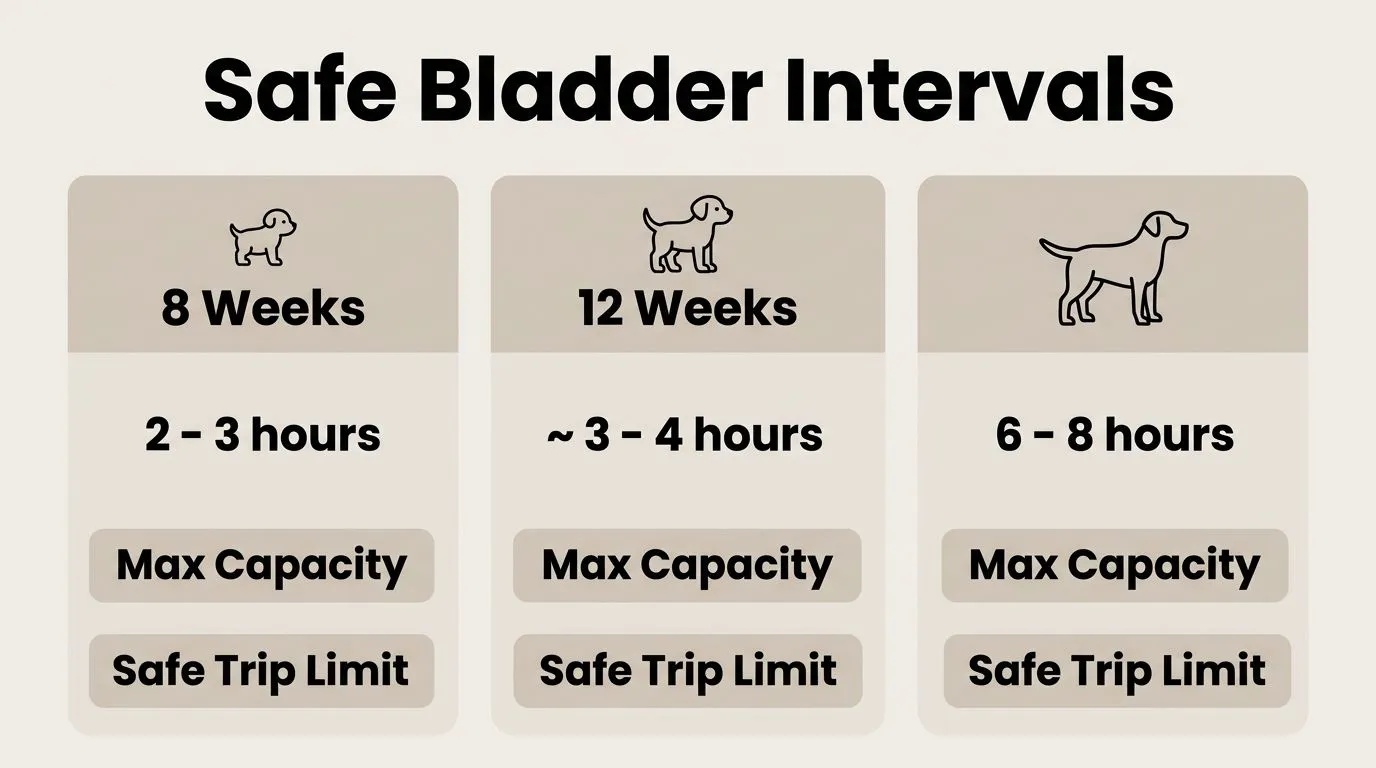
| Puppy Age | Maximum Biological Limit | 75% Safe Zone Limit | Adjustment Triggers (Cut Safe Zone in Half) |
|---|---|---|---|
| 8 Weeks | 2 Hours | 1.5 Hours (90 mins) | Heavy play, drinking water, or waking from a nap |
| 12 Weeks | 3 Hours | 2 Hours, 15 Mins | Post-meal digestion, high-excitement training sessions |
| 16 Weeks | 4 Hours | 3 Hours | Social visits, physical exercise, or change in routine |
| 20-24 Weeks | 5 to 6 Hours | 3.75 to 4.5 Hours | Major changes in daily climate or household activity |
A common roadblock in this framework is the 'double pee' phenomenon. Puppies are easily distracted by moving leaves, passing cars, or distant barks. They will often eliminate just enough to relieve the initial pressure (about 50% of their bladder volume), get distracted, and head inside, only to release the remaining 25% on your rug ten minutes later. To prevent this, remain at their designated potty spot for an extra five to ten minutes even after they appear to have finished.
For high-rise apartment living or when you must leave your pup for extended periods, starting with indoor pads is often necessary. While the Animal Humane Society outlines how pads offer a convenient indoor option, relying on them too long can delay outdoor training. Transition your pup by gradually moving the pads closer to the exit door, eventually placing a pad directly on the outdoor grass to help them link the substrate texture with the elimination spot.
Setting Up a Consistent Routine and Feeding Schedule
A predictable routine is the foundation of housebreaking because canine digestion operates on a highly consistent internal schedule. By feeding your puppy at the exact same times every day and tracking their water intake, you can reliably calculate when they will need to eliminate. This structured approach replaces frantic guesswork with a reliable routine, keeping unexpected household messes to a minimum.
- Eliminate free-feeding entirely by offering meals at the exact same times every day to make digestion highly predictable.
- Take your puppy out immediately after they wake up, fifteen minutes after eating, and directly after any energetic play sessions.
- Track their daily output patterns using a basic log to discover their unique digestion timeline, which typically takes thirty to forty-five minutes.
- Pick up their water bowl approximately two to three hours before bedtime to prevent midnight bladder emergencies without risking dehydration.
- Ensure the final potty trip of the night occurs right before you lock up their crate and head to bed yourself.
How Diet Consistency Impacts Training
Abrupt dietary changes or excessive high-calorie treats can cause mild gastrointestinal inflammation, resulting in loose stools and unpredictable bowel urgency. To maintain control over their schedule, feed a single, high-quality recipe. As emphasized by the clinical team at Newport Veterinary Hospital, a stable, high-quality diet promotes firm, regular stools, which simplifies your planning and minimizes sudden gastrointestinal emergencies.
Using Crate Training and Tethering to Speed Up Housebreaking
Crate training leverages a puppy's innate denning instinct, a biological drive to keep their sleeping quarters clean to avoid drawing predators. When sized and used correctly, a crate is not a tool of confinement, but a safe haven that naturally encourages a puppy to exercise bladder and bowel control. Because they do not want to soil their bed, they learn to hold their muscles until released.
The most critical factor in crate training is securing the correct dimensions. The crate must only be large enough for your puppy to stand up, turn around, and lie down comfortably. If the crate is too spacious, they will sleep in one far corner and designate the opposite end as their bathroom, rendering the natural denning instinct completely useless. Most quality wire crates include divider panels so you can adjust the space as your puppy grows.
If you are working from home but cannot focus your eyes on your puppy every second, tethering is an invaluable strategy. As recommended by the Oregon Humane Society, you can keep your pup in the same room by tethering them to your waist or a heavy piece of furniture with a four-to-six-foot leash. Keeping them within your immediate line of sight completely prevents them from wandering off to eliminate in a quiet guest room.
Establishing Long-Term Confinement Zones
When you must leave your puppy home alone for longer than their physical bladder limit, standard crating is no longer safe or humane. Instead, confine them to a small, easy-to-clean room like a utility room or bathroom secured with a baby gate, as suggested by Best Friends Animal Society. Arrange their bed and water bowl at one end, and place a potty pad at the far end to protect your floors while maintaining a clear division between sleeping and elimination zones.
How to Read the Signs Your Puppy Needs to Go
Recognizing your puppy's subtle behavioral cues allows you to intervene before an accident happens on your hardwood. While some puppies bark or whine to alert you, most young dogs communicate their discomfort through distinct physical shifts. Learning to read these pre-elimination signs is the most effective way to eliminate indoor accidents entirely.
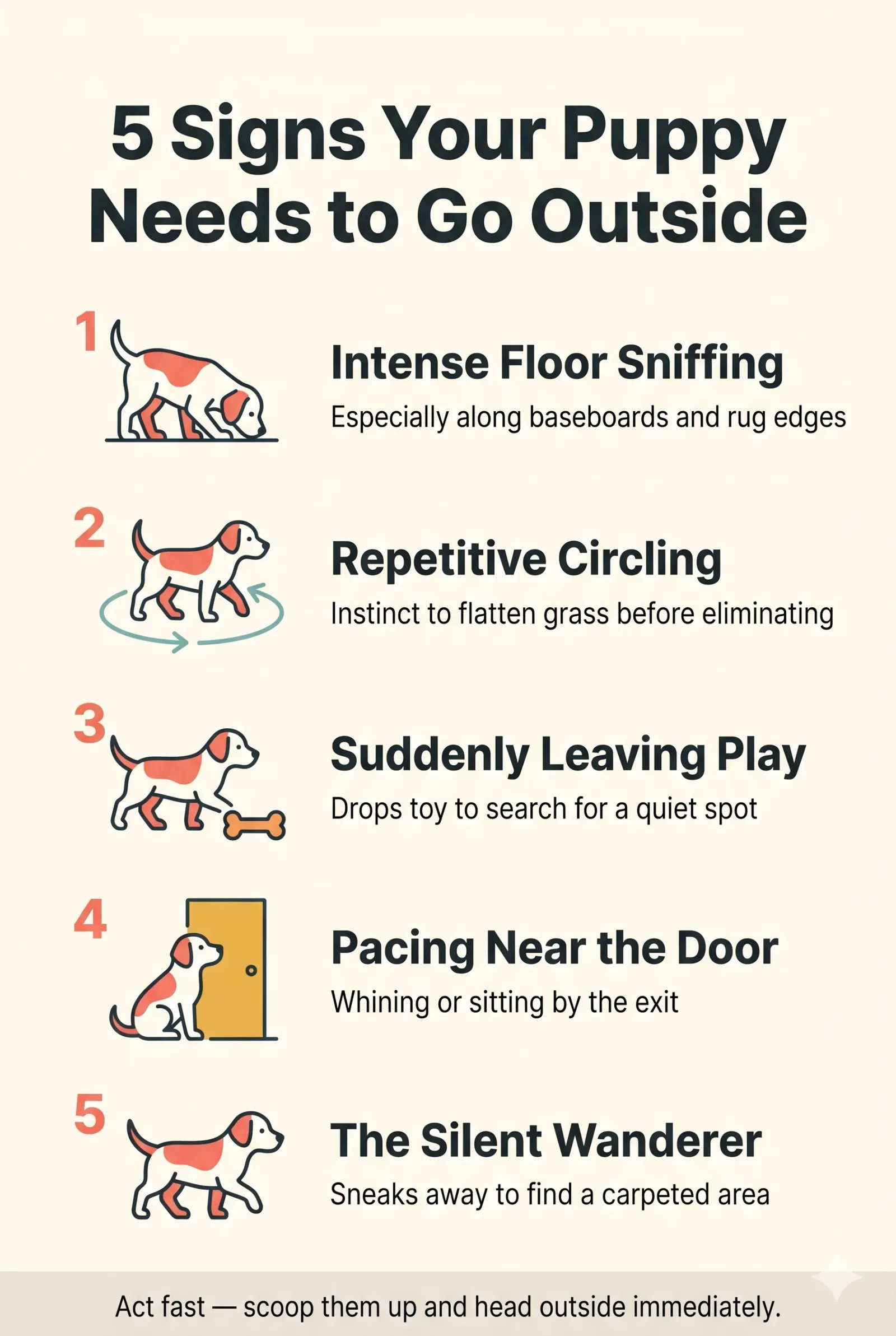
- Sudden, intense sniffing of the floor, especially along baseboards or the edges of rugs where previous scents might linger.
- Circling repeatedly in a tight spot, which is a hardwired instinctual behavior to flatten grass and clear a safe potty area.
- Abruptly walking away from a high-energy play session or leaving a favorite toy behind to search for a quiet space.
- Whining, pacing near the door, or sitting quietly by the exit you normally use to take them outside.
- The dangerous 'silent wanderer' behavior, where a puppy quietly slips out of the room to find a carpeted area where they feel safe.
Tracking Subtle Behavioral Shifts
Typical warning signs include sudden, intense sniffing of the floor, frantic circling, or a sudden change in activity. For instance, if your puppy is chewing a toy and abruptly stops to wander off with a glazed expression, their brain has just processed the pelvic nerve signal of a full bladder. When you observe these abrupt shifts, scoop them up calmly and head directly to their outdoor toilet area.
Positive Reinforcement: Rewarding the Right Behavior
Operant conditioning through positive reinforcement is the fastest way to establish reliable house-training habits. Dogs learn strictly through the immediate, real-time consequences of their actions. When you mark and reward the exact second their tail lifts after finishing outside, they form a clear cognitive link between the outdoor substrate and a highly positive outcome.
A frequent mistake owners make is waiting until they walk back inside the house to reward their puppy. By the time you open the back door and grab a treat from the counter, several minutes have passed. Your puppy will associate the reward with crossing the threshold or sitting at your feet, not with peeing on the grass. Keep high-value treats in your pocket so you can reward them within two to three seconds of completion.
To maximize motivation, reserve an exceptionally high-value reward exclusively for successful outdoor potty trips. As recommended by training experts on Chewy, pungent treats like freeze-dried beef liver, small bits of baked chicken, or string cheese work best. Pair this with a verbal cue like 'go potty' the moment they begin to eliminate, allowing you to prompt the behavior on command in the future.
Handling Accidents Without Punishment
How you react to the inevitable indoor accident dictates how quickly your puppy learns and whether they trust you. Physical punishment, yelling, or rubbing their nose in a mess never communicates that eliminating indoors is wrong. It merely teaches them to fear you, which often causes them to hide their next accident behind the sofa or under a bed. Instead, interrupt them with a neutral sound, scoop them up, and carry them to their outdoor spot.
- Interrupt the active accident calmly by clapping your hands or making a gentle 'oop' sound to stop their stream without scaring them.
- Pick up the puppy immediately or lead them gently by the collar, and walk them directly to their designated outdoor spot.
- Encourage them to finish their business outside, and reward them enthusiastically with treats if they complete the job on the grass.
- Bring the puppy back inside and confine them safely to their crate or pen so they cannot access the wet area while you prepare to clean it.
- Saturate the entire soiled area with a high-quality enzymatic cleaner to completely digest the microscopic proteins and eliminate the scent.
The Chemistry of Clean Up
Standard ammonia-based household cleaners may smell pleasant to you, but they actually mimic the chemical signature of urine to a dog. Since a dog's olfactory system is up to 100,000 times more powerful than ours, they easily detect residual uric acid salts right through artificial perfumes. You must use a specialized enzymatic cleaner formulated to digest the organic proteins and urea, eliminating the scent markers that attract repeat accidents.
Common Potty Training Mistakes to Avoid
If your puppy is not progressing despite a consistent schedule, you must diagnose whether the roadblock is behavioral or medical. Behavioral setbacks often stem from crate-soiling caused by past isolation trauma, fear of outdoor environments, or inconsistent human routines. Conversely, medical obstacles-such as urinary tract infections (UTIs), intestinal parasites, or congenital anomalies like ectopic ureters-require clinical intervention rather than training adjustments.
- Using ammonia-based cleaning products, which chemically mimic the scent of urine and actually attract the puppy back to soil the same spot.
- Granting your puppy too much unsupervised freedom in the house too early, allowing them to establish bad habits in vacant rooms.
- Scolding your puppy for an old accident you discovered after the fact, which confuses them because they cannot link the punishment to a past action.
- Expecting your puppy to signal their need to go outside before they are physically and neurologically mature enough to do so.
- Failing to clean up previous indoor accidents thoroughly, leaving scent markers that serve as an open invitation to use that spot again.
Your Housebreaking Checklist
- Verify your puppy's exact age in weeks to calculate their current 75% safe bladder capacity interval.
- Purchase a high-quality enzymatic cleaner specifically formulated for pet urine and eliminate all ammonia products from your cabinets.
- Set up a properly sized crate containing only safe, durable bedding that your puppy cannot easily tear or soil.
- Establish a daily feeding schedule with exact times for morning, noon, and evening meals.
- Keep a jar of high-value training treats next to the door so you can reward outdoor success within three seconds.
Common questions
How long does it take to fully potty train a puppy?
Most puppies develop reliable bladder control between 4 and 6 months of age, though the timeline varies depending on breed size, consistency of training, and the puppy's individual neurological development. The ideal window to begin structured training is between 8 and 12 weeks, when puppies first gain voluntary control over their elimination muscles. With a consistent feeding schedule, proper crate use, and proactive outdoor trips based on the 75% Bladder Capacity Framework, most owners see significant progress within a few weeks, but full reliability typically comes closer to the 6-month mark.
Should I use pee pads when potty training a puppy?
Pee pads can be a practical solution for apartment dwellers, high-rise living, or situations where you must leave your puppy for extended periods. However, relying on them too long can delay outdoor training, as puppies may become accustomed to eliminating indoors. If you use pads, plan a gradual transition: slowly move the pad closer to the exit door over time, and eventually place it directly on outdoor grass so your puppy begins to associate the texture and location with the act of elimination. The goal is always to phase them out as soon as your schedule allows.
Sources consulted
Sources consulted for this article:
- How to Potty Train a Puppy or Dog | Best Friends Animal Society
- Potty Training your Puppy
- How To Potty Train a Puppy | Chewy
- Effective Puppy Potty Training Methods at Home
- Potty pad training your dog