How to Clean Dog Ears at Home Without Making an Irritated Ear Worse
Your dog's ear looks a little waxy. Maybe there's a faint smell. Here's what you actually need to know, and a clear way to decide whether tonight calls for a cotton ball or a call to your vet.
What to know before you start
- Most healthy dogs don't need their ears cleaned on a fixed schedule.
- Never insert cotton swabs into the ear canal, they push debris deeper.
- Hydrogen peroxide and alcohol irritate the canal and should never be used.
- Dark, crumbly discharge and a foul odor are not normal, call your vet.
- Clean after every swim or bath; skip cleaning when healthy ears look fine.
Does My Dog Actually Need Their Ears Cleaned?
Not every waxy ear is a dirty ear. Cornell University's College of Veterinary Medicine is clear: for a dog with healthy, normal ears, routine cleaning is only needed if dirt or debris is visible, or after the ears get wet from swimming or bathing. Overcleaning causes its own problems, stripping the canal's natural protection and triggering the irritation you were trying to prevent.
Use this table to decide whether to clean tonight or wait:
| What You See or Notice | What It Likely Means | Your Move |
|---|---|---|
| Light tan wax, no smell | Normal cerumen buildup | Wipe visible area only, or leave it |
| Wet ears after a bath or swim | Moisture trapped in canal | Clean with a drying solution tonight |
| Mild odor, more wax than usual | Early buildup or minor irritation | Clean gently; watch for 48 hours |
| Strong odor, yellow or green discharge | Likely bacterial infection | Skip home cleaning, call your vet |
| Dark brown, crumbly, coffee-ground debris | Possible ear mites | Do not clean, call your vet today |
| Redness, swelling, your dog cries when touched | Active infection or pain | Do not touch, emergency vet visit |
What Does a Healthy vs. Problem Ear Look Like?
I've been examining Barnaby's ears since he was a puppy, and after a decade I can read the difference between "fine" and "not fine" in about five seconds.
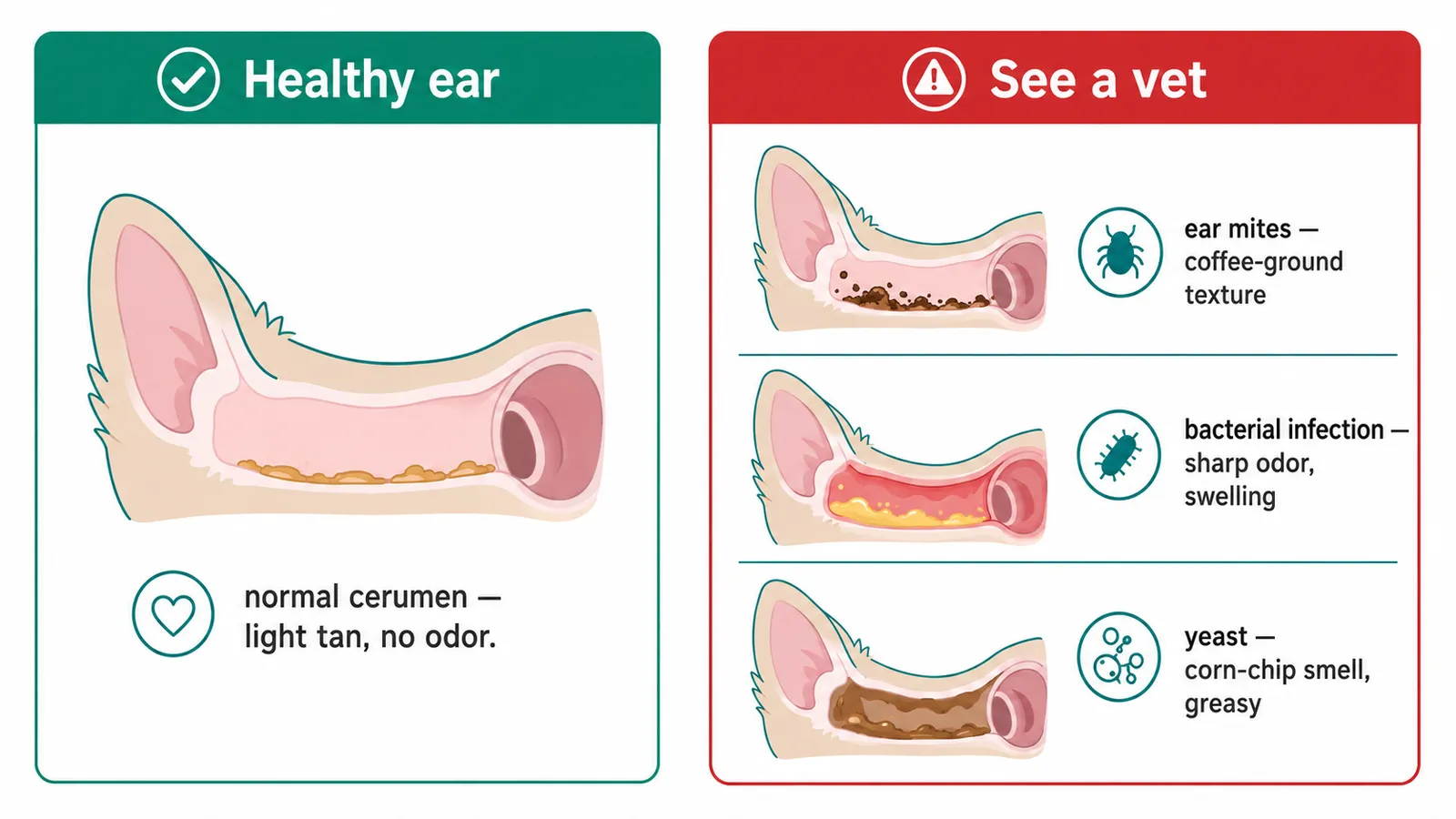
A healthy ear smells like nothing, or very faintly like a warm, clean dog. The inner flap is pale pink. The visible canal has a small amount of light tan to yellowish wax, cerumen, produced by the ceruminous glands lining the canal, and it's doing its job. The skin around the ear is unbroken, not scaly, and your dog doesn't flinch when you touch the base. When those signs run the other way, with odour, discharge, heat or visible pain, you are usually looking at an ear infection rather than a cleaning job.
A problem ear tells a different story:
Bacterial infection: Yellow or greenish discharge. A sharp, pungent smell. The canal looks red, possibly swollen. The Merck Veterinary Manual notes severe bacterial infections produce significant discharge and pain.
Yeast (Malassezia) infection: A greasy, brownish discharge with a sweet-musty odor, many owners describe it as corn chips. The same Merck source notes that yeast (Malassezia pachydermatis) lives naturally in healthy ears in small numbers but multiplies rapidly once otitis sets in.
Ear mites: Dark, dry, crumbly debris resembling coffee grounds. Less wet than a yeast infection. Mites require a confirmed diagnosis and prescription treatment, not a home cleaning.
Foreign body: Sudden, intense head shaking in a dog that spent time outdoors in tall grass. Your dog may cry or snap when touched near the ear. Don't probe. Get to a vet that day.
If you notice any skin redness or scaling around the ear flap or on the face, allergies may be the underlying driver, a very common cause of chronic ear infections in dogs.
Step-by-Step: How to Clean Your Dog's Ears at Home
What you need: veterinary ear cleaning solution, cotton balls or gauze squares, treats, and a towel. That's it.
What you do not need: cotton swabs. VCA Animal Hospitals explicitly warns against cotton-tipped applicators because they risk puncturing the eardrum and push debris further down the canal rather than removing it.
- Get your dog settled. Sit on the floor with a medium-sized dog between your legs. For a large dog, position them against a wall with their rear in a corner. Give a treat. Make this feel routine.
- Lift the ear flap. Hold it straight up to open the canal. You're working with an L-shaped structure, a short vertical section that drops down, then a longer horizontal section that turns inward toward the eardrum. This angle is why liquid cleaners work well: they flow to the bend and loosen debris naturally.
- Fill the canal. Hold the applicator tip at the opening (don't insert it) and squeeze in enough solution to fill the canal visibly.
- Massage the base for 20-30 seconds. Grip the base of the ear through the skin and knead firmly. You'll hear a wet squishing sound. This is the most important step, it breaks up debris against the canal walls.
- Step back and let them shake. Release your dog. The motion throws loosened debris out. Do this near a wall you can wipe down.
- Wipe the visible area. Use a cotton ball to clean the visible folds and the entrance to the canal. Go only as deep as your finger can naturally reach.
- Reward immediately. Treats right after, every time.
⚠️ Safety note: If your dog cries, snaps, or shows any sign of pain during cleaning, stop immediately. Pain means something is wrong underneath. Cornell's veterinary guidance is clear: don't force a dog to tolerate a painful ear examination. That's your signal to call the vet.
What Cleaner Should I Use?
Veterinary-formulated cleaners: what to look for
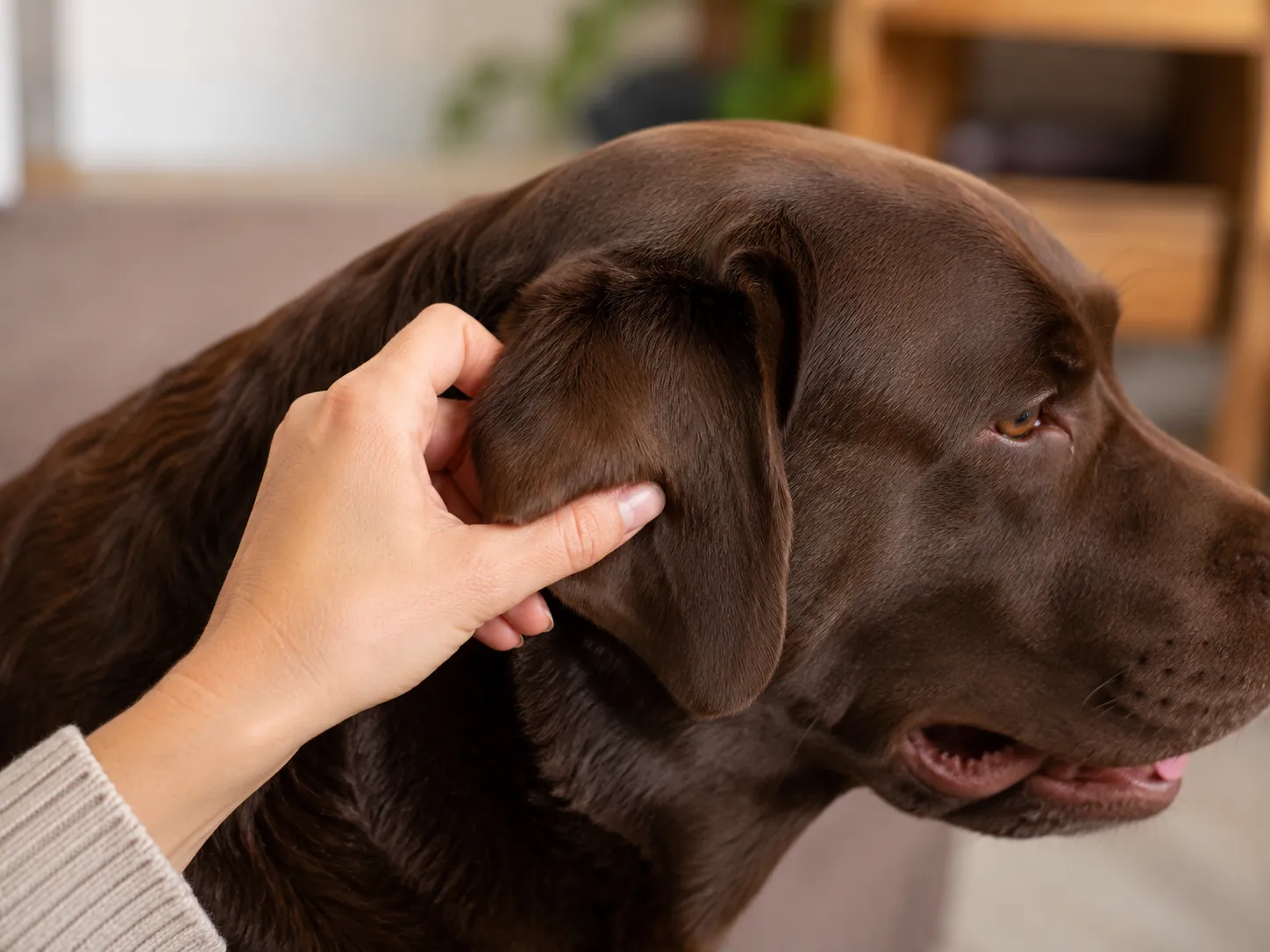
Choose a product with a neutral pH designed specifically for dogs. VCA Animal Hospitals recommends avoiding anything with hydrogen peroxide or alcohol, both irritate the canal, especially when the tissue is already inflamed. The Merck Veterinary Manual echoes this, specifically warning against "irritating home remedies" like vinegar mixtures, which can worsen swelling and secretions.
Look for these ingredients on the label:
| Ingredient | What It Does | Best For |
|---|---|---|
| Salicylic acid | Dries the canal, mild antimicrobial | Routine cleaning, yeast prevention |
| Acetic acid (dilute) | Acidifies canal, antifungal | Post-swim drying in healthy ears |
| Boric acid | Drying agent, mild antifungal | Maintenance in infection-prone dogs |
| TrizEDTA | Breaks down bacterial biofilm | Ears prone to bacterial buildup |
| Chlorhexidine | Antiseptic | Only under vet guidance |
DIY solutions: proceed with caution
Pure apple cider vinegar is popular online. The Merck Veterinary Manual explicitly warns against it, vinegar mixtures can worsen swelling and secretions and increase infection risk. Even diluted, acetic acid burns inflamed tissue. You may not know the canal is already irritated until your dog reacts.
Hydrogen peroxide and rubbing alcohol are harder no's. Both damage the canal lining, and Cornell University's guidance is unambiguous: avoid them entirely.
The S-E-E-D Framework: Should You Clean or Call?
Every time I look at Barnaby's ears, I run through the same four-step check. Here it is formalized:
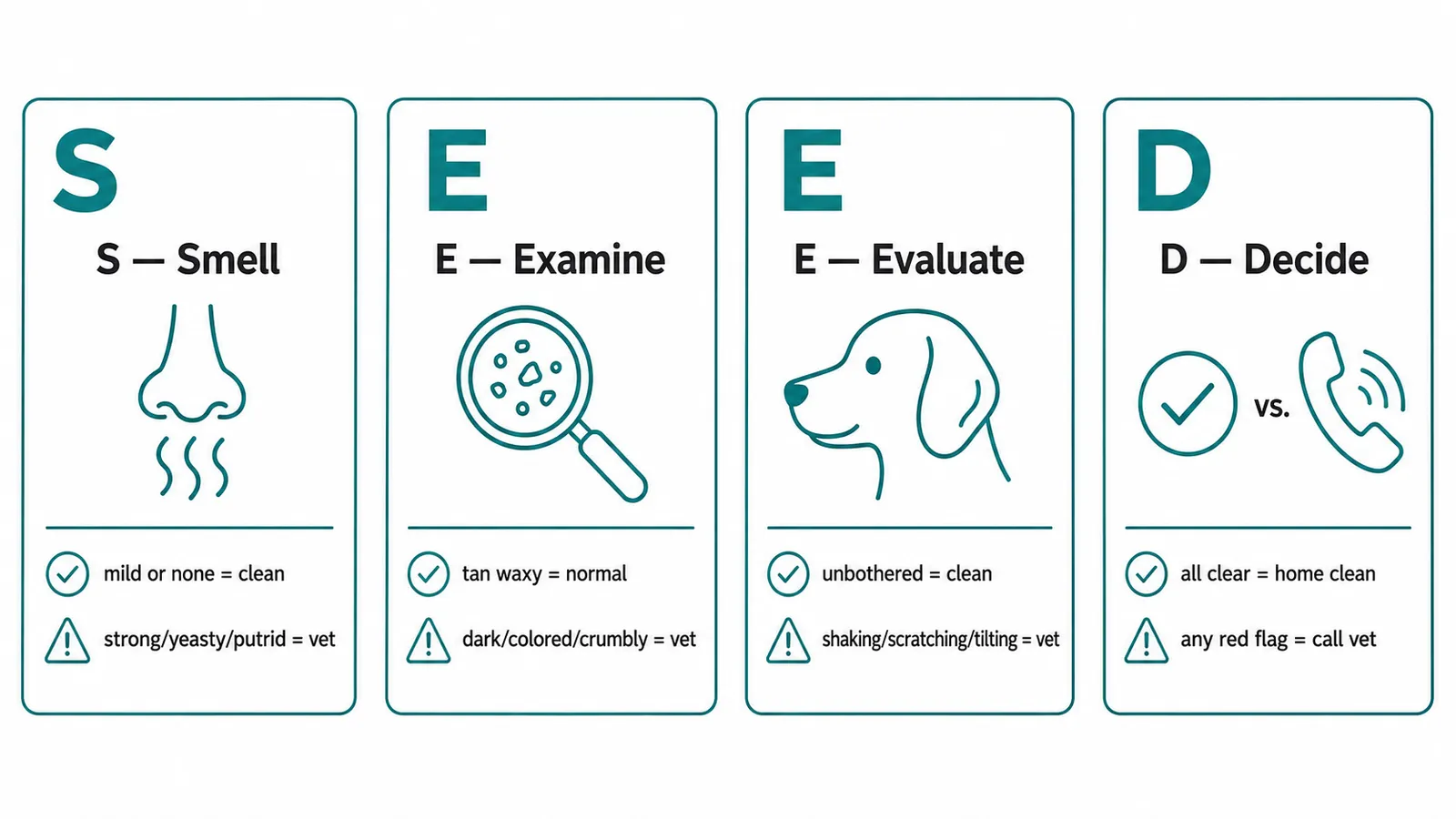
S, Smell Clean ears smell like nothing, or very faintly like dog. A sour, yeasty, sweet-corn-chip smell points to yeast. A sharp, putrid smell points to bacteria. Any strong smell: skip home cleaning and call your vet.
E, Examine the discharge Light tan and waxy? Normal cerumen. Yellow, green, or pus-like? Bacteria. Greasy brown-gray? Yeast. Dry, dark, crumbly coffee grounds? Likely ear mites. Texture and color tell you almost everything before a vet confirms it.
E, Evaluate your dog's behavior A dog with clean ears doesn't think about them. Repeated head shaking, scratching at one or both ears, or a persistent head tilt means something is wrong. If your dog is shaking their head persistently, that behavioral signal matters as much as what you see visually.
D, Decide and act Clean at home only when: smell is absent or very mild, discharge is light-colored and waxy, your dog is unbothered. Call your vet when: smell is strong, discharge is dark or colored, your dog shows any sign of pain, or symptoms persist more than 48 hours after cleaning.
Breed-Specific Notes: Is Your Dog at Higher Risk?
Anatomy and genetics dramatically affect ear health. Knowing your dog's profile helps you clean proactively rather than reactively.
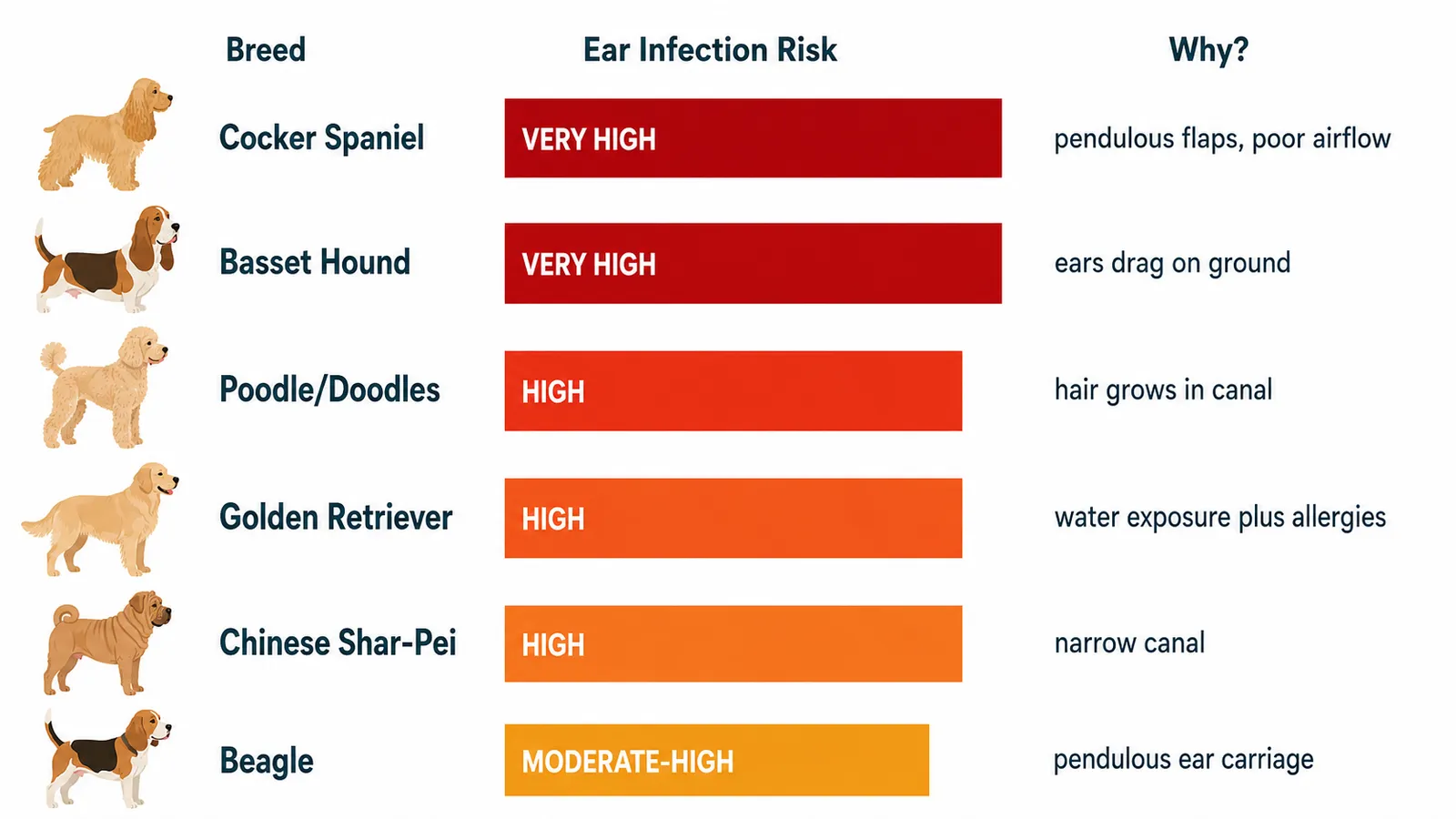
Cocker Spaniel, Heavy, pendulous ear flaps block airflow, keeping the canal warm and humid. Add hair inside the canal and high allergy susceptibility, and you have a dog that often needs biweekly monitoring. The AKC identifies Cocker Spaniels among the breeds most prone to ear infections.
Basset Hound, Those long ears drag on the ground, picking up debris on every walk, and seal off the canal almost completely. Basset Hounds ranked in the top five most-affected breeds in Royal Veterinary College research comparing infection rates across breed types.
Poodle (and Doodle mixes), Hair grows inside the ear canal, trapping moisture and debris. The same RVC study found poodle breeds had nearly twice the ear infection risk of non-poodle breeds, a finding that extended to Labradoodles and Goldendoodles, challenging the assumption that hybrid dogs escape ear problems.
Golden Retriever, Water lovers with floppy ears and high susceptibility to environmental allergens. Barnaby is exactly this dog, which is why we clean his ears every time he swims. In Goldens, allergic inflammation often drives repeat infections as much as moisture does.
Chinese Shar-Pei, Very narrow ear canals combined with deep skin folds. Even small amounts of debris cause disproportionate discomfort. Shar-Peis do better with light, frequent checks and close vet guidance rather than aggressive home cleaning.
Beagle, Pendulous ear carriage limits airflow. The RVC study found breeds with this ear type had 1.76 times the infection risk of erect-eared dogs.
When to Call the Vet
Home cleaning has a ceiling. Here's exactly where it is:
- Strong, foul, or yeasty smell that persists after cleaning
- Yellow, green, or blood-tinged discharge
- Dark, crumbly debris resembling coffee grounds
- Visible redness, swelling, or crusting inside the canal or on the flap
- Your dog cries, snaps, or pulls away when the ear is touched
- Head tilting that doesn't resolve
- No improvement 48 hours after a gentle cleaning
- Any history of ruptured eardrums, never clean without vet guidance first
The AKC is direct: untreated ear infections can cause permanent hearing loss. Don't wait.
Common questions
How often should I clean my dog's ears if they seem healthy? Cornell University's veterinary guidance is the clearest answer: for a dog with healthy, normal ears, clean only when you notice dirt, debris, or after water exposure. There's no universal "once a week" rule. Some healthy-eared dogs barely need cleaning; others, especially swimmers, benefit from a post-activity routine. Your vet can calibrate the schedule for your dog.
Can I use olive oil or coconut oil to clean my dog's ears? No. Neither has been validated as safe for ear canal use by any veterinary institution. Oils coat the canal and trap moisture, exactly the environment that encourages bacterial and yeast growth. Use a veterinary-formulated solution only.
My dog hates having their ears touched. What should I do? Start by touching and lifting the ear without any solution, giving a high-value treat each time. Do this daily for a week or two before introducing the cleaner. VCA notes that dogs who first experience ear handling during a painful infection often develop lasting aversion, building the positive association early prevents this entirely.
Is it safe to clean a dog's ears when there's already an infection? Consult your vet first. VCA Animal Hospitals advises against home cleaning if the ear is red, inflamed, or painful, a ruptured eardrum could make liquid cleaners dangerous. Your vet may prescribe a medicated solution or ask you to bring the dog in for the first cleaning.
How deep should I insert the cleaning solution? You don't insert the applicator into the canal. Hold the tip at the entrance and squeeze in enough solution to fill it. The L-shaped anatomy does the rest, liquid flows down the vertical section and pools at the bend. Massaging the base for 20 to 30 seconds moves it through. Never probe deeper than the first visible fold.
Medical disclaimer: This article provides general educational information about home ear care in dogs. It is not a substitute for veterinary diagnosis or treatment. If your dog shows signs of pain, infection, or hearing changes, consult a licensed veterinarian. Emily Harper is a dog owner and editorial writer, not a veterinarian.
References
The veterinary references behind this guide:
- 5 Tips & Tricks for Cleaning Your Dog's Ears at Home
- How to Clean Your Dog's Ears at Home - Anicira
- Ear Cleaning and Administering Ear Medication in Dogs | VCA Animal Hospitals
- How to Clean Your Dog's Ears - Merck Veterinary Manual
- DIY Disaster: Ear Cleaner - Mayfield Veterinary Clinic