
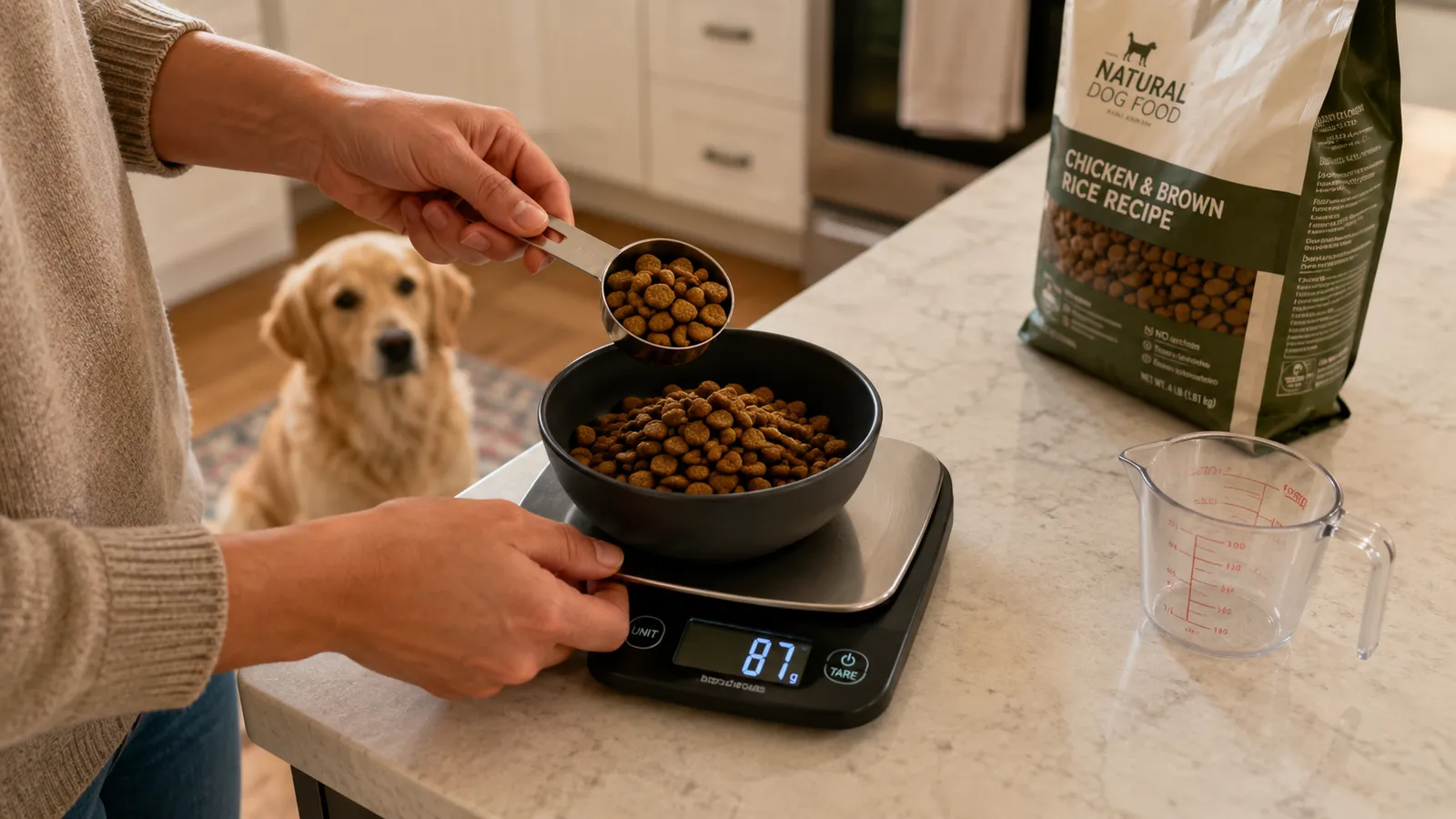
How Much Should I Feed My Dog? The Calorie-and-Condition Guide Owners Actually Need
How much you should feed your dog comes down to calories, not cups. The right starting amount depends on your dog’s current weight, age, activity level, body condition, and the calorie density of the food. The bag chart is only a rough estimate, and even a dog that looks "pretty normal" can still be getting too much or too little.
The short version
- Calories matter more than cups or scoops.
- Body condition score is the best reality check.
- Age, activity, and neuter status can change daily needs a lot.
- Begging does not always mean your dog is underfed.
- If weight or appetite changes suddenly, call your vet.
What should you use instead of the bag chart?
Use the label as a starting point, but judge the result by calories and body condition, not volume alone. Cups vary a lot across brands and formats, so one cup of kibble can have very different energy than a cup of another food. A better approach is to start with the feeding guide, check the kcal information, then adjust based on your dog’s shape and weight trend.
| Method | What it tells you | Where it helps | Main weakness |
|---|---|---|---|
| Label feeding guide | A rough daily amount by weight | Quick first guess for a new bag of food | Often based on averages that ignore body condition and calorie density |
| Calorie-based feeding | How much energy your dog actually gets | Best for dry food, wet food, and mixed feeding | Requires checking the package for kcal per cup, can, or pouch |
| Body condition score | Whether the amount is actually keeping your dog lean | Final check after you start feeding | Needs you to look beyond appetite and treatable begging |
That last point matters. A dog can act hungry and still be overfed, especially if meals are calorie-dense, treats are adding up, or the dog has slowed down with age. Body condition score is the reality check: ribs should be easy to feel but not starkly visible, the waist should show from above, and there should be a belly tuck from the side. Fruit counts against that budget too: a banana serving carries more calories than most owners assume.
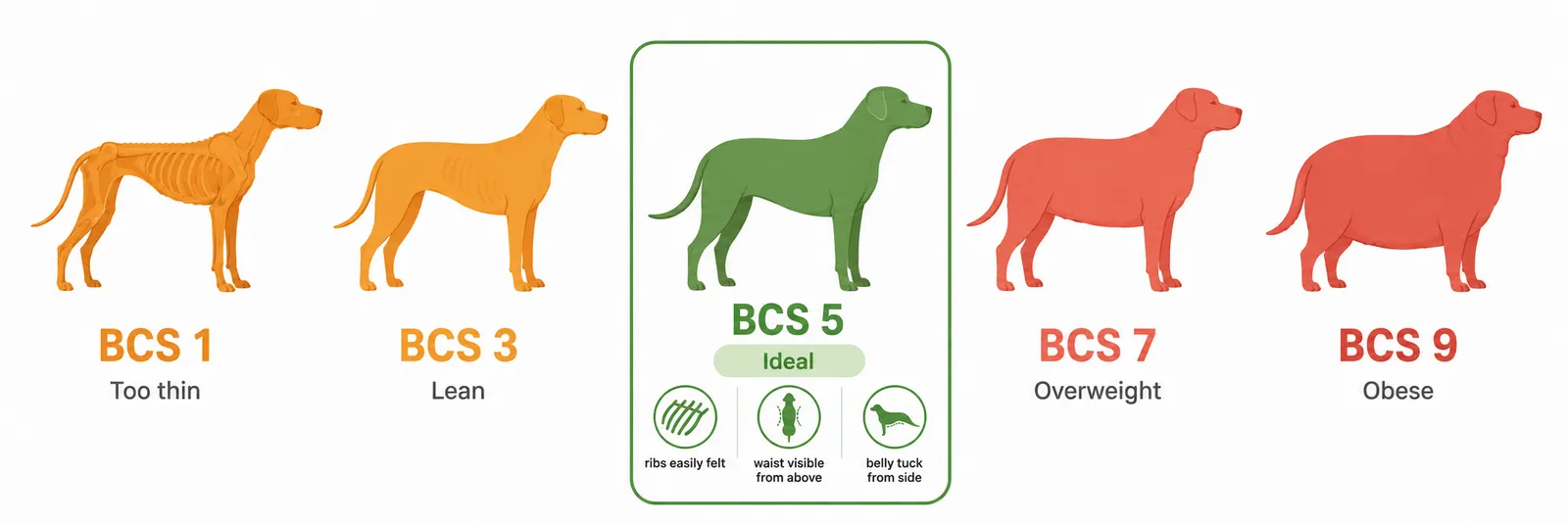
A simple rule helps at the start. Use the lower end of a feeding range for dogs that are less active, neutered, or already carrying extra weight. Use the higher end for puppies, very active dogs, and dogs that are too thin. BARK.co and IAMS both stress that feeding should start with a guide and then move with the dog, not with the bag alone. BARK.co
How do age, size, and activity change the amount?
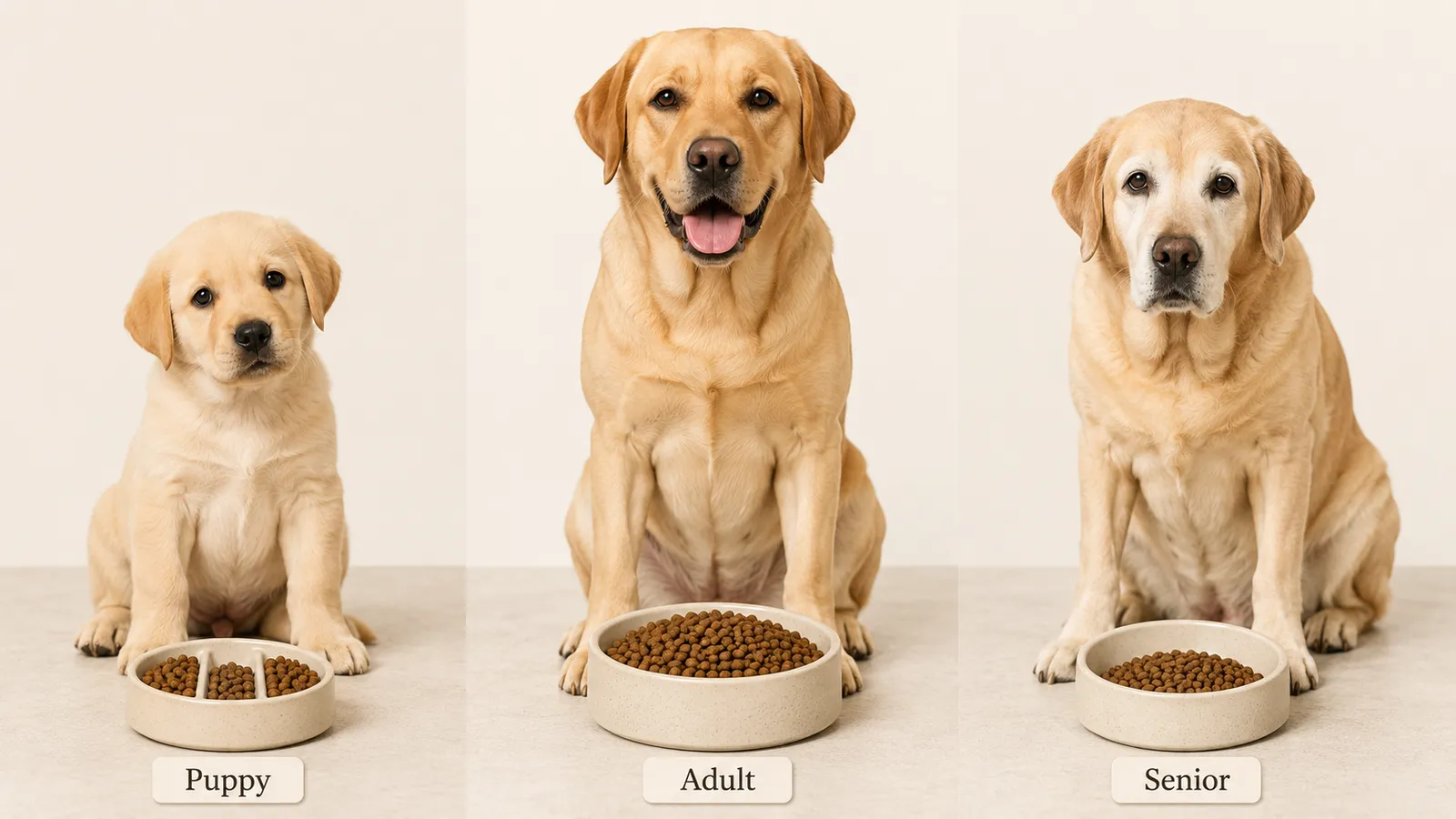
Age and lifestyle change the answer more than most owners expect. A puppy, a couch-loving adult, and a senior with arthritis may weigh the same and still need very different calorie counts. For that reason, the same chart should never be treated as one-size-fits-all.
| Life stage / dog type | Feeding approach | What usually changes | What to watch for |
|---|---|---|---|
| Puppy | Use growth-focused portions and split meals through the day | More frequent meals and more calories per pound than an adult | Steady growth, not sudden chunkiness |
| Healthy adult | Base portions on maintenance needs, then adjust by activity and body condition | Exercise level, neuter status, and metabolism can shift needs a lot | Waistline, stool quality, and weekly weight trend |
| Senior dog | Keep calories matched to current body condition, not age alone | Some seniors need less food, but not automatically less protein | Muscle loss, weight change, and lower daily activity |
| Small or large breed | Use the dog’s own condition and life stage, not breed size alone | Body size changes energy needs, but not in a simple straight line | Ribs, waist, and overall condition |
For puppies, PetMD notes that small and medium breeds up to 4 months old are often fed three meals per day, while adults and seniors commonly do well on two to three meals daily. That schedule matters because younger dogs have smaller stomachs and faster growth needs, so one big meal is rarely the cleanest way to feed them. PetMD
Puppy math can be tricky. Pawlicy Advisor gives a useful rule of thumb: puppies often need about five to six percent of their estimated adult body weight in food each day, then that amount is adjusted as they grow. That is a starting point, not a guarantee, and it should still be checked against body condition and your vet’s guidance for the breed and growth rate. Pawlicy Advisor
For adult dogs, activity is the big swing factor. A dog that gets daily running or agility work will usually need more than a similar dog that gets short leash walks, even if they look nearly identical on paper. Size alone does not solve the problem, because two 40-pound dogs can land in very different calorie ranges if one is sedentary and the other spends weekends hiking.
Senior dogs deserve a separate thought. Some slow down and need fewer calories, but a dog that is lean and losing muscle may need a different adjustment, not simply a smaller bowl. IAMS also points out that nutritional needs change as dogs grow, which is why older dogs still need a plan based on the individual dog, not just the birthday. IAMS
How can you tell if you are feeding too much or too little?

The clearest signs show up in body shape, weight trend, and energy, not in begging at the kitchen counter. A dog can act interested in food and still be eating the wrong amount, so appetite alone is a shaky guide. What you want is a pattern over one to two weeks, not a single dramatic meal or a hungry look after exercise.
- Too much food often shows up as gradual weight gain, a waist that disappears, softer stools, less enthusiasm for exercise, or ribs that are hard to feel under a layer of fat.
- Too little food often shows up as weight loss, visible ribs with little padding, low energy, persistent food-seeking, or a coat that looks duller than usual.
- An ideal body condition means you can feel the ribs easily, see a waist from above, and notice a gentle tummy tuck from the side.
- Begging by itself is not proof of hunger; dogs learn quickly when the food cabinet opens.
- Stool quality can help you spot a mismatch, but it should never override body condition and weight trend.
This is where owners often get misled by the bag chart. If a dog starts looking rounder on the recommended amount, the chart is not "right" just because it came from the package. If a dog seems thin but is constantly getting treats, the problem may be less about meal size and more about what is sneaking in between meals.
When should I change the amount or call the vet?

Change the amount at home only when the issue is small and the dog otherwise seems well. Sudden weight loss, a big appetite shift, vomiting, diarrhea, increased thirst, or clear lethargy can mean the feeding problem is really a medical problem, and that needs a vet rather than a bigger or smaller scoop. Persistent change matters more than one skipped meal.
- Watch for sudden changes in weight, appetite, drinking, vomiting, diarrhea, or energy.
- If the change is small and your dog seems otherwise normal, adjust the portion gradually over several days instead of making a big jump.
- Recheck body condition after 1 to 2 weeks, because day-to-day fluctuations are easy to overread.
- If the change comes with illness signs, or if weight keeps moving up or down without a clear reason, call your vet. The feeding amount may be reacting to disease rather than causing it.
That distinction is important. A dog that is losing weight despite eating well may have a problem that has nothing to do with portion size. A dog that suddenly stops finishing meals, especially if drinking more or vomiting, should not be managed as a simple feeding adjustment at home.
Wet food, dry food, and mixed feeding: how do you measure it correctly?
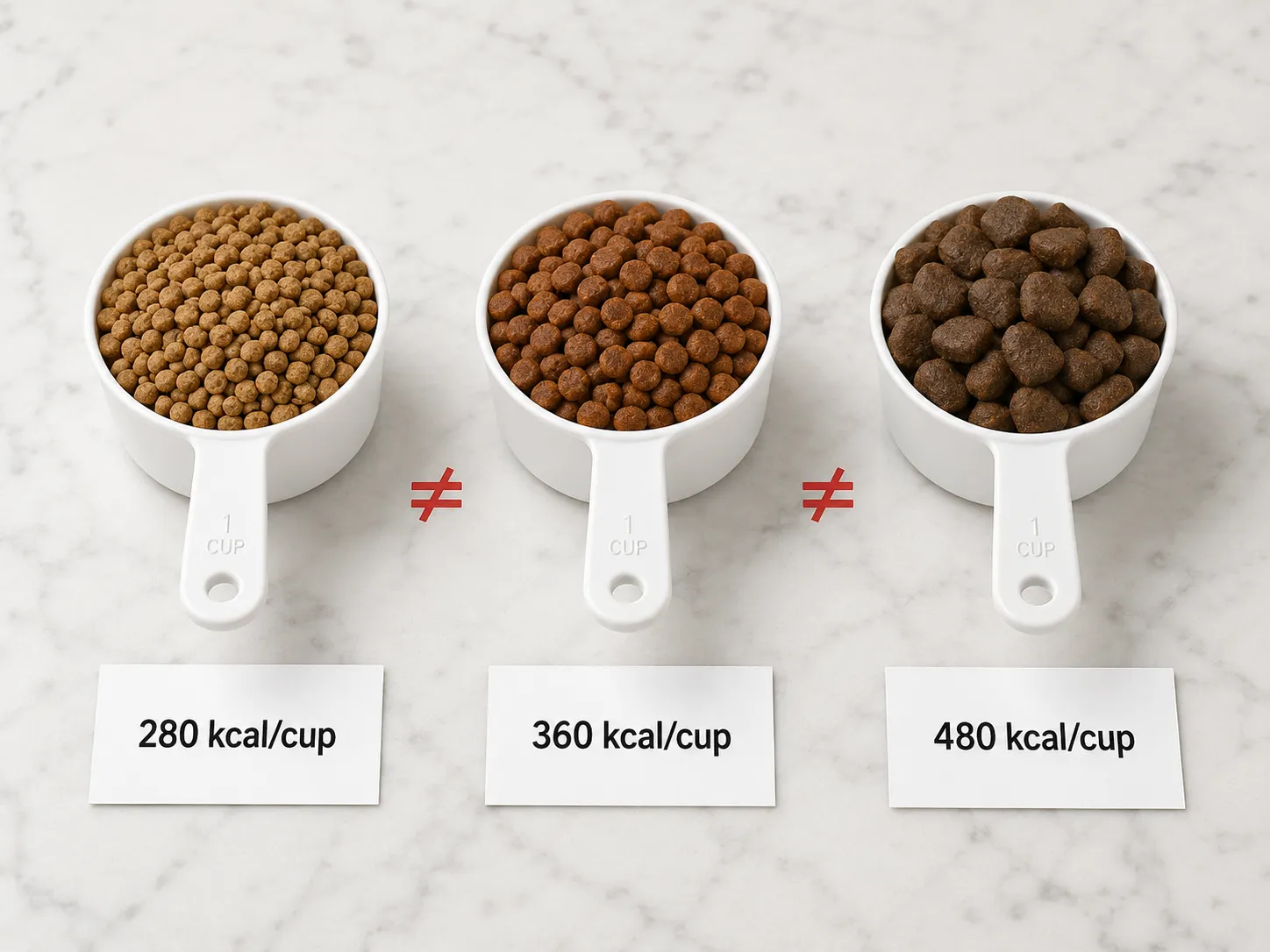
Measure by total daily calories, not by how full the bowl looks. Wet food, dry kibble, and mixed feeding can all work well, but the numbers only make sense if you compare kcal per cup, per can, or per pouch. A can of wet food can look generous while delivering fewer calories than a small scoop of kibble.
| Food type | How to read the label | Common mistake | What to do instead |
|---|---|---|---|
| Dry food | Look for kcal per cup or kcal per kg on the bag | Assuming every cup measure is equal across brands | Use the package’s calorie information, not just a measuring cup |
| Wet food | Check kcal per can, pouch, or 100 g | Assuming a larger volume means more energy | Total the calories the dog gets across the whole day |
| Mixed feeding | Add the calories from both foods together | Counting the full label amount of each food separately | Split the daily calorie target between wet and dry |
| Brand changes | Compare kcal, not just serving size | Switching foods and keeping the same number of cups | Recalculate because the new food may be denser or lighter |
Pedigree UK’s feeding calculator gives a good example of why format matters: it uses grams for wet food, because volume alone is too blunt a tool. That is the right idea to keep in mind whenever you change from kibble to canned food or combine the two. Pedigree UK
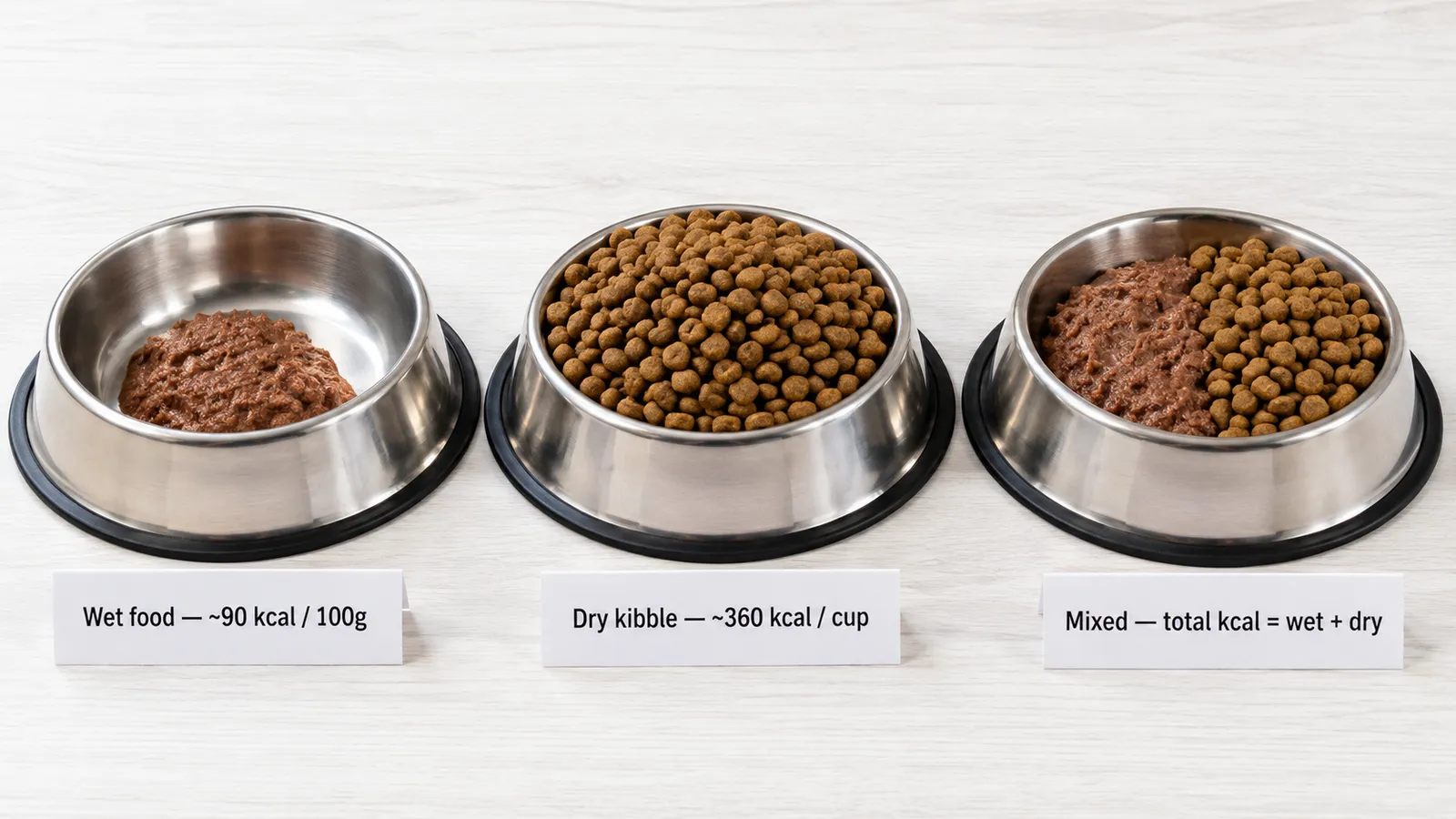
This is also where some label confusion comes from. A feeding chart may look reassuringly specific, but if the food is more calorie-dense than the old one, the same scoop can push your dog into weight gain. If it is less calorie-dense, the same scoop can leave your dog hungry and underfed.
A simple decision framework: from label to body condition
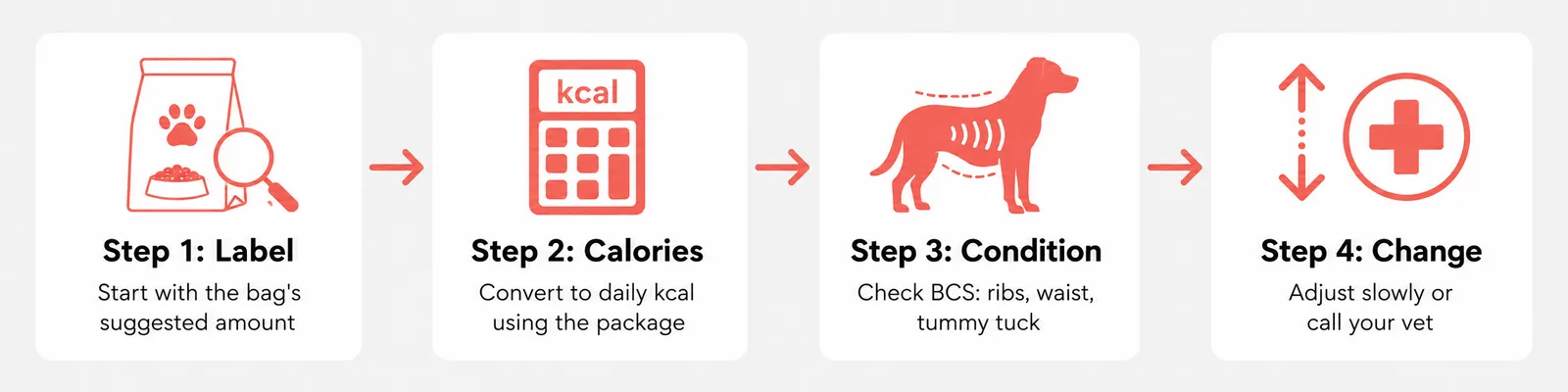
Use a four-part check: Label, Calories, Condition, and Change. Start with the bag’s feeding guide, convert that amount to calories, judge your dog’s body condition, and then adjust only as needed. This keeps you from guessing from cups alone and helps you decide whether to move the portion up, down, or call the vet.
- Label: note the brand’s suggested daily amount for your dog’s current weight and life stage.
- Calories: find kcal per cup, can, pouch, or gram and calculate the actual daily energy target.
- Condition: check whether the ribs, waist, and belly tuck match a lean body condition score.
- Change: adjust slowly if the dog is otherwise well; call the vet if appetite, thirst, stool, or energy change in a worrying way.
That framework is the part most feeding charts leave out. BARK.co, PetMD, Pawlicy Advisor, IAMS, and the UK Pedigree calculator all point in the same direction: the feeding guide gets you started, but the dog in front of you decides where you end up. The chart is a map, not the destination. BARK.co
If you want one sentence to keep in your pocket, make it this: feed the calorie target that keeps your dog lean, then let body condition and weekly weight trend tell you whether the bowl is still right. That is steadier, and far more honest, than trying to make a cup chart fit every dog on the planet.
Calculate Your Dog's Daily Calories
Use the calculator below to estimate how many calories your dog needs each day. Enter your dog's weight, life stage, activity level, and how many meals you feed, and the tool will apply the RER/MER formula used by veterinary nutritionists to give you a personalized starting point. If you know the calorie density of your dog's food (listed on the bag as kcal/cup), you can also get an estimated daily cup amount.
Dog Daily Calorie Calculator
Based on veterinary RER/MER formulas (WSAVA & AAHA guidelines)
Always confirm with your veterinarian before changing your dog's diet.
Formula: RER = 70 × (kg)^0.75 · MER = RER × life stage multiplier (WSAVA/AAHA)
Common questions
How much should I feed my dog based on weight?
Weight is only a starting point, because the same weight can mean very different calorie needs. Use your dog’s current weight plus age, activity level, and body condition to estimate calories, then adjust from there.
Should I feed my dog once or twice a day?
Most adult dogs do well on two meals a day. Puppies often need three or more meals, while the best schedule for a specific dog depends on age, size, health, and how well they tolerate larger meals.
Why does my dog still seem hungry after eating the right amount?
Some dogs act hungry even when they’re getting enough calories, especially if meals are calorie-dense or treats are part of the routine. Begging can also be learned behavior, so body condition and weight trend matter more than appetite alone.
Can I just follow the amount on the dog food bag?
No. The bag chart is a rough estimate, but it can be off because calorie density, cups, and individual needs vary a lot. Treat it as a starting point, then adjust based on your dog’s body condition and weight trend.
Sources consulted
Sources consulted for this article:
- How Much Food Should I Feed My Dog? - BARK.co
- How Much Food to Feed Your Dog? Complete Guide - pedigree uk
- Dog Feeding Chart: How Much Food Should I Feed My Dog? - PetMD
- How Much To Feed A Puppy: Chart By Weight & Age | Pawlicy Advisor
- How Much Dry Food Should I Feed My Dog? | IAMS™