
German Shepherd Health Problems and Lifespan
A neighbour of mine has owned German Shepherds her whole life, and a few years ago she asked me something I couldn't answer well: why do her dogs, every one of them brilliant and devoted, seem to face more health battles than the scruffy mixed-breeds down the street? I started reading, and I didn't stop for weeks. What follows is the article I wish she'd had, and the one I'd want for myself if I ever brought a Shepherd home as a companion for Barnaby. Here's the uncomfortable truth up front: with this breed, understanding the specific health risks isn't optional background reading. For almost no other dog does a little foresight change the outcome as much as it does for the German Shepherd.
The breed's main health risks
- German Shepherds live roughly 9 to 13 years on average, measurably shorter than most mixed-breed dogs of similar size, a gap researchers trace in part to a narrowed gene pool.
- The breed's explosive popularity after Rin Tin Tin's 1920s stardom drove decades of overbreeding, concentrating hereditary conditions that careful genetic screening is only now beginning to unwind.
- Hip and elbow dysplasia are the breed's signature orthopedic risks, and the puppy growth window, birth to about 18 months, is when your feeding and exercise choices carry the most weight.
- Bloat (GDV) is the breed's deadliest sudden emergency, while degenerative myelopathy is its most heartbreaking slow decline, and the two demand completely different responses from you.
- Most German Shepherd conditions are genetic and can't be erased, but early DNA screening, steady weight control, and a strong vet relationship genuinely shift the odds in your dog's favour.
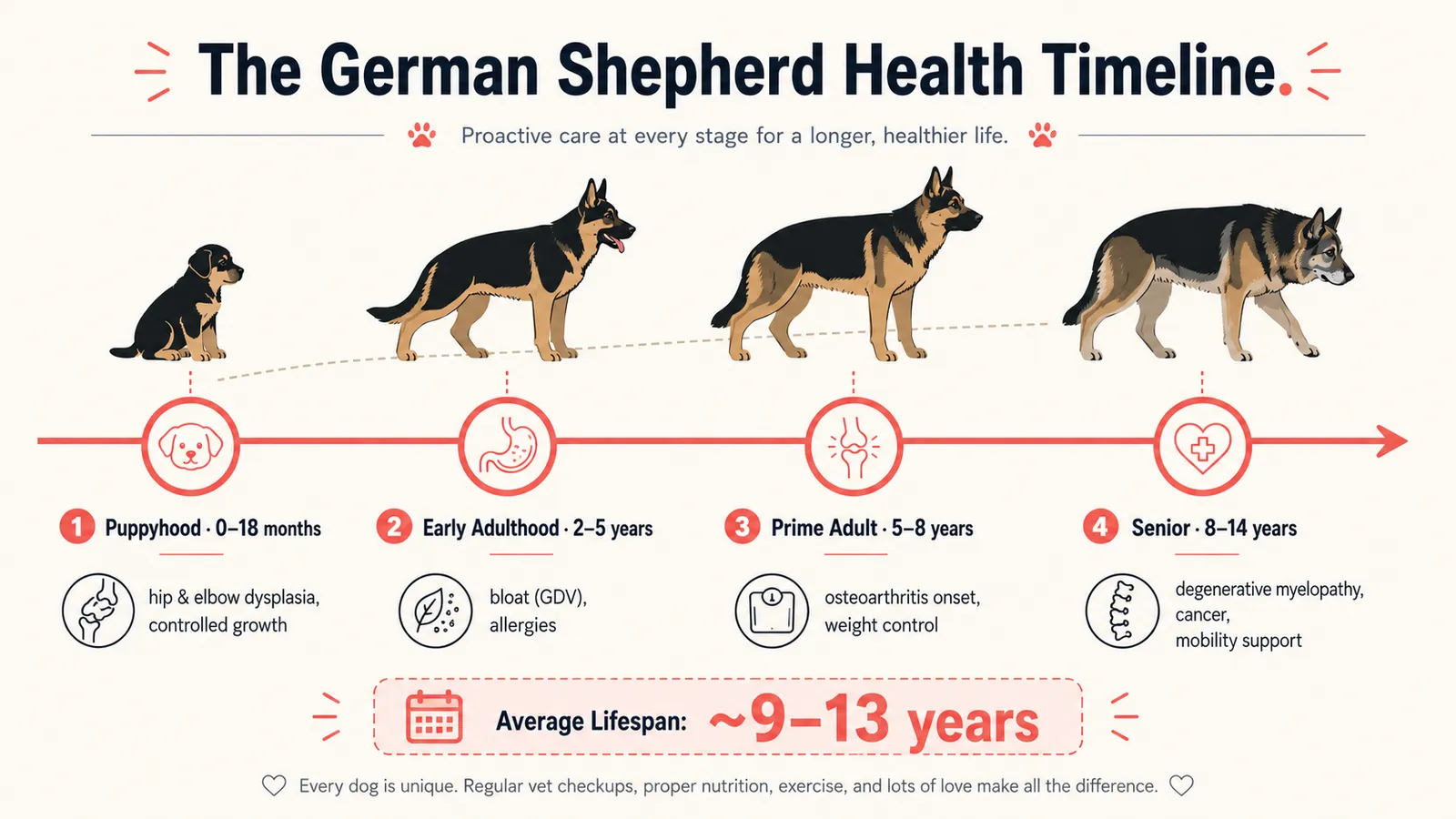
The GSD Risk Timeline: What to watch and when
Before getting into each condition individually, here's the framework I now use to think about GSD health, not by condition, but by life stage.
| Life Stage | Age Range | Primary Risk(s) | Owner Priority |
|---|---|---|---|
| Puppyhood | 0-18 months | Hip/elbow dysplasia; growth plate injury | Controlled diet, low-impact exercise, PennHIP from 16 weeks |
| Early adulthood | 2-5 years | GDV/bloat; PAA; skin and coat allergies | Slow-feed protocols, digestive monitoring, allergy workup |
| Prime adult | 5-8 years | Osteoarthritis onset; recurring infections | Joint supplements, weight management, annual vet bloodwork |
| Senior | 8-14 years | Degenerative myelopathy; cancer; kidney decline | DNA screening results review, mobility support, palliative planning |
A word of caution about reading this too literally: these risk windows overlap, and plenty of dogs never develop the conditions listed for their stage at all. A two-year-old can show early hip trouble, and a perfectly screened senior can sail through to fourteen. Treat the timeline as a way to prioritize the conversations you have with your vet, a prompt to ask the right questions at the right age, rather than a prediction of what will go wrong. It tells you where to point your attention, not what fate has in store.
The German Shepherd lifespan: what the numbers actually mean
Most reliable sources put the German Shepherd's average lifespan between 9 and 13 years, with around 10 to 11 years being the realistic middle of that range for a healthy, well-cared-for dog. A large 2024 UK study landed on a mean of about 11.3 years, and the telling part is the comparison: that same study found crossbreeds living to roughly 12 years and the purebred average sitting near 12.7. In other words, the German Shepherd comes in below not just mixed breeds but the typical purebred too. There's also a sex difference worth knowing, with females tending to outlive males by well over a year on average.
That mixed-breed gap isn't an accident, and explaining it means going back almost exactly a century. When a German Shepherd named Rin Tin Tin, rescued from a French battlefield in 1918, became one of Hollywood's biggest stars of the 1920s, he single-handedly turned the breed into America's most wanted dog. Demand exploded, and where demand explodes, careless breeding follows. Decades of selecting for appearance and volume over health narrowed the gene pool and baked in the very conditions this article covers. You can even see it in the dogs' bodies: the dramatically sloped back of the modern show-line Shepherd is a relatively recent conformation choice, not the squarer, more level build Rin Tin Tin himself had.
Learning that history genuinely reframed how I think about the word "purebred." I'd grown up half-assuming a papered pedigree meant a sturdier dog, when in many breeds it can mean the opposite, a smaller pool of ancestors and a higher chance of doubling up on the same harmful genes. It's exactly why organizations like the AKC Canine Health Foundation now pour resources into genetic research and why responsible breeders screen so heavily. The lifespan number isn't destiny. A Shepherd from health-tested parents, kept lean and screened early, can absolutely push toward and past the top of that range.
Hip and elbow dysplasia: the growth window that matters most
If there's one health issue welded to this breed's reputation, it's hip dysplasia, with elbow dysplasia close behind. Both are problems of fit, and the puppy growth window is where the story is written.
How the joint goes wrong
A healthy hip is a clean ball-and-socket: the rounded head of the femur sits snugly in a cup called the acetabulum, gliding smoothly. In a dysplastic hip, that fit is loose. The socket may be too shallow, or the ligaments too lax, so the femoral head slides partly out of place, a movement vets call subluxation. Every step then grinds bone against cartilage in ways the joint was never built for.
The body's response only deepens the problem. To stabilize a wobbling joint, it lays down extra bony growths called osteophytes, and the smooth cartilage wears thin. The end result is osteoarthritis, often years before you'd expect it in a large dog. Elbow dysplasia follows the same logic at the front legs, where tiny mismatches between the bones of the joint cause pain, lameness, and the same slow slide into arthritis. If you want the deeper clinical picture, our full guide to hip dysplasia symptoms and treatment options walks through diagnosis and management in detail.
The early warning signs owners miss
The frustrating thing about dysplasia is how quietly it starts. The classic early tells are subtle: a "bunny-hop" gait where the dog pushes off with both hind legs together instead of alternating, a "lazy sit" with one hip splayed out to the side, a tendency to stand with the hind feet tucked unusually close together, stiffness after rest that eases once the dog warms up, and a new reluctance to take stairs or jump into the car.
I learned to spot the bunny-hop the hard way, through a friend's young Shepherd. He was maybe ten months old, bounding across a field after a ball, and I noticed both back legs were launching in unison, a little rabbit-like hop instead of a normal stride. I genuinely thought it was just a goofy puppy quirk and said as much. It was her vet who explained, weeks later, that the gait can be one of the earliest visible signs of hip laxity. That moment stuck with me. It taught me that with this breed, a slightly odd way of moving isn't something to wave off, it's information worth photographing on video and showing a professional.
Growth, diet, and early screening
Here's where owners have real power. Overfeeding a Shepherd puppy to make it grow big and fast is one of the worst things you can do for its joints. Rapid growth and excess weight pile mechanical stress onto immature joints during the exact months they're forming, and that accelerated growth is strongly linked to worse dysplasia. Large-breed puppy formulas exist precisely to slow and steady that growth curve, and getting how much to feed your dog right in the first year is genuine preventive medicine, not fussiness.
Screening lets you act on facts rather than guesswork. PennHIP can assess hip laxity from as early as 16 weeks of age, giving you an early read on risk, while the Orthopedic Foundation for Animals (OFA) provides standardized hip and elbow grading from two years of age. The OFA's grading system is also the backbone of responsible breeding decisions, which is how the breed slowly improves generation over generation. If you're buying a puppy, asking to see the parents' OFA results isn't rude, it's the single most useful question you can pose.
Bloat (GDV) and digestive vulnerabilities
German Shepherds carry a deep, narrow chest, and that one anatomical fact sits behind several of the breed's digestive risks, the most dangerous of which can kill a healthy dog in a matter of hours.
GDV, the clock-is-ticking emergency
Gastric dilatation-volvulus, or bloat, is the emergency every Shepherd owner needs to recognize on sight. It begins when the stomach fills rapidly with gas and fluid (dilatation), then rotates on itself (volvulus). That twist seals off both ends of the stomach and, critically, kinks the major blood vessels, cutting off circulation to the stomach and choking blood flow back to the heart. Tissue starts dying. Shock sets in. Without surgery, GDV is very often fatal, and the window is measured in hours, not days.
The breed-specific risk here is not theoretical. German Shepherds are among the most commonly reported breeds for GDV, studies suggest something like a 2.4 times higher risk than mixed breeds, because that long chest cavity gives the stomach room to move and twist, and the ligament anchoring it stretches further with age. The signs to burn into memory: a swollen, hard belly, unproductive retching (trying to vomit but bringing nothing up), restlessness and pacing, drooling, and obvious distress. If you see this combination, you do not wait until morning. You drive to an emergency vet immediately.
Pancreatic acinar atrophy, the slow counterpart
If GDV is the breed's violent digestive emergency, pancreatic acinar atrophy (PAA) is its chronic, creeping one, and German Shepherds are the poster breed for it. In PAA, the cells that produce digestive enzymes (the acinar cells) progressively waste away. The result is exocrine pancreatic insufficiency: the dog simply can't break down and absorb the food it eats. It's estimated to affect around 1% of the UK Shepherd population, which is strikingly high for a single breed.
The hallmark is heartbreaking once you understand it, a dog that eats ravenously, sometimes desperately, yet steadily loses weight, passing large, pale, greasy, foul-smelling stools because the nutrients are sailing straight through undigested. It's diagnosed with a simple blood test (serum cTLI) and managed, often very successfully, with prescription enzyme supplementation sprinkled on every meal. A related but separate problem, megaesophagus, can also appear in the breed, where the esophagus loses its ability to push food down to the stomach, causing regurgitation. Because greasy or loose stools can have many causes, it helps to understand when diarrhea becomes a reason to worry and to know the signs of pancreatitis in dogs, which is a distinct condition that's easy to confuse with PAA.
The preventive feeding playbook
You can't change your dog's chest shape, but you can stack the odds in your favour with how you feed. The core protocol most vets recommend for at-risk breeds: feed two or three smaller meals a day rather than one large one, use a slow-feeder bowl to stop fast gulping (which swallows air), and keep your dog calm with no vigorous exercise for at least an hour before and after eating. Worth noting on the flip side, raised feeding bowls, once recommended, are now thought to possibly increase bloat risk, so most guidance has moved back to floor-level feeding.
The single most effective preventive measure, though, is surgical. A prophylactic gastropexy tacks the stomach to the abdominal wall so it physically cannot twist, and it reduces GDV risk by well over 90%. It can often be done laparoscopically at the same time as spaying or neutering, which is why it's worth raising with your vet early, the procedure doesn't stop dilatation, but it removes the deadly twist that turns bloat into a killer. Feeding choices also support a sensitive system more broadly, and choosing the right food for dogs with sensitive stomachs is a sensible companion habit alongside the gastropexy conversation.
Degenerative myelopathy vs joint wear: the difference that changes everything
This is the section I'd most want a Shepherd owner to read slowly, because two very different conditions can look almost identical from across the room, and confusing them leads to the wrong care and a lot of unnecessary heartache.
Degenerative myelopathy, when the wiring fails
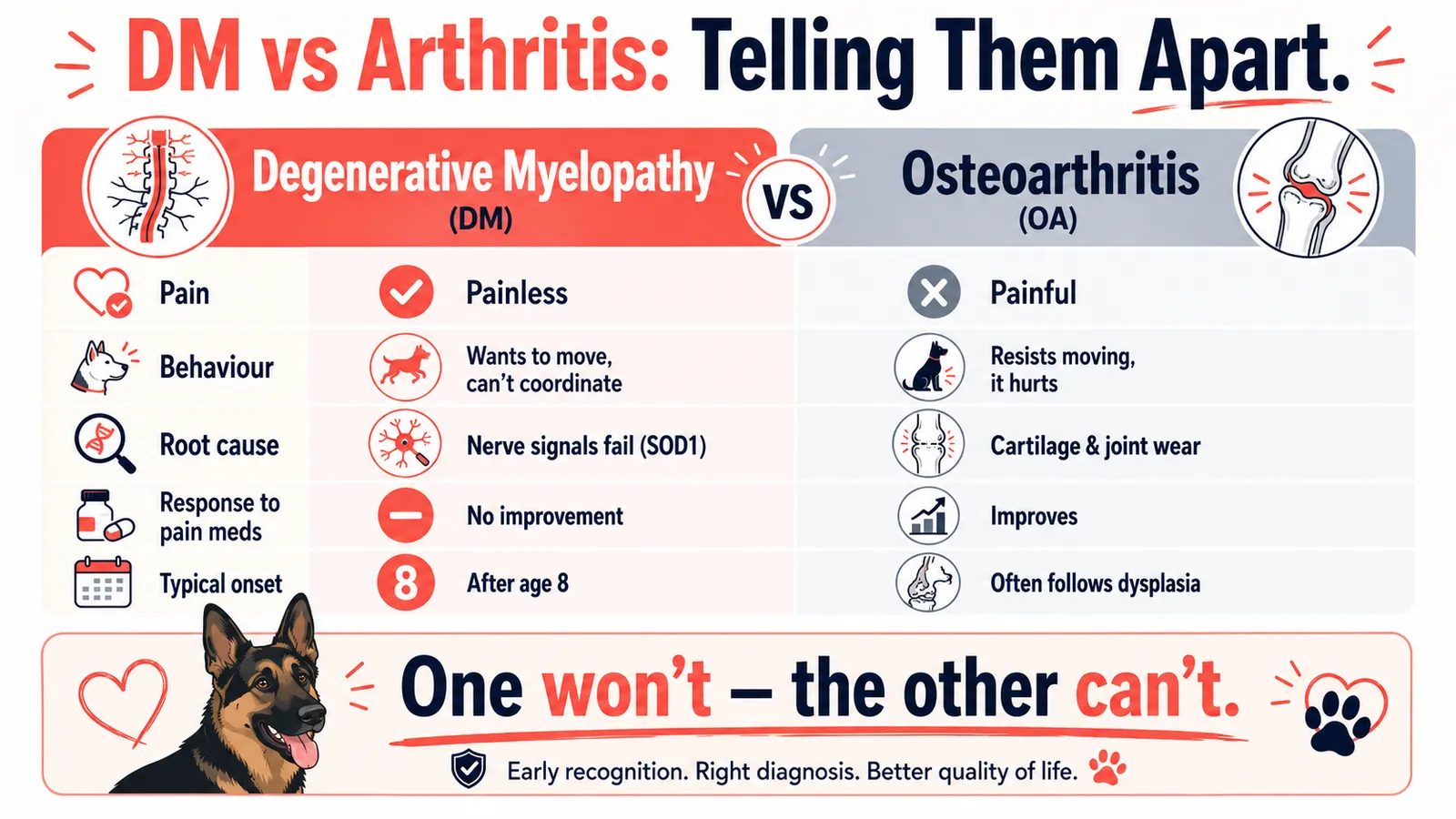
Degenerative myelopathy (DM) is a progressive disease of the spinal cord, frequently compared to ALS in people. It's linked to a mutation in the SOD1 gene, and it works by slowly destroying the myelin sheath, the insulating layer around nerve fibres that lets signals travel from brain to legs. As that insulation degrades, the messages stop getting through. The dog isn't in pain; the body simply stops receiving the instructions to move correctly.
The progression has a cruel signature. It usually starts after age eight with subtle hind-end clumsiness: a paw that knuckles over so the dog walks on the top of its foot, toenails that scrape and wear down from dragging on pavement, a slight sway or crossing of the back legs. Over roughly 6 to 18 months it ascends, the hindquarters weakening toward paralysis, and in its final stage it can reach the muscles involved in breathing. What struck me most when I first learned about DM was that "painless" part. With most decline we brace for our dogs hurting, but a DM dog feels fine and stays bright and willing while its body quietly stops obeying. That changes the emotional calculus entirely. The job shifts from managing pain to preserving dignity and mobility for a mind that's still completely present. If you ever notice unexplained wobbliness, it's worth understanding why your dog might be shaking or losing coordination before assuming the worst.
Osteoarthritis, when the hardware wears
Arthritis is the more familiar enemy, and in this breed it's often the long tail of that earlier hip or elbow dysplasia. The modern show-line Shepherd's sloped-back conformation can alter the biomechanics of the spine and hindquarters, loading certain joints unevenly. Over years, cartilage wears down, those bony osteophytes build up, and the joint becomes inflamed and genuinely painful.
The key word there is painful, and it drives behaviour you can read. An arthritic dog is stiff after rest and tends to loosen up once it gets moving, hesitates at stairs, and may flinch or pull away when a sore joint is touched. The good news is that arthritis responds to treatment, anti-inflammatory medication (NSAIDs), weight management, joint supplements, and controlled exercise can keep an arthritic Shepherd comfortable and mobile for a long time. That treatability is itself a clue, and it leads straight to the distinction that matters most.
Telling them apart
Here is the single most useful mental test I know. An arthritic dog resists movement because moving hurts, it's a pain problem, and the dog is protecting itself. A DM dog wants to move but can't coordinate it, the signals aren't arriving, so the legs fail mechanically even though nothing hurts. One dog won't; the other can't. That difference is the hinge everything turns on.
It matters because the responses diverge completely. Pile pain medication onto a DM dog and you'll see no improvement, because there's no pain to relieve, and you'll lose precious time. Recognize early arthritis, though, and aggressive comfort care can buy years of good life. Because DM can also appear alongside other age-related decline, it's wise to keep an eye on whole-body health in senior dogs, including the early signs of kidney disease, so you're seeing the full picture rather than fixating on the legs alone. When in doubt, a neurological exam, not just an orthopedic one, is what tells the two apart.
Mobility support
Whichever condition you're facing, the goal becomes keeping a willing dog moving safely. A supportive lifting harness with a handle over the hips lets you assist a wobbly back end on stairs and slick floors, and non-slip runners through the house remove a daily source of falls and frustration. For dogs whose hind legs have largely given out, a canine wheelchair, companies like K9 Carts make them as one example of the category, can restore genuine independence and joy, and many dogs take to them remarkably fast.
Beyond equipment, hands-on therapy keeps the body as functional as possible. Hydrotherapy uses water's buoyancy to let a dog exercise muscles without joint strain, which helps both arthritic and DM patients. Passive range-of-motion work, gently flexing and extending the limbs, maintains circulation and joint flexibility in legs the dog can no longer fully use itself. None of this cures DM, but it can meaningfully stretch the window of good days, and that's the whole game.
Skin, coat, and immune-mediated allergies
Not every Shepherd problem is dramatic. One of the breed's most common and quietly miserable issues is allergic skin disease, rooted in how their immune system and skin barrier are built.
The barrier defect and atopic dermatitis
German Shepherds are prone to a defect in the skin's outermost protective layer, the epidermal barrier that's supposed to keep allergens out and moisture in. When that barrier is leaky, environmental allergens like pollen, dust mites, and mould slip through and trigger an overreaction. The clinical name for this allergic skin condition is atopic dermatitis, and it tends to show up in the first one to three years of life.
The visible result is a dog that itches, scratches, licks, and chews, often targeting the paws, belly, ears, and face. Over time that self-trauma breaks the skin and opens the door to secondary bacterial and yeast infections, which itch even more, creating a maddening cycle. Recognizing it early is half the battle, and our full guide to dog skin allergies goes deeper into spotting and soothing it before it spirals.
Ears, hot spots, and the double coat
That same allergic tendency expresses itself in two other classic Shepherd complaints. Recurrent ear infections are common, partly because allergic inflammation extends into the ear canal, turning it red, smelly, and itchy. Hot spots, those angry, weeping, suddenly-appearing patches of inflamed skin, flare up where a dog has licked or chewed one area raw, often over a single frustrating night.
The breed's glorious double coat plays a supporting role in all of this. It's built to insulate against both cold and heat, but it also traps moisture and warmth against the skin, creating exactly the humid micro-climate that bacteria and yeast love. Regular grooming to keep that coat clean and free of dead undercoat genuinely helps, and learning how to clean your dog's ears at home gives you a frontline tool to catch ear trouble before it becomes a full infection.
Getting to a diagnosis and relief
Pinning down the trigger takes patience, because food allergies and environmental allergies look almost identical on the skin. To rule food in or out, vets use an elimination diet trial, feeding a novel protein or hydrolyzed diet exclusively for 8 to 12 weeks with zero treats or table scraps. It's tedious and requires real discipline, but it's the only reliable way to identify a food allergy. For environmental allergies, medicated shampoos containing chlorhexidine and ketoconazole help control the secondary infections that ride along.
On the relief side, modern medicine has changed the game. Targeted treatments, Apoquel and Cytopoint are two widely used options, can interrupt the itch cycle far more precisely than the old approach of blanket steroids, with fewer side effects. Alongside medication, Omega-3 and Omega-6 fatty acid supplementation supports the skin barrier from the inside out, and consistent grooming of that double coat rounds out a management plan that, while rarely a one-time fix, can give an itchy Shepherd real and lasting comfort.
Proactive care: the GSD owner's screening blueprint
Everything above can sound like a catalogue of doom, but here's the reframe I hold onto: almost none of it is a surprise anymore. We know what this breed faces, which means we can screen, prepare, and act early. This is where the GSD Risk Timeline earns its place, it turns a scary list of conditions into a simple schedule of things to check at each life stage.
Start with genetics. Direct-to-consumer DNA panels like Embark and Wisdom Panel can test for the SOD1 mutation behind degenerative myelopathy, giving you years of warning to plan for mobility support if your dog carries two copies. In puppyhood, PennHIP from 16 weeks and OFA grading from two years give you an early, factual read on joint health. In early adulthood, the bloat conversation moves to the top of the list, slow-feed bowls, meal timing, and a serious discussion with your vet about prophylactic gastropexy. Throughout life, Omega-3 supplementation, lean body weight, and annual bloodwork form the quiet backbone of prevention. The single consolidated table below maps the breed's major conditions to their detection and prevention at a glance.
| Condition | Typical onset | Best detection method | Key preventive action |
|---|---|---|---|
| Hip dysplasia | 4-18 months | PennHIP (16+ weeks) or OFA X-rays | Controlled growth diet, avoid high-impact exercise during puppyhood |
| Degenerative myelopathy | 8-14 years | DNA test (SOD1 mutation) | Early physical therapy, mobility harness training |
| Gastric dilatation-volvulus | 2-8 years | Clinical exam + abdominal X-rays | Slow feeders, small meals, no exercise 1 hour before/after meals |
| Pancreatic acinar atrophy | 1-5 years | Serum cTLI blood test | High-digestibility diet, prescription enzyme supplementation |
| Atopic dermatitis | 1-3 years | Elimination diet trial + allergen testing | Omega-3 supplementation, regular grooming, allergen management |
If a friend told me today they were bringing home a Shepherd puppy, here's exactly what I'd say, and I'd say it warmly because I'd be a little envious of the years of devotion ahead of them. Choose a breeder who shows you the parents' OFA hip and elbow results and their SOD1 status, not because paperwork is sacred, but because it's the clearest proof someone is breeding for health. Keep the puppy lean; resist every urge to grow it big and fast. Have the bloat plan in place before you need it, gastropexy included. And build a real relationship with one good vet who knows your dog from the start. That's not anxious over-management, for any large breed, and this one especially, it's just how you give a dog its best shot at the long end of that lifespan range.
Questions Shepherd owners ask
What is the most common cause of death in German Shepherds?
There isn't a single answer, but the breed's leading causes cluster into a few categories. Musculoskeletal decline is the big one, advanced hip dysplasia and degenerative myelopathy together rob so many older Shepherds of mobility that humane euthanasia becomes the kindest option. Bloat (GDV) is the most common acute, sudden cause of death, capable of killing a healthy dog in hours. Cancers, particularly hemangiosarcoma, are also a significant threat in the breed's senior years. It's a sobering list, but each one is exactly why early screening and fast emergency recognition matter so much.
How do I know if my German Shepherd has hip dysplasia?
The earliest signs are often behavioral and easy to dismiss. Watch for a "bunny-hop" gait where both hind legs move together, a "lazy sit" with one hip flopped out to the side, hind feet held unusually close together, stiffness after rest that eases with movement, and a growing reluctance to climb stairs or jump up. None of these confirm anything on their own, they're prompts to investigate. A definitive diagnosis requires X-rays, ideally read against PennHIP or OFA standards, so the real answer to "how do I know" is: you note the signs, then you let imaging confirm it.
Are German Shepherds high-maintenance health-wise?
Yes, honestly, they require more proactive health management than the average dog, and pretending otherwise does no one any favours. They're predisposed to serious orthopedic, digestive, neurological, and skin conditions, several of them hereditary. But "high-maintenance" doesn't mean "doomed." Armed with the right knowledge, a good breeder's screening, sensible feeding, and a vet who knows the breed, the large majority of owners manage these risks well and share many wonderful years with their dogs. It's a breed that rewards preparation. Go in informed, and the maintenance becomes routine rather than crisis.
Can German Shepherd health problems be prevented?
Mostly, no, and it's important to be clear-eyed about that. The breed's signature conditions are largely genetic, written into the dog before you ever met it, so "prevention" in the strict sense often isn't on the table. What you can do is change the odds: early DNA and orthopedic screening, lean weight management, appropriate low-impact exercise during growth, and good nutrition can delay onset and reduce severity in a real, measurable way. Think of it as the difference between prevention and management. You can't change the genes, but you can absolutely change the odds.
If you'd like to keep building your knowledge across the rest of your dog's health, we cover it all in straightforward, jargon-free terms in our plain-language dog health guides, because with a breed like this one, an informed owner is genuinely the best health insurance a dog can have.
Where this information comes from
- German Shepherd Health Problems | K9 Carts
- German Shepherd Health: What Every Owner Should Know | ImpriMed
- 13 Common Health Problems in German Shepherds | Veterinary Formula
- Orthopedic Foundation for Animals, Hip Dysplasia
- AKC Canine Health Foundation, German Shepherd