
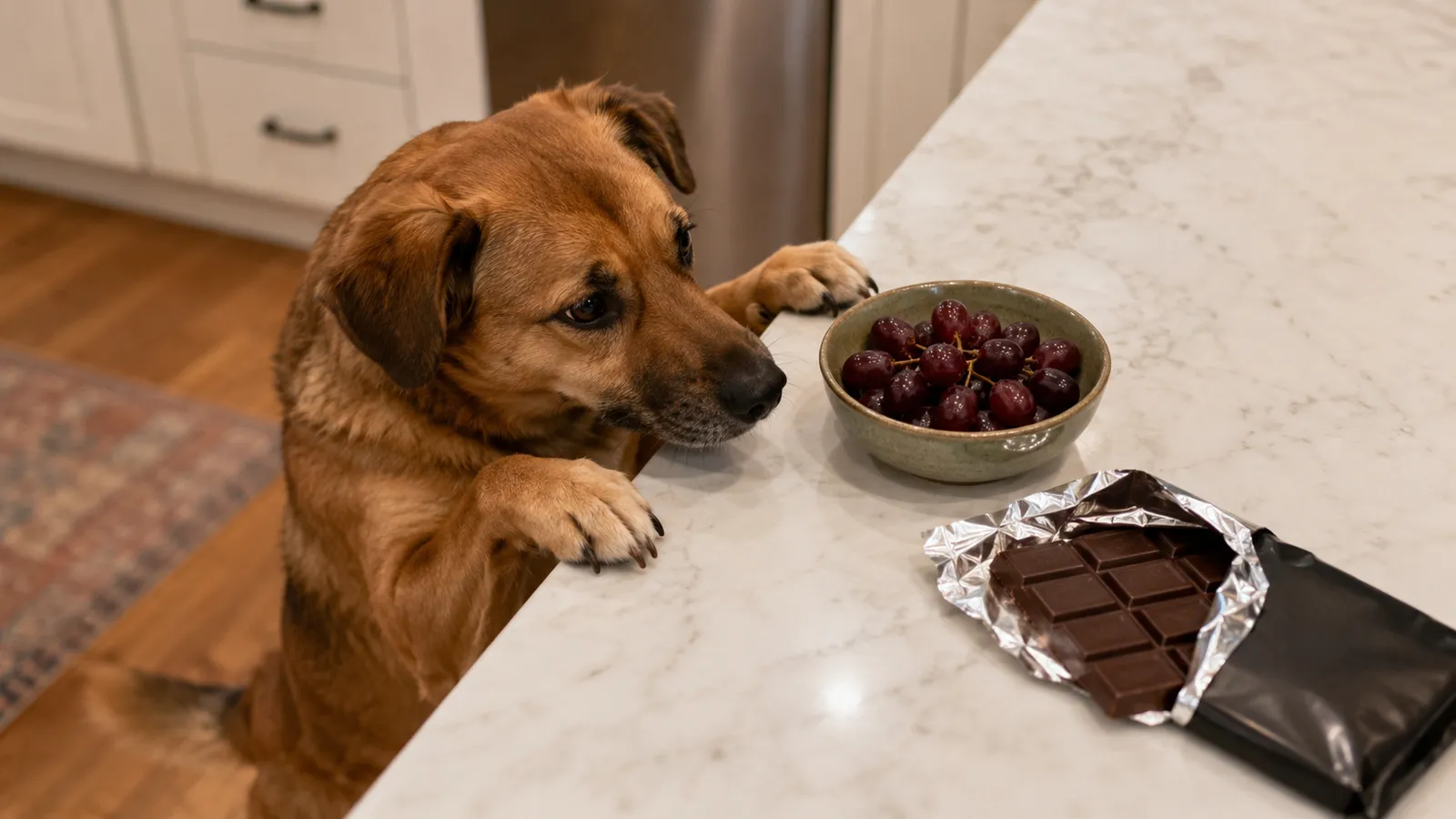
Foods Toxic to Dogs Complete List, Sorted by Danger, Hidden Ingredients, and What to Do Next
Xylitol, grapes and raisins, and chocolate are the three most likely to land your dog in an emergency room, and in each case, minutes matter. Waiting for symptoms is the wrong call, because many of these toxins cause organ damage long before a dog looks sick. This article works as a triage guide first: every section tells you what to do right now before explaining why the food is dangerous.
Key Takeaways
- Call ASPCA Animal Poison Control (888-426-4435) or Pet Poison Helpline (855-764-7661) immediately, don't wait for symptoms.
- Note the exact food, estimated amount eaten, and your dog's weight before you call.
- Never induce vomiting on your own unless a poison control expert or vet specifically instructs you to.
- Xylitol is the most dangerous hidden ingredient, it can trigger life-threatening hypoglycemia within 30 minutes.
- Onions and garlic are toxic in all forms, raw, cooked, powdered, and dehydrated, and the damage accumulates over time.
If your dog just ate something toxic: Call ASPCA Animal Poison Control (888-426-4435) or Pet Poison Helpline (855-764-7661) immediately. Do not wait for symptoms. Do not induce vomiting unless instructed by a professional.
Which Foods Are Genuinely Toxic, and How Dangerous Is Each One?
| Food | Danger level | Why it's toxic | Hidden sources | Call now or wait? |
|---|---|---|---|---|
| Xylitol | 🔴 Emergency | Triggers a massive insulin release in dogs, causing hypoglycemia within 10-60 minutes; higher doses cause liver failure | Sugar-free gum, some peanut butters, baked goods, vitamins, mouthwash, toothpaste | Call now. Any confirmed xylitol ingestion is an emergency. |
| Grapes & raisins | 🔴 Emergency | Tartaric acid causes proximal renal tubular necrosis; even a single grape has triggered kidney failure | Trail mix, fruit cakes, cereals, yogurt-covered raisins | Call now. There is no known safe dose. |
| Chocolate & cocoa | 🟡 Dose-dependent | Contains methylxanthines (theobromine and caffeine); theobromine has a half-life of ~17.5 hours in dogs, allowing toxin buildup | Baked goods, protein bars, cocoa mulch, hot chocolate mix | Call now for dark or baking chocolate; call for calculation on milk chocolate. |
| Onions, garlic & alliums | 🟡 Dose-dependent | Sulfur-containing oxidants cause oxidative damage to red blood cells (Heinz body hemolytic anemia); damage peaks 72 hours after exposure | Baby food, gravies, sauces, soups, seasoning blends, onion powder | Call now for large or repeated exposures; monitor and call for small one-time exposure. |
| Alcohol | 🔴 Emergency | Causes rapid CNS depression, metabolic acidosis, vomiting, and can be fatal even in small amounts | Raw yeast dough, certain fruit-based desserts, mouthwash | Call now. Absorbed rapidly; act immediately. |
| Macadamia nuts | 🟠 Context-dependent | Exact toxin unknown; causes weakness, hind-limb tremors, vomiting, and hyperthermia within 12 hours | Cookies, trail mix, chocolate-covered nuts | Call now if eaten in quantity or combined with chocolate. |
| Avocado (persin) | 🟠 Context-dependent | Persin (leaves, skin, bark) causes vomiting and diarrhea; large pit is a serious obstruction risk; fat content can trigger pancreatitis | Guacamole (also contains onion and garlic), prepared dips | Call now if pit was swallowed; monitor for GI signs otherwise. |
| Raw yeast dough | 🔴 Emergency | Expands in the warm stomach, risking gastric dilatation-volvulus; fermenting yeast produces ethanol causing concurrent alcohol toxicity | Homemade bread, pizza dough, any unattended raw dough | Call now. Two independent dangers make this a genuine emergency. |
| Caffeine | 🟡 Dose-dependent | Methylxanthine stimulant; causes tremors, cardiac arrhythmia, and seizures | Coffee grounds, energy drinks, pre-workout powders, protein bars | Call now if a significant amount was consumed. |
What Are the Most Dangerous Hidden Sources?
The foods that worry me most aren't the obvious ones, they're the everyday items that look completely harmless.
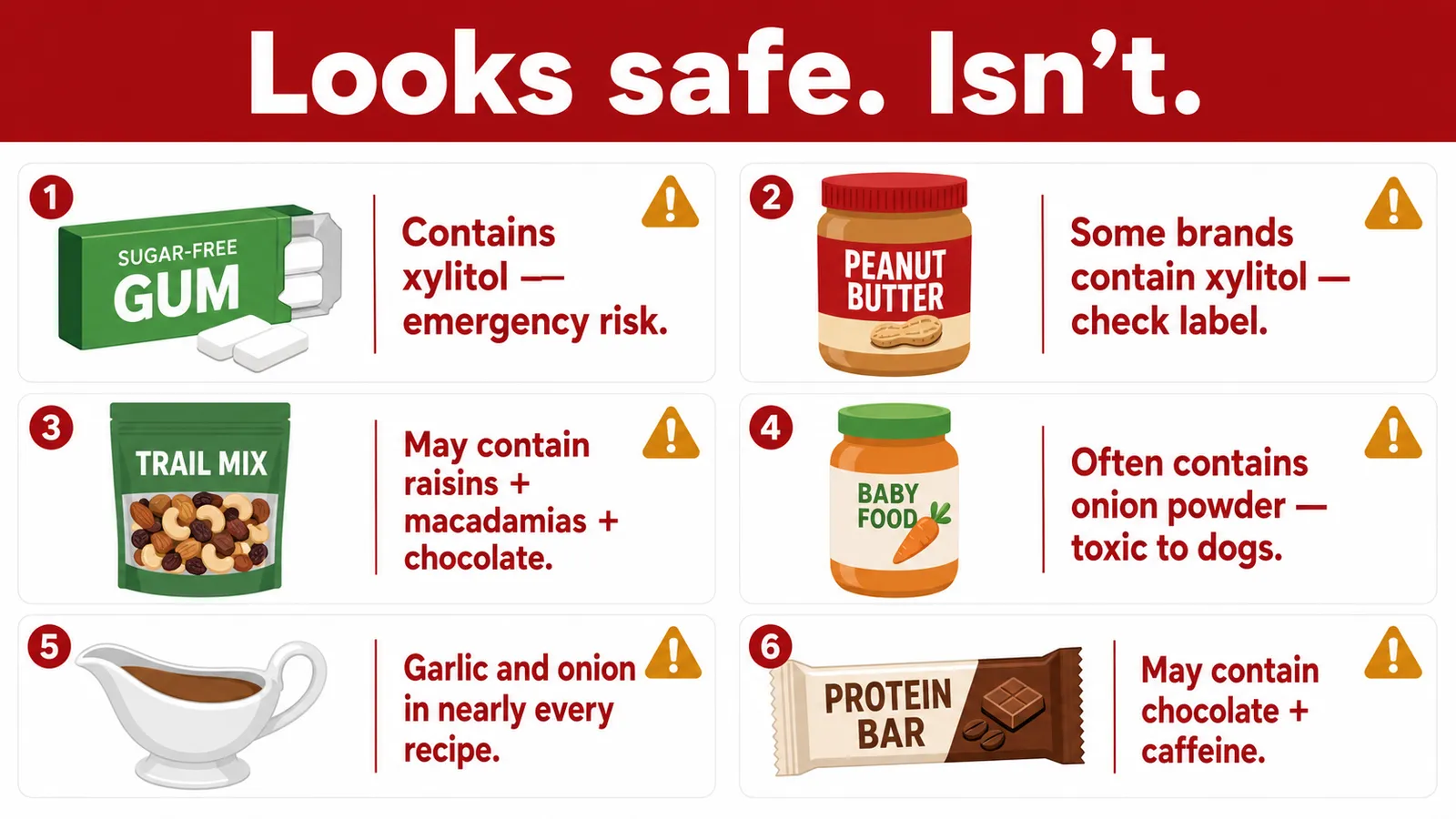
Sugar-free gum is the most dangerous product in most households. The ASPCA Animal Poison Control Center lists xylitol among its top food toxins year after year, and it appears in products most owners never suspect. A single piece of some brands contains enough xylitol to cause hypoglycemia in a small dog.
Peanut butter wears a health halo but hides the same risk. Most brands are safe, but several natural and sugar-free varieties contain xylitol. I learned to read labels after a scare with Barnaby, he got into a "natural" brand I hadn't checked. Verify ingredients before every use.
Trail mix is a trifecta of danger: it frequently combines raisins, macadamia nuts, and chocolate chips. Any one of those warrants a call to poison control. Together, they are a genuine emergency.
Baby food surprises most owners, many formulations use onion powder as a flavoring. Powder forms are more concentrated than fresh onion; a small amount causes more damage than a much larger piece of raw onion.
Gravies, sauces, and stir-fry leftovers routinely contain garlic and onion. Cooking does not neutralize the toxins. Cooked alliums are just as dangerous as raw.
The DOSE Framework: Your In-the-Moment Triage Guide
When your dog eats something and your mind goes blank, use DOSE.
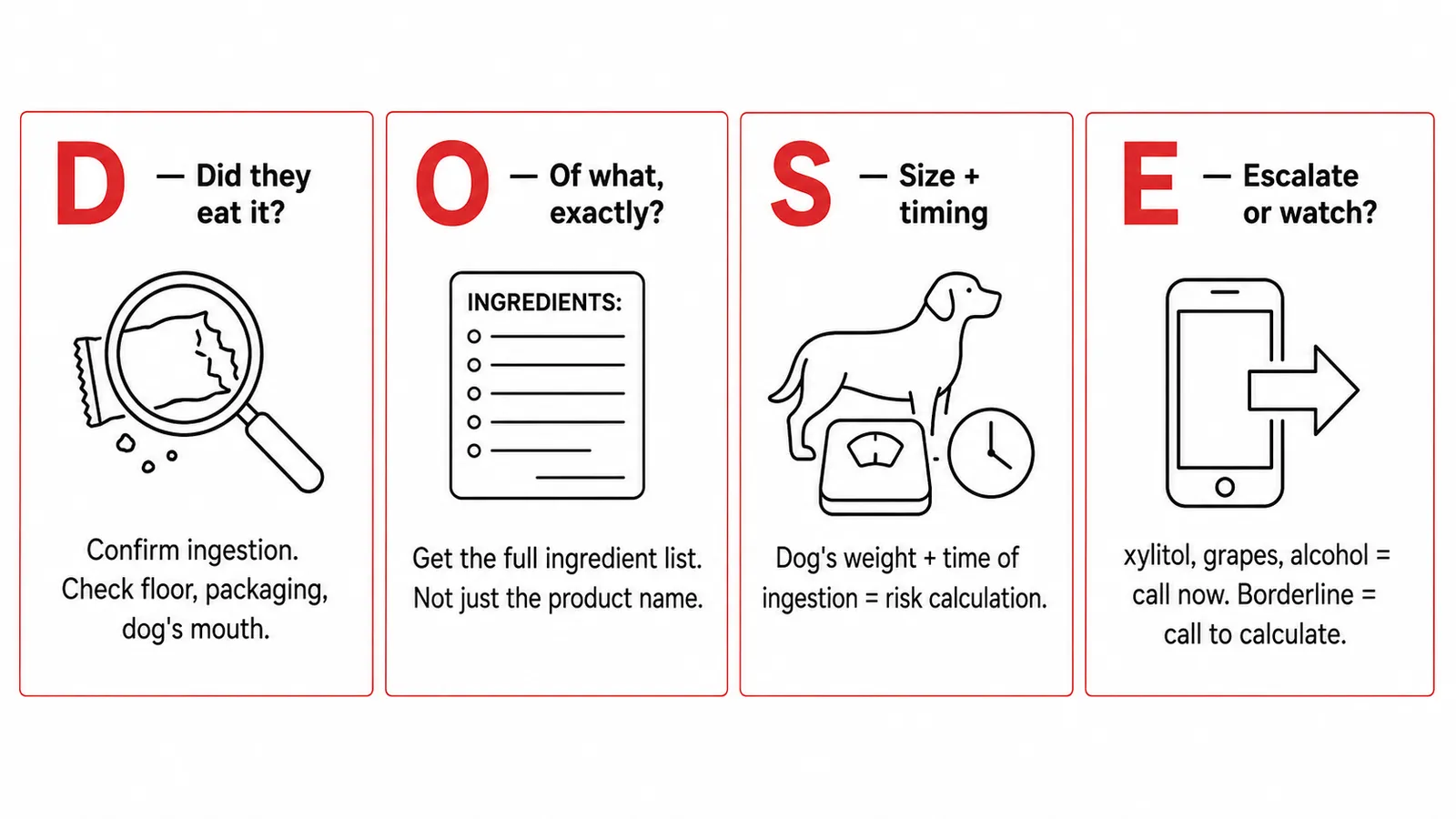
D, Did they actually eat it, and how much? Confirm ingestion and estimate quantity. Check the floor, the packaging, and your dog's mouth. A torn wrapper with crumbs is not the same as an empty bag. The amount consumed is the single most important factor in determining risk.
O, Of what, exactly? Identify the specific food and the full ingredient list. "Chocolate" and "dark baking chocolate" are not the same risk. "Peanut butter" and "xylitol-containing peanut butter" are not the same risk. The ingredient list on the packaging is what poison control needs, not the product name.
S, Size of your dog, and when did it happen? A 10-pound dog and a 70-pound dog face very different risk from the same quantity of chocolate. Time matters too: the first 30-60 minutes is the intervention window for most toxins. Know your dog's weight and the time of exposure before you dial.
E, Escalate immediately or watch? Based on D, O, and S, make a decision right now. For xylitol, grapes, alcohol, and raw dough: escalate immediately. For borderline exposures: call poison control to calculate the threshold. Never choose "wait and see" without a professional calculation, that call takes five minutes.
What Do I Do in the Next 10 Minutes?
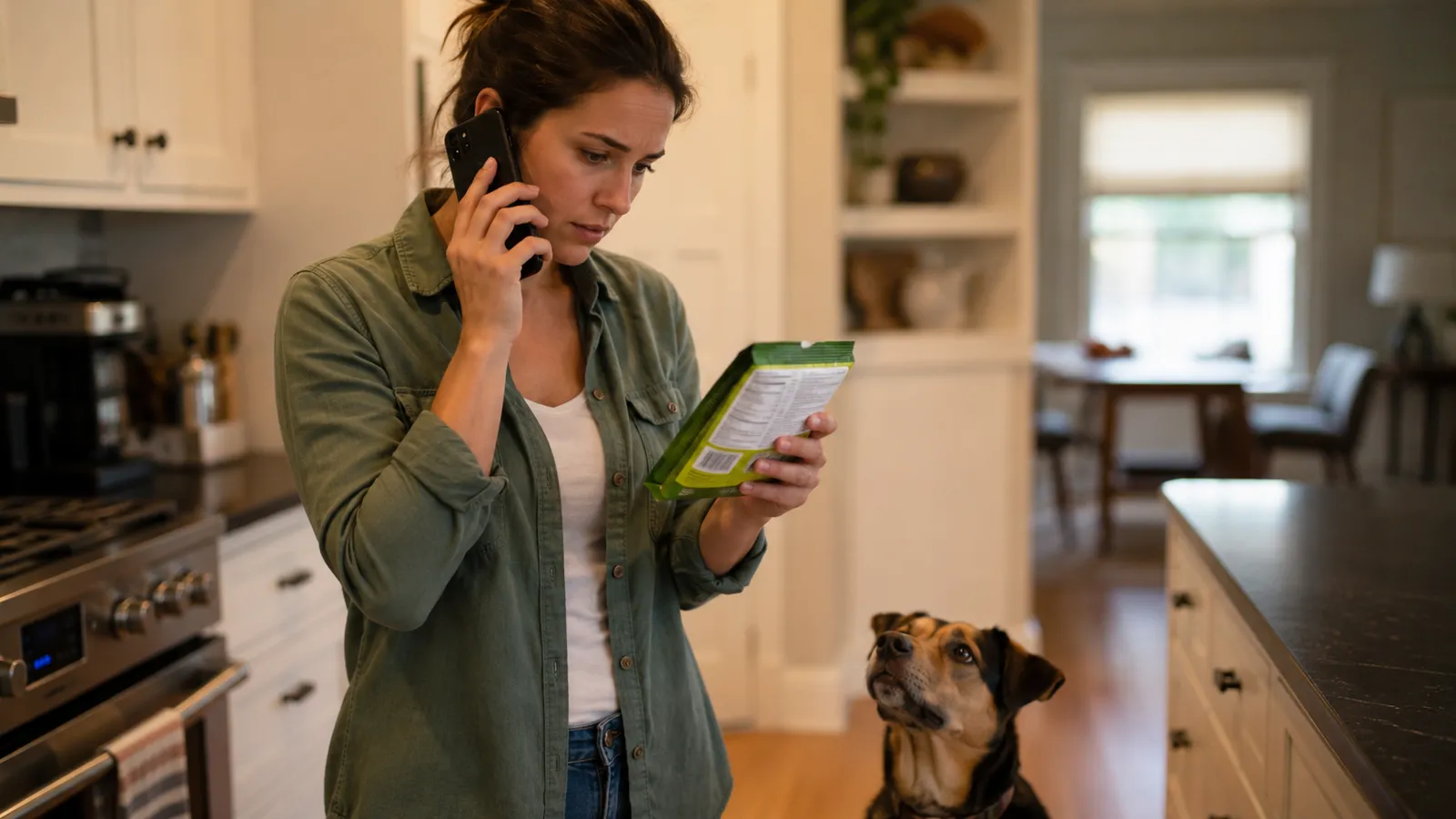
- Secure the food source. Put the food out of reach immediately. You need accurate packaging information and cannot have more ingestion happening while you're on the phone.
- Collect the packaging and read the full ingredient list. ASPCA Animal Poison Control needs the product name, ingredients, and your best estimate of the amount consumed.
- Call ASPCA Animal Poison Control (888-426-4435) or Pet Poison Helpline (855-764-7661). These lines are 24/7. A consultation fee applies, but the specialist will tell you whether this requires an emergency vet right now. Do not rely on internet searches to make this call.
- Have your dog's weight and the ingestion time ready. The specialist will use these to calculate whether the dose crosses a toxic threshold. Estimates are fine.
- Do not induce vomiting, give milk, or give bread without instruction. For xylitol ingestion, inducing vomiting can accelerate a hypoglycemic crash. For yeast dough, any delay worsens bloat. Follow the poison control specialist's instructions only.
- Watch for these specific signs while you wait: vomiting, tremors or muscle weakness, pale or white gums, excessive drooling, loss of coordination, labored breathing, or collapse. If any of these appear before you reach a vet, go to the nearest emergency clinic immediately. For vomiting or diarrhea after eating, note the timing and frequency to report accurately.
Which Foods Cause Problems Without Being True Poisons?
| Food | Main risk | Why owners underestimate it | What to do |
|---|---|---|---|
| Fatty scraps and skin | Pancreatitis | Owners assume "natural" food is safe; one rich meal can trigger a serious attack | Avoid all fatty table scraps; if vomiting and abdominal pain develop, see a vet same day |
| Cooked bones | Splintering causes GI perforation or obstruction | Cooked bones look identical to raw but are far more brittle | No cooked bones; if swallowed, watch for gagging, pain, or inability to defecate |
| Dairy products | GI upset (diarrhea, vomiting) | Dogs show no immediate reaction to small amounts | Limit or eliminate; if GI symptoms develop, withhold dairy and monitor |
| High-salt snacks | Salt toxicity (vomiting, tremors, seizures in large doses) | A few chips seem harmless; cumulative exposure is the real risk | No chips, pretzels, or salted popcorn; seek care if lethargy or tremors appear |
| Corn on the cob | Intestinal obstruction (the cob, not the kernels) | Dogs often swallow large chunks whole; kernels pass safely but the cob does not | Emergency vet if you suspect cob ingestion; watch for vomiting and inability to pass stool |
| Raw yeast dough | Stomach bloat and alcohol toxicity (this appears in both tables because the risk is severe) | Danger develops inside the dog invisibly after ingestion | Treat as an emergency, call poison control immediately |
When Should I Go to an Emergency Vet vs. Call My Regular Vet?
Go to emergency vet now
- Your dog is showing tremors, seizures, collapse, or loss of consciousness
- Your dog ate xylitol, grapes, raisins, alcohol, or raw yeast dough, regardless of whether symptoms have appeared
- Gums are pale, white, or blue-tinged
- Your dog is vomiting repeatedly and cannot stand steadily
- Your dog ate a corncob or bone fragment and is retching without producing anything
- Your dog has stopped producing urine following any grape or raisin exposure
Call your vet or poison control today
- Your dog ate a borderline amount of chocolate (milk chocolate, large dog, small quantity) and is currently asymptomatic
- You found evidence of onion or garlic ingestion but the amount was small and ingestion was over an hour ago
- Your dog is showing early signs of kidney damage, increased thirst, decreased urination, or lethargy, following any grape or raisin exposure in the last 72 hours
- You're unsure what your dog ate but found a chewed-up package
- Your dog ate avocado flesh only (not the pit) and has mild GI upset
Monitor at home, but call if anything changes
- Your dog stole a small lick of milk chocolate and weighs over 50 pounds
- Your dog ate a small piece of plain bread with no raisins or xylitol and is acting normally
- Your dog ate a small amount of non-sweetened dairy with only mild, soft stool
- Call immediately if vomiting becomes frequent, your dog becomes lethargic, or gums change color
Quick answers
What should I do if my dog just ate something toxic?
Call ASPCA Animal Poison Control (888-426-4435) or Pet Poison Helpline (855-764-7661) immediately. These are 24/7 lines. Before calling, find the packaging and note the food, estimated quantity, and your dog's weight. Do not induce vomiting, give home remedies, or wait for symptoms, many toxins cause organ damage before a dog looks sick.
Is a small amount of chocolate or grapes dangerous for a large dog?
For grapes and raisins: yes, a single grape has triggered acute kidney failure in some dogs and there is no known safe dose. Call poison control regardless of quantity. For chocolate: risk is dose-dependent and a large dog who licked a small amount of milk chocolate may be below the toxic threshold, but you should still call with the chocolate type, approximate quantity, and your dog's weight so the specialist can calculate the actual risk.
Are onions and garlic toxic to dogs even when cooked?
Yes. Cooking does not neutralize the organosulfur compounds that cause oxidative damage to red blood cells. All forms, raw, sautéed, roasted, and powdered, are toxic. Powdered forms are more concentrated than fresh. The damage is cumulative, meaning repeated small exposures add up. Symptoms like lethargy and pale gums can take 24-72 hours to appear.
Should I make my dog vomit at home after eating something toxic?
No, not without explicit instruction from a vet or poison control. For xylitol ingestion, inducing vomiting can accelerate a dangerous blood sugar crash. For yeast dough, the sticky mass rarely comes up and the delay wastes intervention time. Call ASPCA Animal Poison Control (888-426-4435) first. If vomiting is appropriate, they will tell you how to do it safely.
What is the most dangerous hidden ingredient in everyday foods?
Xylitol. It appears in sugar-free gum, some peanut butters, baked goods, vitamins, mouthwash, and toothpaste. In dogs, xylitol triggers the pancreas to release a massive insulin surge, causing blood glucose to crash within 10-60 minutes. Liver failure can follow at higher doses. Unlike chocolate, where size and dose determine risk, even a small amount of xylitol can be fatal in a small dog. Read ingredient labels on anything you give your dog.
This article is for informational purposes only and does not replace professional veterinary advice. If you believe your dog has ingested a toxic substance, call ASPCA Animal Poison Control at 888-426-4435 or Pet Poison Helpline at 855-764-7661 immediately.
Sources
- People Foods to Avoid Feeding Your Pets, ASPCA Animal Poison Control Center
- Xylitol Toxicosis in Dogs, Toxicology, Merck Veterinary Manual
- Chocolate Toxicosis in Animals, Toxicology, Merck Veterinary Manual
- Garlic and Onion (Allium spp) Toxicosis in Animals, Toxicology, Merck Veterinary Manual
- Grape, Raisin, and Currant Poisoning in Dogs, VCA Animal Hospitals
- Xylitol Poisoning in Dogs, VCA Animal Hospitals
- Can Dogs Eat Onions?, American Kennel Club
- Xylitol Poisoning Symptoms in Dogs, Pet Poison Helpline