
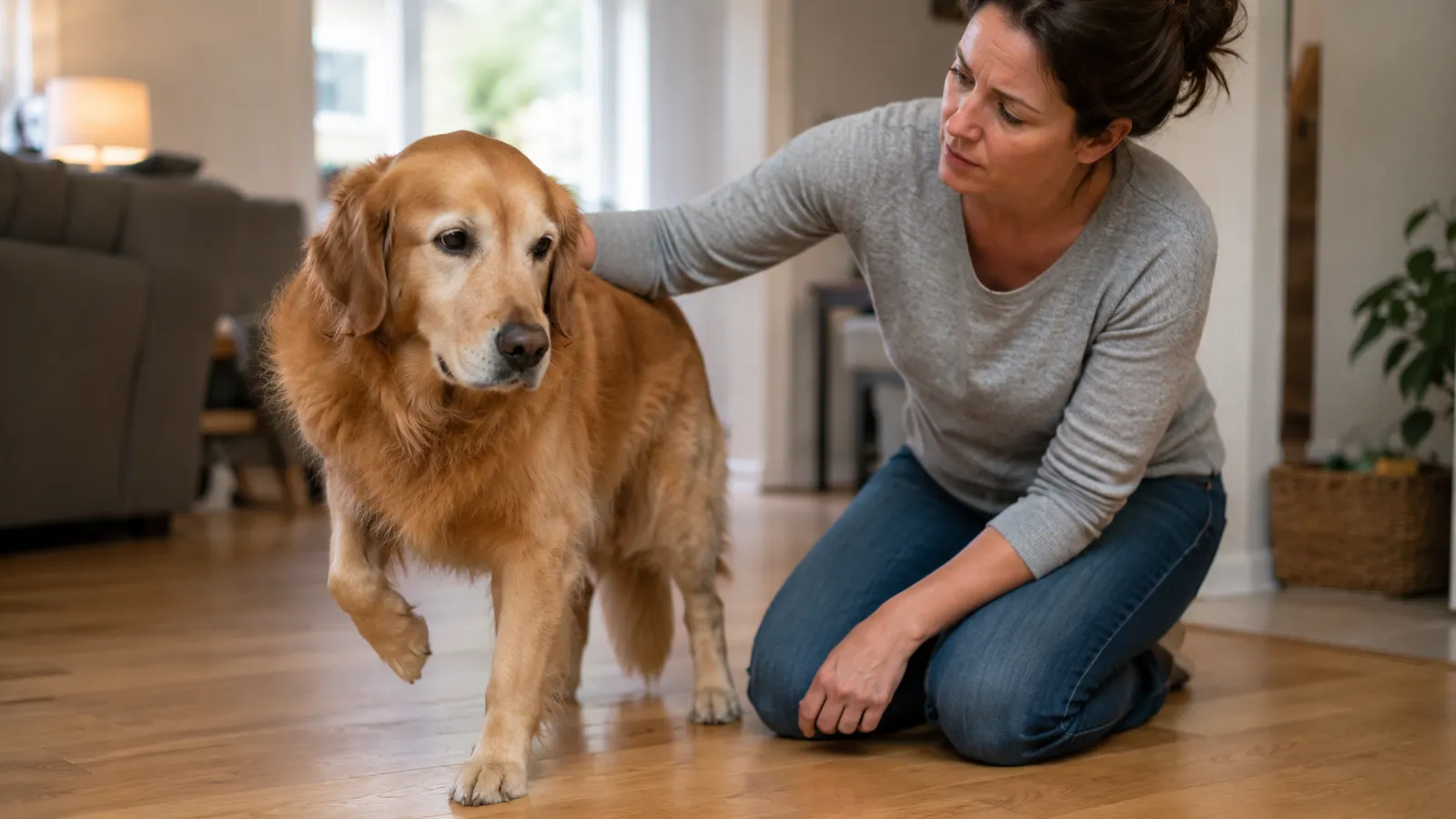
Dog Limping Front Leg: A Calm, Practical Guide to Causes, Red Flags, and Next Steps
A front-leg limp is one of those things that can mean almost nothing or quite a lot, depending on a handful of specific details. Most of the time, a mild limp, dog still putting weight on the leg, no obvious trauma, you are looking at something minor and a night of restricted rest is a reasonable first response. But a dog that won't touch the leg to the ground, is worsening by the hour, or has just come through a fall or collision is a different situation entirely. That dog needs a vet today, not tomorrow.
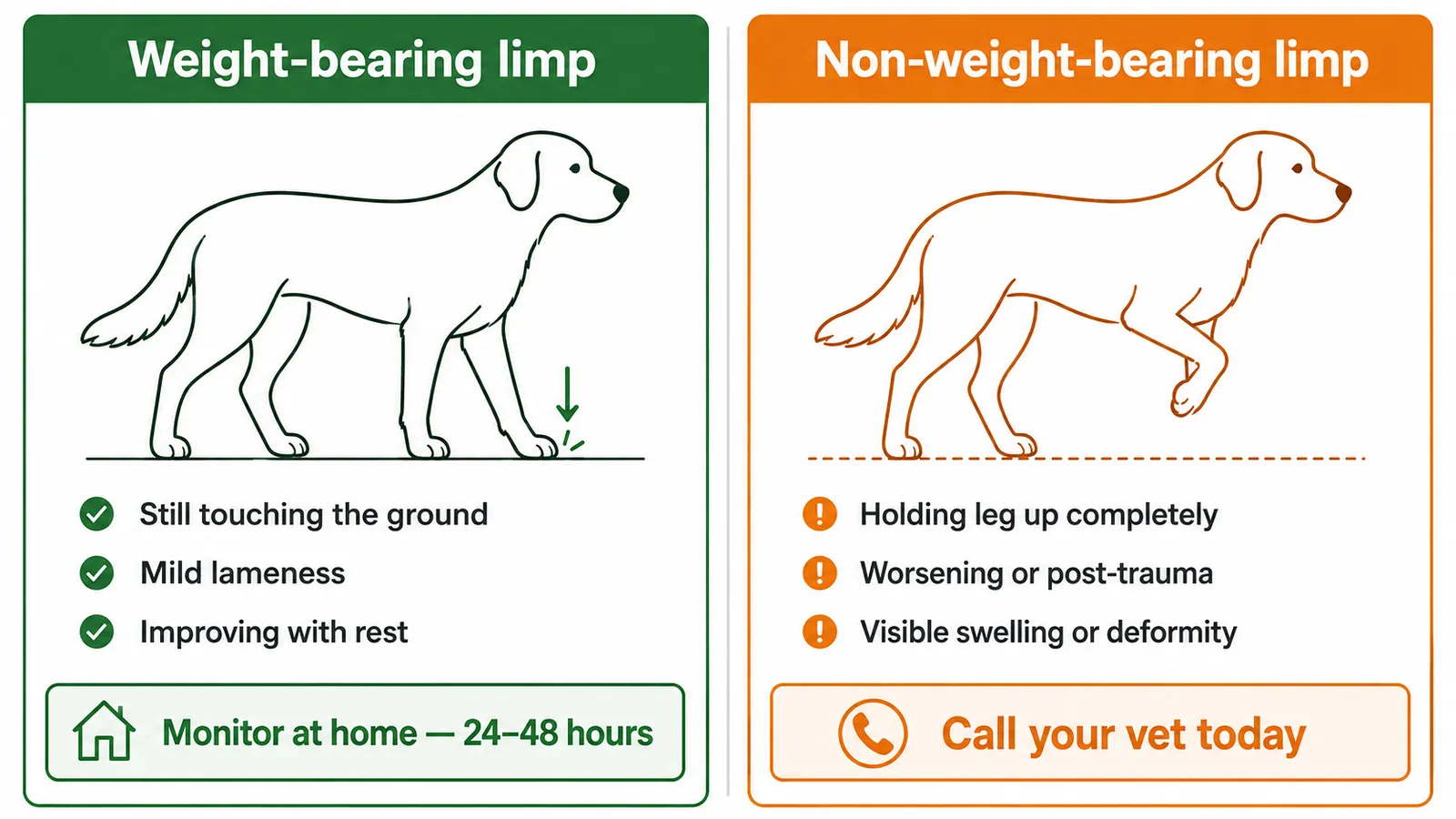
The short version: mild + weight-bearing + improving = watch carefully at home for up to 48 hours. Non-weight-bearing, worsening, or tied to a known injury = don't wait.
Before you do anything else
- A dog that is still putting some weight on the limping leg can reasonably be monitored at home for 24-48 hours, but only if the limp is clearly improving, not just staying the same.
- Never give your dog ibuprofen, acetaminophen, aspirin, or any other human pain medication; even a single dose can cause serious harm.
- Restrict activity completely in the first 24 hours, no fetch, no stairs, no off-leash time, even if your dog seems fine.
- A dog that eats normally, greets you at the door, and acts cheerful can still have a real injury; dogs are wired to hide pain, and normal behavior is not a green light to skip the vet.
- If the limp is non-weight-bearing, came on after a trauma, or is getting worse rather than better, those are same-day vet signs, don't try to wait it out.
How urgent is a front-leg limp?
The first question is always: is the dog putting any weight on that leg at all?
A dog that is limping but still touching the foot to the ground, bearing some load, even gingerly, has what vets call a weight-bearing lameness. That usually means the injury is somewhere on the milder end of the spectrum. Strict rest for 24 hours is reasonable, and if the limp visibly improves over that window, you can continue monitoring at home.
A dog that holds the leg completely off the ground, not touching it down at all, even briefly, is a different situation. That level of pain or mechanical problem warrants a same-day vet visit. So does any limp that starts mild but gets measurably worse over a few hours, any limp that follows a fall, car accident, or rough collision, and any case where you can see visible swelling or an abnormal angle in the limb.
Front legs deserve faster attention than owners sometimes expect. The front end of a dog carries roughly 60 percent of the body weight, so the structures in the front legs, the wrist (carpus), elbow, and shoulder, are under significant load. Damage there can escalate quickly if the dog keeps moving on it.
One thing worth knowing: a dog that still eats and greets you can still be hiding a real injury. Dogs are prey animals, and masking pain is instinct. Normal appetite and normal behavior are reassuring but they are not a reliable injury screen.
Rule of thumb: mild + weight-bearing + improving = watch at home. Anything else, call your vet.
What can cause a front-leg limp in dogs?
Most front-leg limps fall into a small number of categories, and the pattern of onset, weight-bearing status, and visible signs can help narrow things down before you even get to the vet.
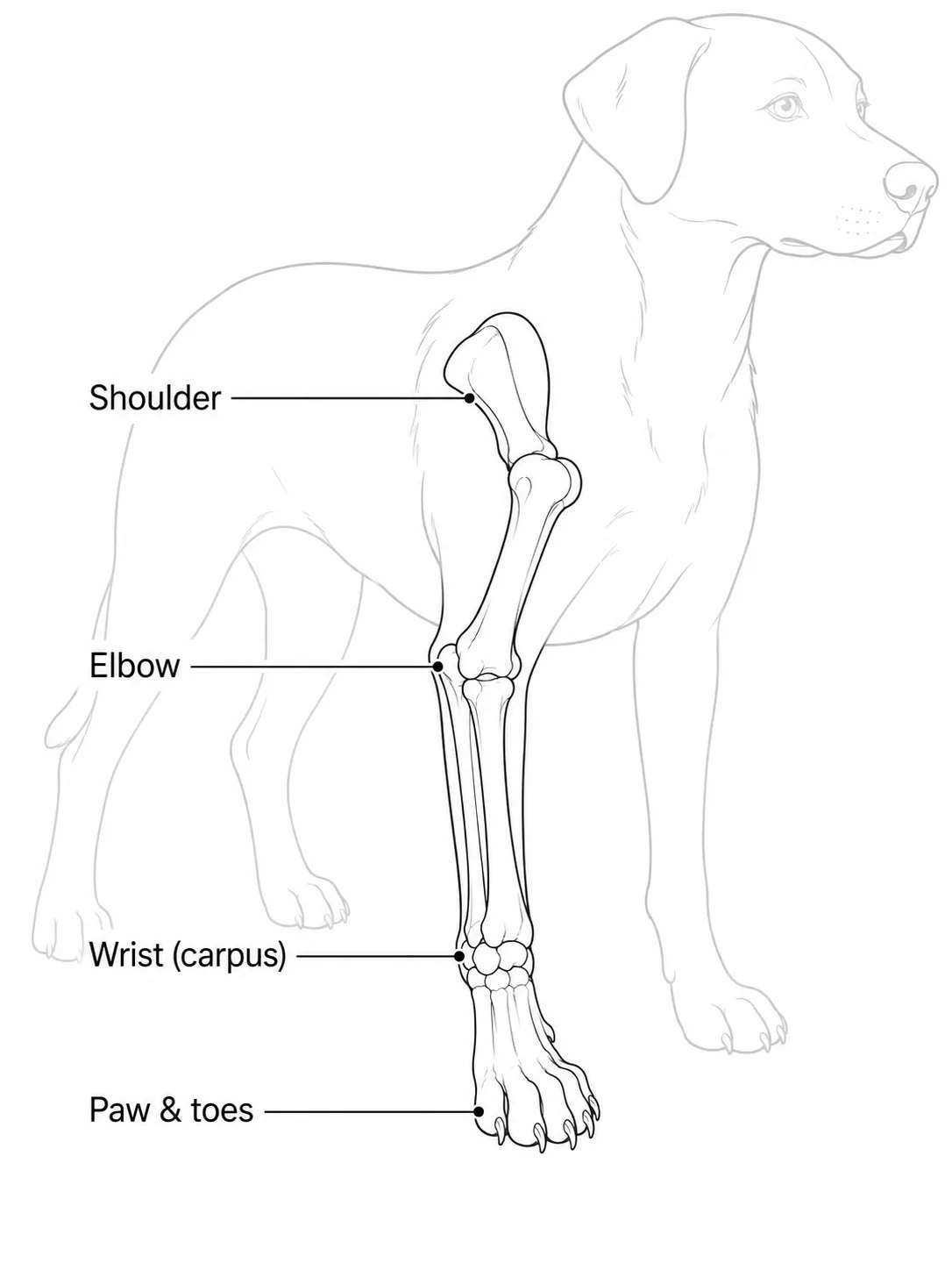
According to VCA Animal Hospitals, limping in dogs can result from anything from a minor paw irritation to a fractured bone, and the physical exam, starting at the paw and working upward, is how vets systematically identify the source. Triangle Animal Clinic notes that the location of the limp visible to the owner is not always the location of the underlying problem, which is why a full limb assessment matters even when the paw looks clean.
| Possible cause | Typical onset | Weight-bearing | Visible signs | Usual pain behavior | Right next step |
|---|---|---|---|---|---|
| Small cut, bruise, or pad irritation | Sudden, often after a walk | Usually yes | May see redness, swelling, or raw skin on pad | Licks the paw repeatedly | Clean gently; monitor 24 hours |
| Foreign object (thorn, grass awn, splinter) | Sudden, often post-walk | Usually yes, with hesitation | May see a puncture or swelling between toes | Constant licking, biting at paw | Inspect carefully; remove if safely accessible; vet if embedded |
| Broken nail or nail-bed injury | Sudden | Usually yes | Nail visibly cracked, hanging, or missing; bleeding at base | Licks base of nail, pulls foot away when touched | Keep clean; vet visit for nail removal or trimming |
| Sprain or strain | Sudden after activity | Yes, often with a distinct hitch | Usually no visible swelling early on | Quiet, less willing to jump or play | Strict rest 24-48 hours; vet if not improving |
| Soft tissue or joint injury (higher up the limb) | Sudden or gradual | Often yes, but worsening over hours | Possible swelling around wrist or elbow | May not be obvious; dog may still greet normally | Vet same-day if worsening; monitor closely if mild and improving |
| Fracture or dislocation | Sudden, usually after trauma | Usually no | Visible deformity, severe swelling, abnormal angle | Obvious distress, crying, or refusal to be touched | Emergency vet immediately |
| Elbow, wrist, or shoulder problem (structural) | Can be gradual | Variable | Swelling around the joint, stiffness after rest | Reluctance to go up stairs, less playful | Vet evaluation; may need X-rays |
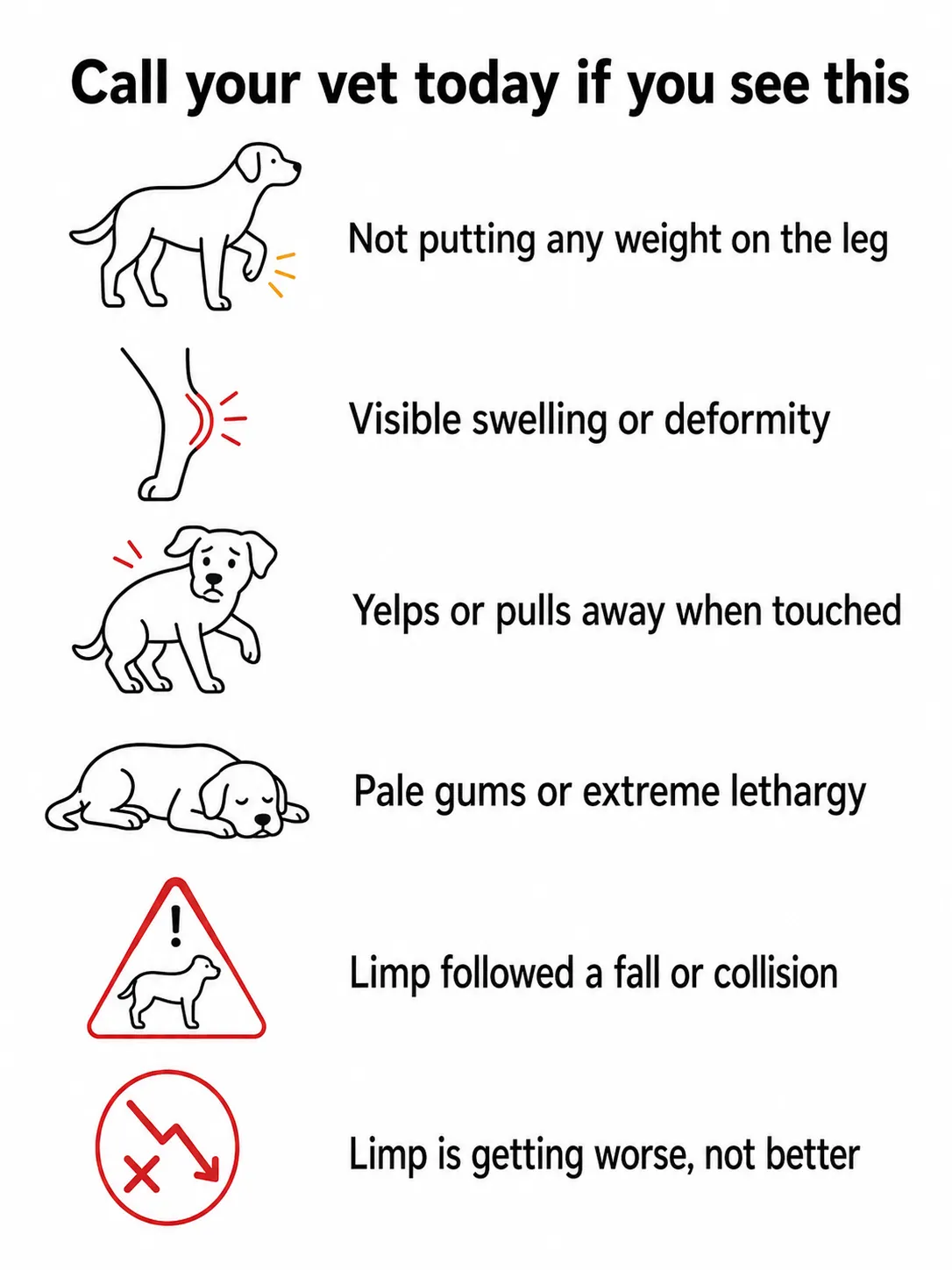
Signs that mean your dog needs a vet today
- The dog is not putting any weight on the front leg at all, holding it up completely.
- There is visible swelling, an abnormal angle, or a limb that looks deformed compared to the other side.
- The dog cries, yelps, or pulls away sharply when you touch the leg or paw.
- The dog shows any sign of shock: pale or white gums, extreme lethargy, rapid or labored breathing.
- The limp came on after a known trauma, a fall, a collision, being hit by a vehicle or bicycle.
- The limp started mild but has gotten noticeably worse over the past few hours rather than improving.
One final reminder here: a dog acting normally does not mean the injury is minor. Vets see dogs every day who were cheerful and eating well hours before a fracture diagnosis. If any of the signs above are present, normal behavior is not a reason to wait.
What to do in the first 24 hours
- Restrict activity immediately. No running, no fetch, no stairs, no jumping on or off furniture. Leash-only potty walks, short, slow, and on a flat surface. Keep this up for the full 24 hours even if the dog seems to feel better.
- Inspect the paw carefully. Lift the foot gently and check between the toes, the pads, and the base of each nail. Look for cuts, swelling, embedded objects, redness, or a cracked nail. Use good light.
- Track weight-bearing over time. Check in every few hours, is the dog putting more weight on the leg, the same, or less? Improvement is the word to focus on. A dog that is neither better nor worse after 24 hours is not getting better.
- Note appetite and overall energy. Write it down if you can: eating normally, not eating, less active than usual, seeking more rest. This information is useful for the vet if you do end up calling.
- Give no human pain medication. Not ibuprofen, not Tylenol, not aspirin. All three are toxic to dogs. If your dog needs pain management, that is a vet conversation.
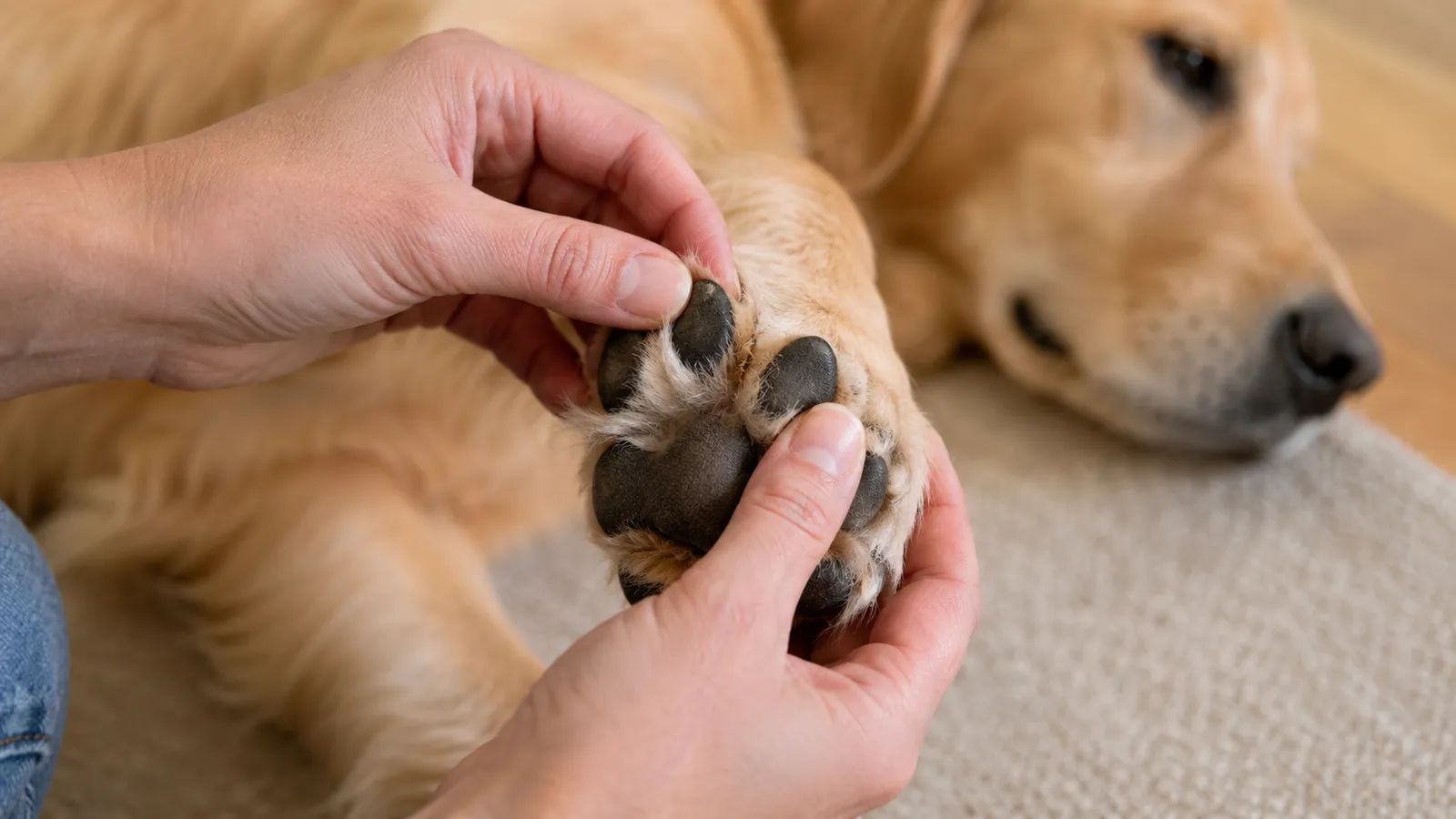
The most common mistake I see owners make, and one I made myself, is letting the dog have a short walk to "test the leg" after an hour or two of rest. The first time Barnaby came in from a morning run holding his left front leg, I let him walk a loop around the garden to see how he moved. His limp was visibly worse within the hour. Soft tissue injuries respond very poorly to activity, even a little. Rest means rest.
How vets diagnose a front-leg limp
When you bring a dog in with a front-leg limp, the vet's first step is usually observation, watching the dog move across the floor or down a hallway to see which leg is affected and how severe the lameness is. From there, the physical exam typically works from the ground up: paw, wrist (carpus), elbow, shoulder.
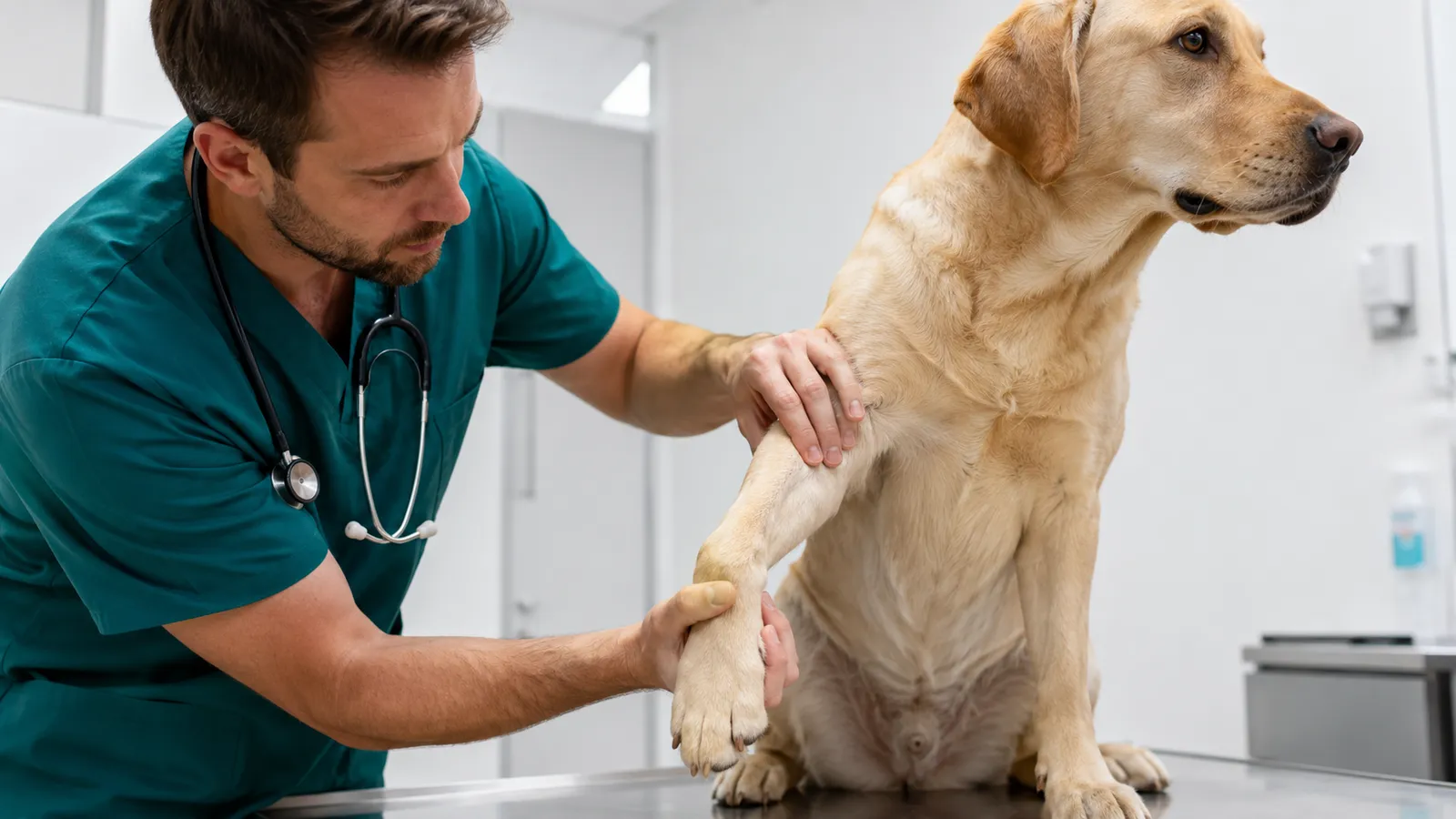
This paw-to-shoulder approach matters because the location of the visible limp and the location of the underlying problem are not always the same. A dog compensating for an elbow problem may look like it is favoring the paw. Checking each joint separately, feeling for swelling, heat, pain response, and range of motion, helps the vet localize where the problem actually originates.
If the physical exam does not clearly identify the source, or if there is reason to suspect a fracture, ligament damage, or a joint problem, X-rays are the usual next step. Soft tissue injuries that don't show on X-ray may prompt additional diagnostics such as ultrasound or referral to a specialist.
For mild lameness with an obvious cause, a visible cut, a broken nail, the exam may be brief. For a dog with no obvious external injury but significant lameness, expect a more thorough assessment and possibly imaging.
Cause patterns and what usually happens next, quick reference table
| Pattern | What it often looks like | What makes it more likely | When not to wait |
|---|---|---|---|
| Paw foreign body | Sudden limp after a walk; dog licks and bites at paw; foot looks normal at a glance | Walking in grass, wooded areas, or gravel; thorn or grass awn season | Swelling between toes develops; dog won't let you near the foot; awn suspected (these migrate) |
| Small cut or pad irritation | Mild limp; visible mark on pad; dog still weight-bearing | Hot pavement, rough terrain, known cut | Bleeding won't stop; pad is deeply split; wound is deep or dirty |
| Broken nail | Sudden limp; nail visibly cracked or missing; bleeding at base | Caught on something; rough play | Nail is partially attached and pulling; base is very swollen or infected-looking |
| Sprain or strain | Limp appeared after activity or sudden movement; no visible injury; improving with rest | Running, jumping, rough play | Not improving at all after 24 hours of strict rest; worsening |
| Soft tissue or joint injury | Limp with mild swelling near wrist or elbow; worsens with activity | Older or active dogs; repetitive stress | Swelling increases; dog stops weight-bearing; limp is getting worse hour by hour |
| Fracture or dislocation | Non-weight-bearing; obvious deformity or abnormal angle; severe pain response | Any trauma: fall, collision, impact | Immediately, this is emergency care, not a wait-and-see situation |
When to monitor at home vs. when to stop waiting
Home monitoring is a reasonable choice in a narrow set of circumstances: the limp is mild, the dog is still putting clear weight on the leg, there is no sign of trauma or severe pain, and the limp is actually improving over the first 24 hours.
The key word is improving. Not stable, improving. A dog that is still limping to the same degree at hour 24 as at hour one is not recovering on its own schedule. That is a dog that needs a vet visit, not another day of watching.
The pattern that should change your decision fastest is sudden escalation: a dog who had a mild limp in the morning and is holding the leg off the ground by the afternoon. That shift, mild to non-weight-bearing, is not a wait-and-see sign. That is a call-the-vet-now sign.
For dogs who are clearly improving, putting more weight on the leg, less hesitation, acting more like themselves, continuing careful rest and monitoring through 48 hours is generally defensible. If improvement stalls or reverses at any point in that window, stop waiting and call.
Next steps if your dog is limping on a front leg
- Stop and restrict activity right now, no further exercise until you have assessed the situation.
- Do a brief paw inspection, check pads, between toes, and nails for anything obvious.
- Assess weight-bearing, is the dog touching the foot to the ground at all? If no: call the vet today.
- If weight-bearing and no obvious trauma: enforce strict rest for 24 hours and monitor closely for improvement.
- Call your regular vet same-day if the limp is worsening, there is visible swelling or deformity, or the dog seems painful at rest. Go to an emergency clinic if it is outside regular hours and the dog is non-weight-bearing, in obvious distress, or the limp followed a trauma.
Questions that come up a lot
Why is my dog limping on a front leg but acting normal?
Dogs are remarkably good at hiding pain, it is a behavioral adaptation, not a choice. A dog that is eating well, greeting you normally, and appearing cheerful can still have a sprain, a soft tissue injury, or even a fracture. Normal behavior tells you the injury is not so severe that the dog is in constant visible distress, but it does not tell you the injury is minor.
If the limp is mild and the dog is still putting weight on the leg, watching carefully for 24-48 hours with strict rest is reasonable. If the limp came on after a known impact, if it is getting worse rather than better, or if the dog eventually stops bearing weight on the leg at all, see a vet regardless of how otherwise normal the dog appears to be.
Should I let my dog walk if they are limping on a front leg?
Leash-only, short, slow potty walks are acceptable. That is the limit. No fetch, no running, no stairs, no jumping on or off furniture or the car. The instinct to let a dog "walk it off" with a quick loop around the block is understandable, but it often makes soft tissue injuries worse. Activity during the first 24 hours can turn a minor sprain into something that takes weeks to heal. Keep the dog rested even if they seem willing and eager to move.
How long should I wait before taking a limping dog to the vet?
For a mild, weight-bearing limp with no trauma history: 24-48 hours of strict rest is a reasonable window, as long as the limp is actively improving, not just holding steady. If there is no clear improvement at 24 hours, call your vet. If the limp is worsening at any point, or the dog was involved in a trauma, do not wait at all. And if your dog is showing signs of pain at rest, restless, unable to settle, crying, don't try to wait overnight.
Can a front-leg limp be caused by a paw problem even if the paw looks fine?
Yes, and the source can also be well above the paw, at the wrist, elbow, or shoulder. A visually clean paw does not rule out a foreign body deep between the toes, a nail-bed injury, or a pad bruise with no surface break. And a paw that looks completely normal can still belong to a dog whose elbow or shoulder is the actual problem. Vets examine the whole limb precisely because the location of the limp and the location of the injury are not always the same place.
Is a sudden front-leg limp always an emergency?
Not automatically, but sudden onset deserves more caution than a limp that has been gradually developing. A limp that appears in a single moment, during a run, a jump, or after a collision, can range from a minor paw issue to a fracture. What makes it an emergency is the combination of factors: non-weight-bearing, known trauma, visible deformity or swelling, or a dog that seems to be in pain even at rest. A sudden mild limp in a dog still bearing weight can often be monitored for a short period. A sudden severe limp with any of those features should be treated as urgent.
This article is for educational purposes only. Emily Harper is not a veterinarian. Always consult a licensed veterinarian if you are concerned about your dog's health or if symptoms are severe, worsening, or tied to a known injury.
Where this information comes from
- VCA Animal Hospitals, "Limping in Dogs" general causes, triage approach, and physical exam methodology. vcahospitals.com
- Triangle Animal Clinic, guidance on front-leg lameness evaluation and the importance of full-limb assessment. triangleanimalclinic.com
- Windsong Veterinary Hospital, practical guidance on home care for limping dogs and activity restriction. windsongvet.com
- GSVS Staten Island Veterinary Hospital, information on dog limping causes and when to seek emergency care. gsvs.com
- Southwest Florida Veterinary Specialists, veterinary specialist guidance on lameness evaluation and diagnostics. swfvs.com