
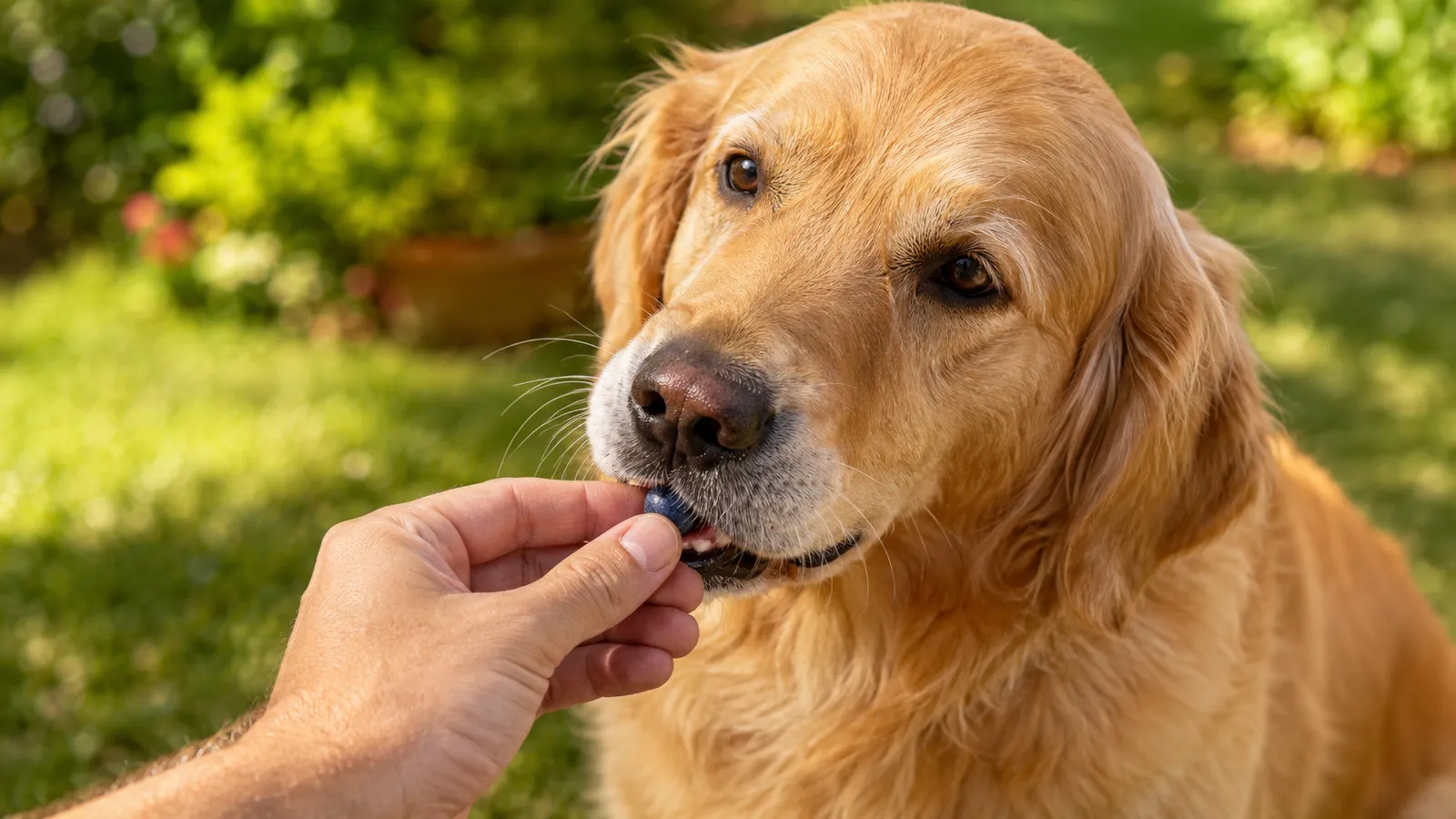
Can Dogs Eat Blueberries? Safe Amounts, Serving Tips, and When to Skip Them
Yes, dogs can eat blueberries, and for most dogs, they're one of the better treat swaps available. The exceptions worth knowing about before you hand over a handful: diabetic dogs require portion control and meal-timing awareness, dogs on prescription diets may need veterinary sign-off first, and fast eaters or small breeds have a choking consideration that changes how you serve them.
Blueberries at a glance
- Yes, blueberries are safe - one of the lowest-calorie, highest-antioxidant treat swaps you can make (a 10-berry serving is ~6 kcal vs. 68 kcal for a cube of cheese).
- Portion by size, not guesswork - from 3-5 berries for tiny dogs up to 40-50 for giant breeds, all staying within the 10% daily treat rule.
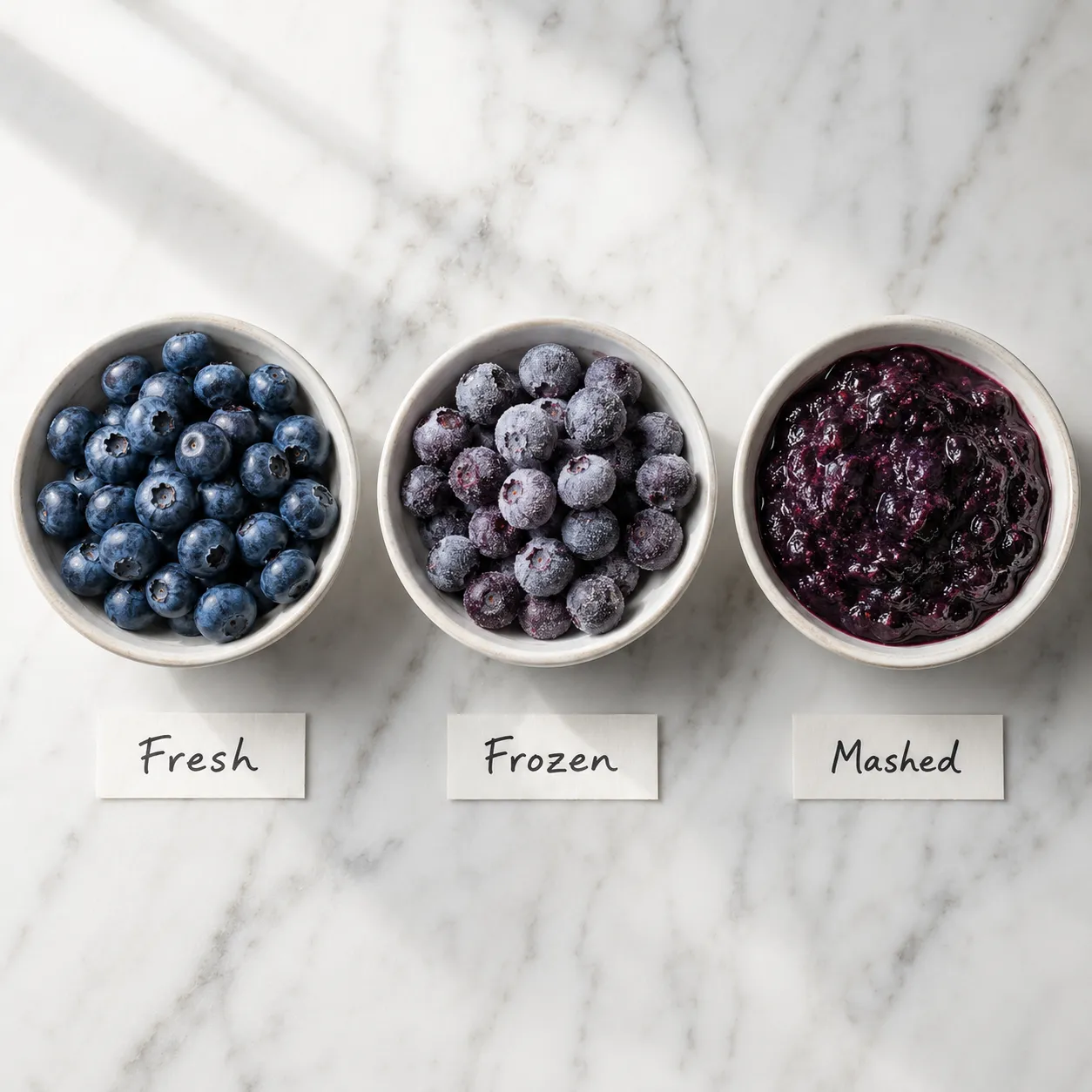
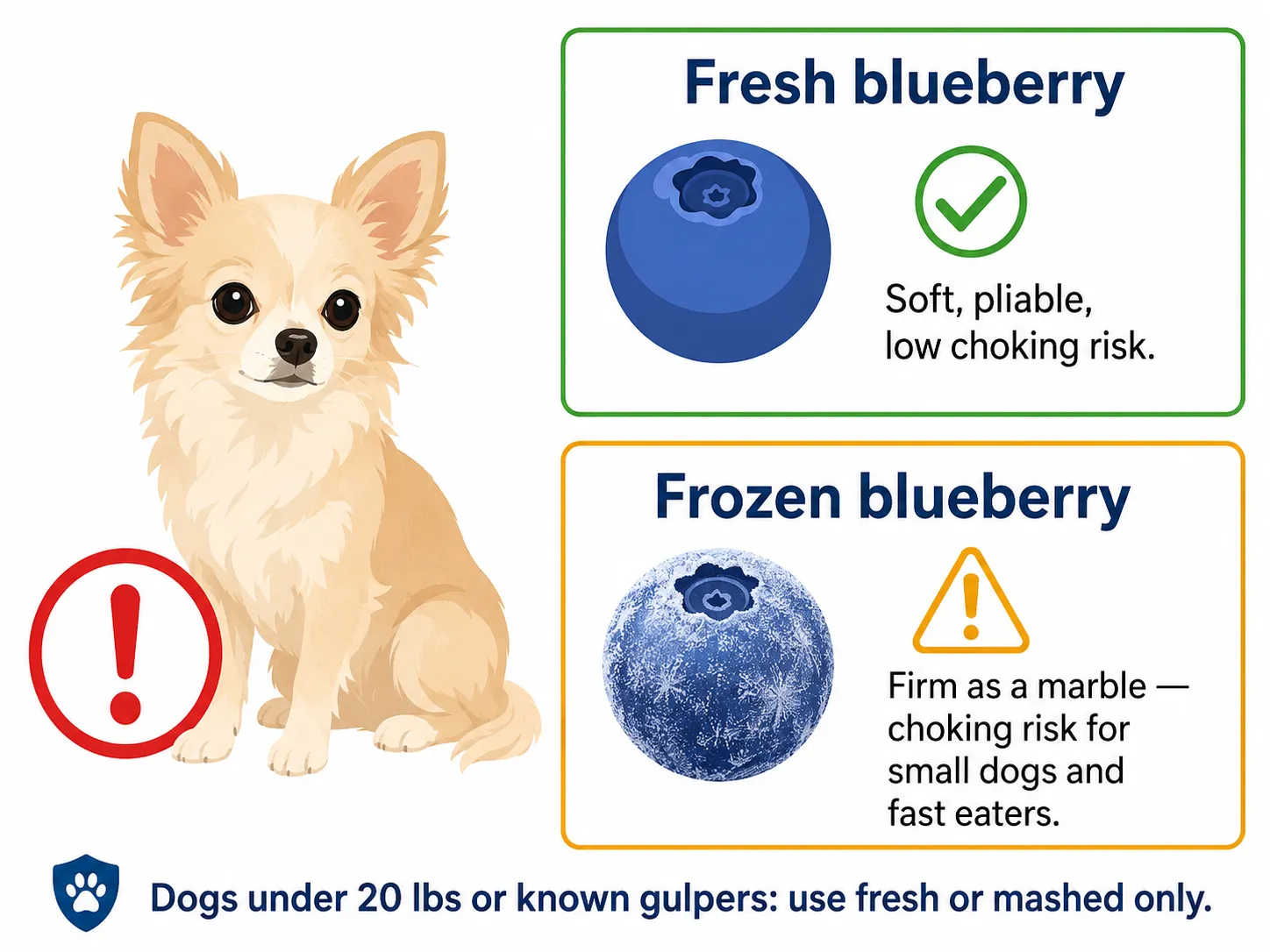
- Form matters more than the berry itself - fresh or mashed is safest; frozen whole berries are a choking risk for small dogs and fast eaters.
- Four groups need extra caution: diabetic dogs, dogs on prescription diets, puppies, and dogs with sensitive stomachs.
- Overeating isn't toxic, just messy - a GI upset (loose stool, gas) is the realistic risk, not poisoning; frozen-berry choking is the one true emergency.
- Daily feeding is fine - as long as it fits the treat budget and doesn't stack on top of other treats already given.
Why Blueberries Are Actually One of the Smarter Treat Swaps
Dog owners often tell us they're surprised by how many calories are hiding in "just a treat." The math matters more than people think, and a side-by-side comparison makes the case quickly.
| Treat | Typical Serving | Calories | Type | Notes |
| Blueberry (1 berry) | 1 berry (~0.7g) | ~0.6 kcal | Whole fruit | |
| Blueberry (10 berries) | 10 berries (~7g) | ~6 kcal | Whole fruit | Fiber, antioxidants, Vit C & K |
| Milk-Bone (small biscuit) | 1 biscuit | 20 kcal | Commercial biscuit | ~3-4× blueberry serving |
| Milk-Bone (mini biscuit) | 1 mini | 5 kcal | Commercial biscuit | Low-cal biscuit option |
| Cheddar cheese (1" cube) | ~28g / 1 oz | 68 kcal | Human food | 11× a 10-berry serving |
| Hot dog piece (small slice) | ~1/8 of a frank | ~15 kcal | Human food | High sodium; use sparingly |
| Zuke's Mini Naturals | 1 treat (3g) | 3.5 kcal | Training treat | Good low-cal commercial option |
| Pig ear strip | 1 strip (~1/4 ear) | ~55-70 kcal | Chew treat | ~9-11× a 10-berry serving |
Sources: Milk-Bone product pages; Zuke's product page; VCA Animal Hospitals treat guide; AAHA Pet Calorie Handout; Big Lu Natural Dog Treats calorie chart; USDA nutrition data for cheese; blueberry nutrition calculated from 84 kcal/cup ÷ ~140 berries/cup.
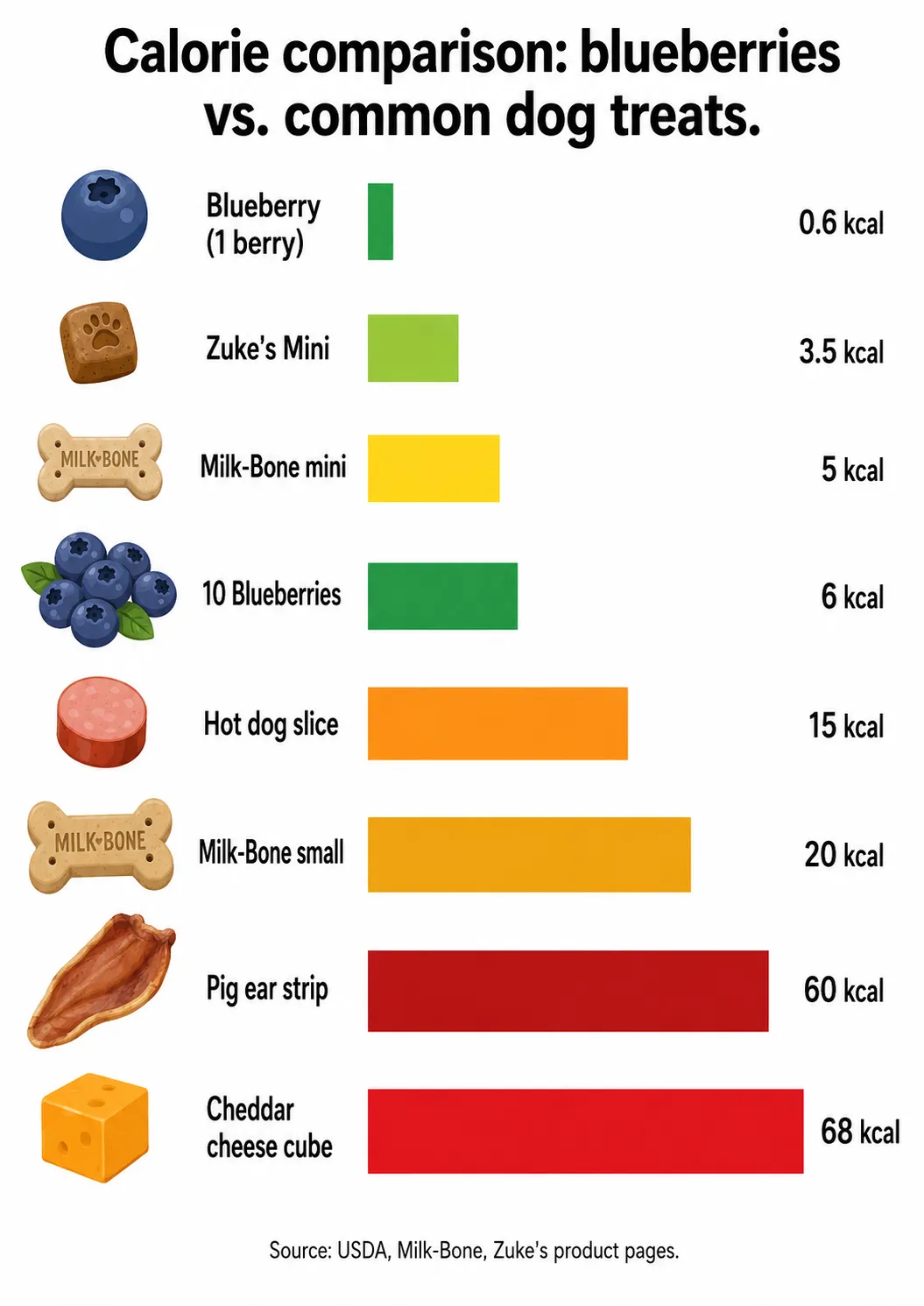
What does this actually mean for weight management? A 1-oz cube of cheddar, a common pill-hiding trick, delivers the same caloric hit as 110 blueberries. If your dog is on a weight-management plan or you train heavily with treats, substituting blueberries for high-calorie rewards can shave hundreds of calories per week without reducing the number of rewards your dog receives.
How Many Blueberries Can a Dog Eat? A Size-Based Guide
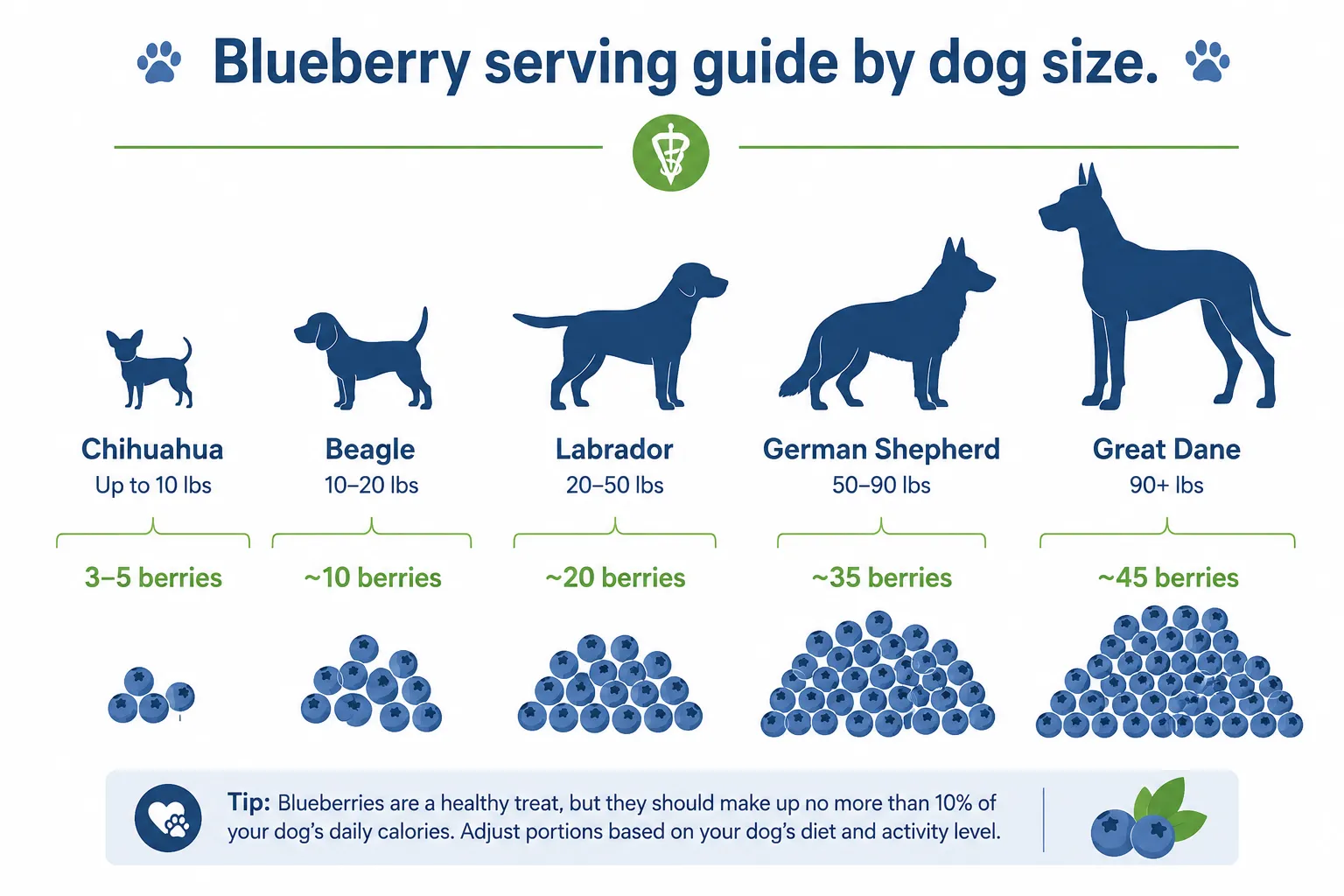
The right amount isn't just about weight, it's about keeping treat calories within a responsible daily budget. The table below shows serving guidance alongside approximate calorie impact so you can see what these numbers actually mean at mealtime.
| Dog Size | Weight Range | Max Serving | Approx. Cal Impact | Notes |
| Tiny | Under 10 lbs | 3-5 berries | ~2-3 kcal | Mash for gulpers; fresh only (no frozen) |
| Small | 10-25 lbs | ~10 berries | ~6 kcal (~1.6% of daily budget) | Fresh recommended; frozen with caution |
| Medium | 25-60 lbs | 15-25 berries | ~10-15 kcal (~1-2% of daily budget) | Fresh or frozen; supervise first time |
| Large | 60-100 lbs | 30-40 berries | ~18-24 kcal (~2-3% of daily budget) | Fresh or frozen OK for most |
| Giant | Over 100 lbs | 40-50 berries | ~24-30 kcal (~2% of daily budget) | Portion generously but don't exceed 10% treat rule |
| Diabetic / Rx diet | Any | 3-5 berries max | ~2-3 kcal | Vet approval required; see section below |
Understanding the 10% rule: Veterinary nutritionists and organizations including the VCA Animal Hospitals and the Pet Nutrition Alliance recommend that treats account for no more than 10% of your dog's daily caloric intake, with the other 90% coming from a complete, balanced diet.
Here's what that looks like in practice: A typical neutered adult dog weighing 20 lbs needs roughly 366 calories per day (based on veterinary RER calculations). Ten percent of that is 36.6 calories, the total treat budget for the day. A 10-berry blueberry serving uses only 6 of those calories, leaving room for other training rewards. By contrast, a single 1-oz cube of cheddar cheese (68 calories) blows the entire treat budget almost twice over.
Fresh, Frozen, or Mashed - Which Form Is Actually Safest?
| Form | Best For | Preparation | Safety Notes |
| Fresh (whole) | All dog sizes | Rinse, remove stems | Best default option; soft texture minimizes choking |
| Frozen (whole) | Medium to large dogs | Freeze plain; no sugar added | NOT recommended for small/toy breeds or fast eaters |
| Mashed / pureed | Tiny dogs, puppies, seniors | Fork-mash fresh berries | Easiest to digest; eliminate choking risk entirely |
| Mixed into kibble | Picky eaters | Stir in 2-3 fresh berries | Good intro method; easy to monitor portion |
| Dried / dehydrated | Training treats | Plain only - no added sugar | Check label carefully; some contain corn syrup or preservatives |
| Canned / in syrup | None - avoid | N/A | Excessive sugar; may contain xylitol - do not use |
| ★ | Field Note: One pattern we see often: owners offer frozen blueberries as a summer treat thinking the cold makes them safer or "harder to overeat." The opposite is true for small dogs and fast eaters - freezing transforms a soft, pliable berry into something with the firmness of a small marble. For a dog that doesn't chew, that's a choking hazard. If your dog is under 20 lbs or known to gulp rather than chew, stick to fresh or mashed berries year-round. |
When Blueberries Are the Wrong Choice for Your Dog

Diabetic dogs: Blueberries have a glycemic index of 53 - technically in the low range (below 55) - and a glycemic load of approximately 9.6 per cup, which is also low. What this means mechanically: the natural sugars in blueberries are absorbed slowly because they're packaged inside a fiber matrix, limiting the rate of glucose entering the bloodstream. However, "low GI" does not mean "zero impact." For a diabetic dog on an insulin protocol, any unplanned carbohydrate source between regulated meals can create a glucose fluctuation that works against the stability insulin therapy is trying to achieve. Three to five berries given consistently at the same time each day - ideally with a meal, not as an independent snack - is manageable for many diabetic dogs, but only with veterinary guidance specific to your dog's insulin dose and timing. The same logic applies to pre-diabetic dogs or those with metabolic syndrome.
Dogs on prescription diets: Prescription veterinary diets (kidney support, hepatic, urinary, hydrolyzed protein for allergies, etc.) are precision-formulated. Adding even a healthy whole food can shift mineral ratios - particularly potassium in kidney diets or fiber load in GI diets - in ways that matter for a dog with compromised organ function. Before offering blueberries to a dog on a prescription diet, one quick call to your veterinarian is worth it. The question to ask: "Does adding X berries per day interfere with the therapeutic target of this diet?"
Sensitive stomachs: Blueberries are moderately high in dietary fiber - a cup contains roughly 3.6 to 4 grams. For most dogs this is a minor positive. For a dog with an already-sensitive GI tract, irritable bowel, or a history of dietary-triggered diarrhea, an abrupt fiber increase can cause loose stools or gas. Introduce slowly: start with two or three berries and observe for 24 hours before increasing the serving.
Puppies: Blueberries are not toxic to puppies, and a few mashed berries are fine for a pup that's eating solid food. The concerns are about proportion, not toxicity. Puppies have smaller daily caloric budgets, and their digestive systems are still developing - what produces mild gas in an adult can cause significant GI upset in a puppy. Treats (including fruit) should not exceed 5% of a puppy's daily calories, and blueberries should be mashed or halved to avoid any choking risk on those tiny, still-forming airways.
Gulpers and fast eaters: Any dog that doesn't consistently chew before swallowing presents a choking risk with small, round foods regardless of breed size. If your dog inhales kibble rather than eating it, either mash the blueberries before serving or use a slow-feeder bowl so the berries can't be swallowed whole in rapid succession.
What to Do If Your Dog Ate Too Many Blueberries
Most "too many blueberries" situations are not emergencies - but the right response depends on what happened. Use the guide below.
| Small extra handful (10-30 extra berries) | Monitor for mild GI signs: loose stool, gas, or soft stool within 12-24 hours. This is the most likely outcome and typically resolves on its own. Withhold fruit treats for the next 24 hours. No vet visit needed unless symptoms persist beyond 24 hours or include vomiting. |
| Large amount (more than 1/2 cup) | Watch for repeated vomiting, diarrhea lasting more than 24 hours, lethargy, or loss of appetite. The high fiber content is the primary risk here, not toxicity - blueberries contain no compounds that are inherently dangerous to dogs. Call your vet if GI symptoms are severe or if your dog is small-breed and consumed a disproportionately large amount. |
| Frozen berries: now coughing or gagging | Treat as a possible airway obstruction. If your dog is actively gagging, pawing at the mouth, or showing distress, call your nearest emergency vet immediately. This is the highest-urgency scenario in this article. Do not wait to see if it resolves. |
| Diabetic dog on insulin: ate unapproved amount | Call your veterinarian the same day. An unplanned carbohydrate load between insulin doses can shift blood glucose in ways that may require monitoring or a dosing adjustment. Don't wait until the next scheduled visit. |
Blueberries vs. Other Dog-Safe Fruits - A Quick Comparison
Understanding where blueberries sit relative to other dog-safe fruits helps you make smarter swaps. Not every fruit is equal in calorie load, sugar density, or preparation complexity.
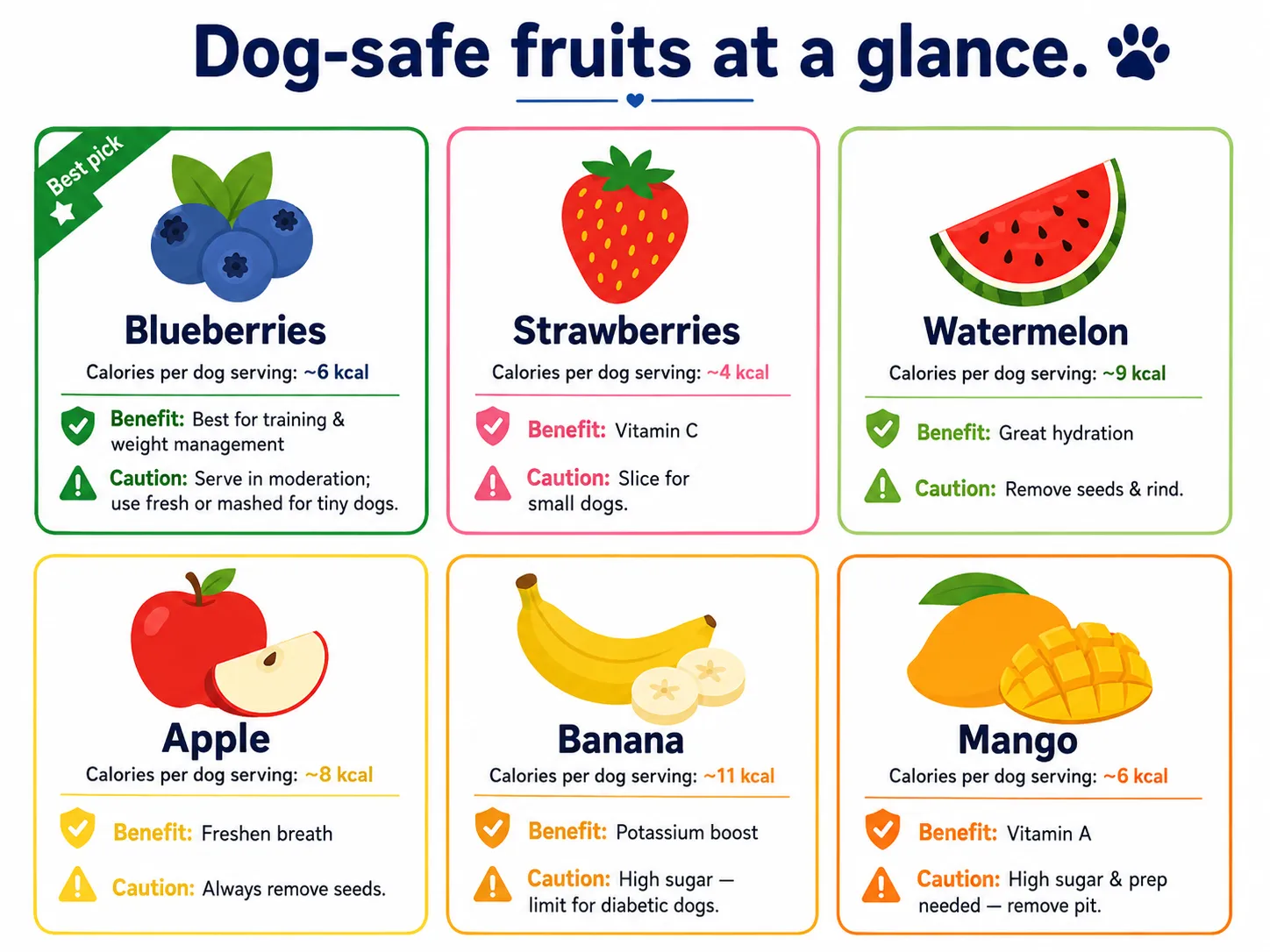
| Fruit | Safe? | Cal / Dog Serving | Main Benefit | Main Caution |
| Blueberries | ✓ Yes | ~6 kcal / 10 berries | Highest antioxidant (anthocyanins), very low sugar | Choking risk for small dogs (frozen form) |
| Strawberries | ✓ Yes | ~4-5 kcal / 1 berry | Vitamin C; natural tooth-whitening enzyme | Slice for small dogs; no hulls |
| Watermelon (seedless) | ✓ Yes | ~45 kcal / 1 cup diced | Excellent hydration (92% water); vitamins A, B6, C | Remove seeds and rind before serving |
| Apple (no seeds/core) | ✓ Yes | ~15 kcal / 2 slices | Fiber; vitamins A & C; helps freshen breath | Seeds contain trace cyanide - always remove |
| Banana | ✓ Yes (mod.) | ~25-30 kcal / 2 slices | Potassium; magnesium; good pill-hiding option | High natural sugar - limit for diabetic, overweight, or senior dogs |
| Mango (no pit/skin) | ✓ Yes (mod.) | ~25 kcal / 2-3 chunks | Vitamins A, B6, C, E; concentrated micronutrients | Very high sugar - avoid for diabetic dogs; pit is a choking hazard |
When does the blueberry win? When you're training, managing weight, or dealing with a small dog - blueberries are the better choice over banana or mango almost every time: lower calories, lower sugar, and no prep required (no seeds to remove, no rind to cut away). Strawberries are a close second. Watermelon earns its spot as a summer hydration treat for medium and large dogs, but the prep time and caloric density mean it doesn't replace blueberries as a daily reward. For a diabetic dog, blueberries are also the lower-risk fruit choice compared to banana or mango, though veterinary guidance is still required before including any fruit in that dog's diet.
Questions owners ask

Can dogs eat blueberries every day?
Yes, for most healthy adult dogs, a small serving of blueberries every day is fine - with one important condition: the serving must consistently fit within the 10% daily treat rule. If your 20-lb dog's treat budget is around 36 calories per day, 10 blueberries (6 calories) leaves room for other rewards.
The concern with daily fruit isn't toxicity - blueberries have none - it's cumulative sugar intake and caloric creep. If blueberries are replacing a higher-calorie treat you were already giving, daily is a straightforward upgrade. If they're being added on top of an existing treat routine, check the total treat calories before making it a daily habit.
For high-sugar fruits like banana or mango, daily feeding isn't advised. Blueberries' relatively low glycemic load makes them a better candidate for consistent daily use than most other fruits in the dog-safe list.
Are frozen blueberries safe for dogs?
It depends on your dog's size and eating style. Frozen blueberries are not toxic, but freezing transforms a soft berry into a firm, marble-like object that behaves differently in a dog's airway than a fresh berry. For medium and large dogs that chew before swallowing, frozen blueberries are generally fine as an occasional warm-weather treat.
For dogs under 20 lbs, toy breeds, or any dog known to gulp food, frozen blueberries present a meaningful choking risk that fresh berries do not. The safest approach for small dogs: stick to fresh, or allow frozen berries to thaw completely before serving.
One workaround for small dogs who love the cold texture: freeze a small amount of mashed blueberry in a silicone mold or spread it in a Kong. The dog gets the cold experience without the round, firm choking hazard.
Can puppies eat blueberries?
Yes, once they're eating solid food, but the portion guidance is different. Puppies should receive no more than 5% of their daily calories from treats (half the adult allowance), and blueberries should always be mashed or halved - their airways are smaller and still developing.
The nutrient profile of blueberries is fine for puppies - there's nothing in a fresh blueberry that's harmful to a developing dog. The caution is purely about proportion and texture. A puppy's primary nutrition should come from a complete, balanced puppy formula, not supplements or treats regardless of how healthy those treats are.
If your puppy is on a prescription puppy diet for a specific condition (growth disorder, early joint issues, etc.), check with your vet before adding any new foods, including fruit.
Are blueberries safe for dogs with diabetes?
It depends - and the nuance matters. Blueberries have a low glycemic index (GI 53) and a low glycemic load (~9.6 per cup), which means their natural sugars enter the bloodstream gradually rather than causing a sharp spike. For that reason, they're generally considered among the safer fruit options for diabetic dogs, and multiple veterinary nutrition sources suggest small portions can fit into a well-managed diabetic diet.
The key variable is meal timing and insulin schedule. Any carbohydrate source, even low-GI fruit, consumed between regulated meals or at an unplanned time can create a blood glucose fluctuation that insulin therapy isn't calibrated to cover. Three to five berries given consistently with a meal (not as a between-meal snack) is a manageable approach for many diabetic dogs.
This is one situation where "ask your vet" is not a filler answer - it's because your vet knows your dog's specific insulin protocol, dosing schedule, and current blood glucose stability. The general principle favors blueberries over higher-sugar fruits like banana or mango, but the specific amount and timing requires a conversation with the clinician managing the case.
What should I do if my dog ate a whole bowl of blueberries?
First: don't panic. Blueberries contain no compounds that are toxic to dogs the way grapes or raisins are. A whole bowl of plain blueberries is unlikely to cause a medical emergency. The realistic risk is a significant GI upset - loose stools, gas, vomiting, or diarrhea - from the high fiber load hitting a digestive system that wasn't accustomed to it.
Monitor your dog for 24 hours. Withhold additional treats and fruit for at least that period. If your dog is a small breed and consumed what amounts to a large portion relative to their body size, call your vet to discuss - not because blueberries are dangerous, but because a high-fiber hit can cause dehydration from diarrhea in small dogs.
If your dog has diabetes or is on a prescription diet and ate an unplanned bowl of blueberries, call your vet the same day. This is the one scenario where waiting doesn't make sense, as an unmonitored glucose fluctuation in a diabetic dog can have consequences that a quick phone call can help prevent.
Are wild blueberries safer or more dangerous than store-bought?
True wild blueberries are generally safe for dogs - and are actually denser in antioxidants than cultivated varieties, containing roughly twice the anthocyanins and up to 6 grams of fiber per cup compared to about 3.6 in cultivated berries. The concern with wild berries isn't the blueberry itself; it's misidentification.
Several toxic berries grow in similar habitats to wild blueberries and can look similar to an untrained eye. Holly berries, poke berries, and certain nightshade species are all dangerous to dogs and could plausibly be mistaken for wild blueberries in low light or at a glance. If you're foraging or hiking and want to share berries with your dog, visual identification by someone who knows local plant species is essential.
From a nutrition standpoint, store-bought blueberries (fresh or frozen, no added sugar) are the safer and more reliable choice simply because you know exactly what you're giving. Wild blueberries are fine if you're certain about identification; store-bought removes the guesswork entirely.
Sources
- AKC, Can Dogs Eat Blueberries? https://www.akc.org/expert-advice/nutrition/can-dogs-eat-blueberries/
- PetMD, Can Dogs Eat Blueberries? Benefits and Risks https://www.petmd.com/dog/nutrition/can-dogs-eat-blueberries
- Petco, Are Blueberries Safe for Dogs? Benefits & Feeding Guide https://www.petco.com/content/content-hub/home/articlePages/food-nutrition/can-dogs-eat-blueberries.html
- Purina, Can Dogs Eat Fruits and Berries? https://www.purina.com/articles/dog/nutrition/can-dogs-eat-fruits-and-berries
- VCA Animal Hospitals, Dog Treats https://vcahospitals.com/know-your-pet/dog-treats
- AAHA, Healthy Local Snacks for Pets (Calorie Handout PDF) https://www.aaha.org/wp-content/uploads/globalassets/05-pet-health-resources/nutritionalresources/petparent/aaha-healthy-local-snacks-for-pets.pdf
- Pupford, Treat Truth: The Sneaky Side of Calories in Dog Treats https://pupford.com/blogs/all/dog-treat-truth
- Milk-Bone, Original Small Biscuits https://www.milkbone.com/dog-treats/biscuits/original-biscuits-small
- Zuke's, Mini Naturals Product Page https://www.zukes.com/dog-treats-and-chews
- Big Lu Natural Dog Treats, Calorie Content on Popular Dog Treats https://big-lu.com/blogs/barkin-journal/calorie-content-on-popular-dog-treats
- Best Friends Veterinary Center, Calorie Requirements For Your Pet https://bestfriendsvet.com/library/calorie-requirements-for-your-pet/
- Pet Nutrition Alliance, Calorie Calculator & Treat Guidelines https://petnutritionalliance.org/resources/calorie-calculator/
- Houndsy, How Many Calories Should a 20 lb Dog Eat? https://www.houndsy.com/blogs/modern-tails/how-many-calories-should-a-20-lb-dog-eat-understanding-your-pups-nutritional-needs
- Aspens Animal Wellness, Worst Foods for Diabetic Dogs https://aspenanimalwellness.com/worst-foods-diabetic-dogs/
- Pet Sweets Lab, 5 Fruits Safe for Diabetic Dogs (Glycemic Index) https://petsweetslab.com/blogs/notes/safe-fruits-diabetic-dogs-glycemic-index
- Healthline, Diabetes and Blueberries: GI, Blood Sugar & Benefits https://www.healthline.com/health/diabetes-blueberries
- Preventive Vet, Safe and Unsafe Fruits For Dogs & Cats https://www.preventivevet.com/pets/safe-fruits-for-dogs-and-cats
- AKC, Fruits and Vegetables Dogs Can or Can't Eat https://www.akc.org/expert-advice/nutrition/fruits-vegetables-dogs-can-and-cant-eat/
- Mayo Clinic Health System, The Nutritional Power of Blueberries https://www.mayoclinichealthsystem.org/hometown-health/speaking-of-health/the-power-of-blueberries