

Best Food for Dogs With Sensitive Stomachs: How to Choose What Actually Helps
Choosing the best food for a dog with a sensitive stomach starts with understanding the pattern behind the symptoms. Occasional soft stool after a sudden food change may only require a simple, highly digestible formula and a slow transition, while recurring vomiting, diarrhea, gas, itching, or weight loss may point to a deeper issue that needs veterinary guidance. In this guide, you’ll learn how to identify what kind of diet makes sense for your dog, which ingredients are usually easier to digest, when an over-the-counter food may be enough, and when a prescription or hydrolyzed diet is the safer next step.
What this guide covers
- "Sensitive stomach" is a pattern, not a diagnosis, occasional upset calls for a simple fix, while recurring symptoms or GI issues paired with skin signs point toward something else (possible food allergy).
- The protein source matters less than recipe simplicity: a short ingredient list and low fat content are better signals than a "natural" label.
- The DIGEST framework (digestibility, ingredient simplicity, goal fit, ease of transition, symptom tracking, trial length) helps decide between an OTC formula, a limited ingredient diet, or a prescription hydrolyzed diet.
- OTC food resolves most mild cases; a hydrolyzed prescription diet only comes into play when skin signs appear alongside GI symptoms, or when simpler diets have already failed.
- The biggest reason a diet trial "doesn't work" usually isn't the food, it's contamination from treats, chews, table scraps, or flavored medications during the test period.
- Transitions should be gradual (7-10 days), and trials need real time: 1-2 weeks for early improvement on an OTC food, 6-8 weeks for a full hydrolyzed elimination trial.
- Some signs skip the "try a new food" step entirely and go straight to the vet: blood in stool, dehydration, repeated vomiting, refusal to eat for more than 24 hours, or significant weight loss.
What does "sensitive stomach" actually mean in dogs?
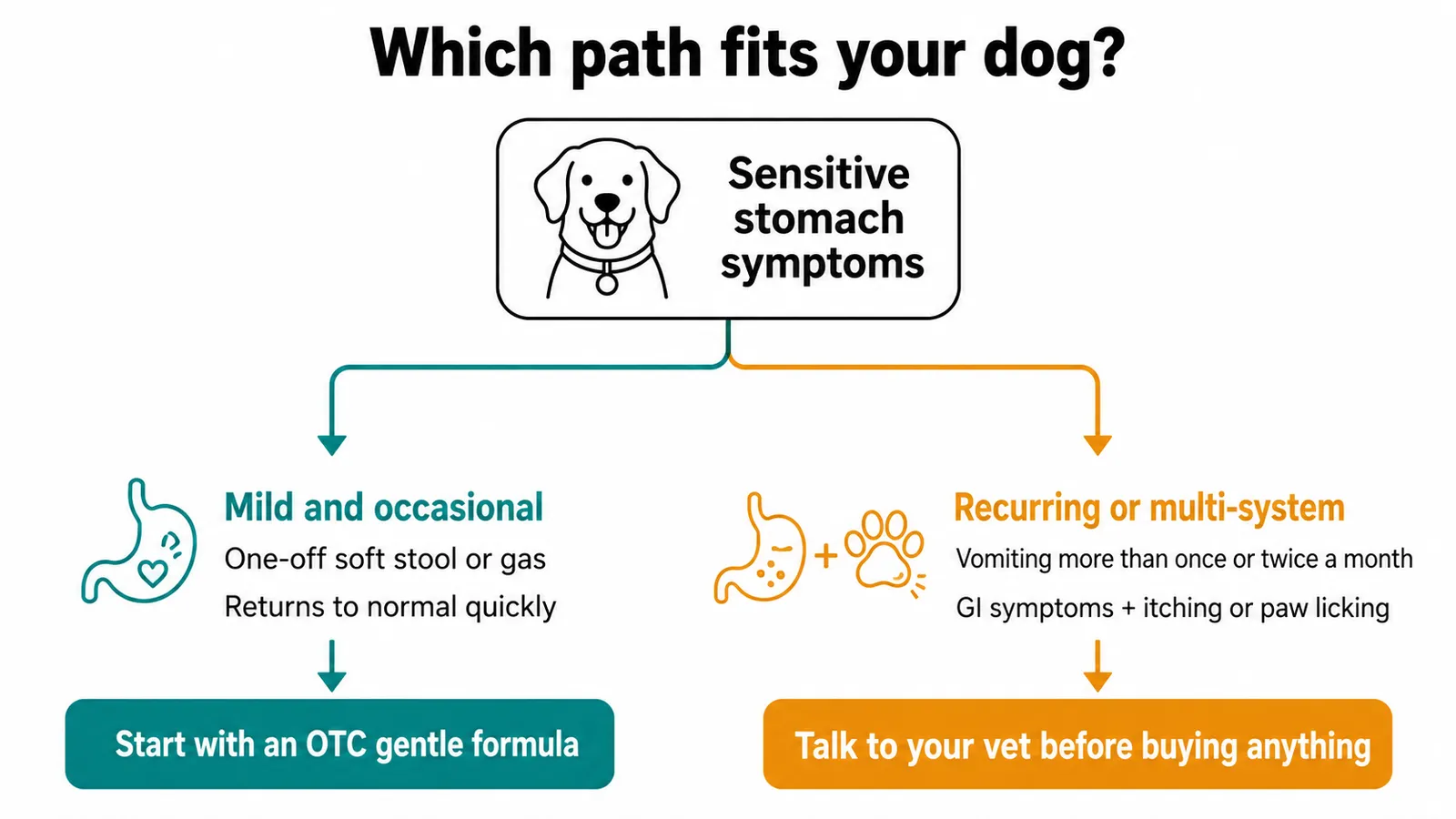
"Sensitive stomach" describes a pattern, not a diagnosis. It covers everything from occasional soft stool after a dietary mistake to chronic vomiting, gas, and loose stool that disrupts a dog's daily life. The reason the distinction matters: the food response that makes sense for a one-off episode looks nothing like the approach you'd take for a dog with recurring GI symptoms or suspected food allergy.
Mild, occasional GI upset is the most common version. A dog eats something off-script, a new treat, a table scrap, food from a different bag, and has a bad day or two before returning to normal. This pattern almost never requires a prescription diet. A simple, digestible OTC formula and a clean transition are usually enough.
Chronic or recurrent symptoms are a different story. If your dog has loose stool or vomiting more than once or twice a month without an obvious one-time trigger, that pattern warrants a closer look. When GI symptoms arrive alongside skin signs, itching, paw licking, recurring ear infections, the picture shifts again, toward potential food allergy rather than simple digestive sensitivity.
The two-path decision runs through everything that follows: is this mild and intermittent, or is it recurring and possibly multi-system? The answer determines whether you're shopping for a retail formula or calling your vet.
Which ingredients are easiest on a sensitive stomach?
The protein source and the overall recipe complexity matter more than any single superfood ingredient. A short, recognizable ingredient list in a low-fat formula is a better signal than a "natural" label. Here is how common ingredients stack up:
| Ingredient | Usually easier on sensitive stomachs | Potential concern | Best use case |
|---|---|---|---|
| Chicken | Often well tolerated in simple, low-fat recipes | Can be the trigger if chicken is the allergen | Good first trial for mild upset in dogs with no history of chicken reaction |
| Turkey | Lean, commonly used in gentle formulas | Still a common protein, not ideal for elimination trials | Practical for loose stool and nausea when chicken isn't the right fit |
| Fish / salmon | Digestible and frequently used in sensitive stomach formulas | Can be richer, portion size matters | Useful when a dog tolerates fish better than poultry |
| Lamb | Used in many sensitive stomach dry foods | Not automatically hypoallergenic despite the reputation | Helpful when chicken-based diets aren't producing results |
| Hydrolyzed protein | Broken into smaller pieces to reduce immune recognition | Veterinary only, not a casual first pick | Best when food allergy is suspected or simpler diets have failed |
| Rice | Gentle, bland, standard in GI recovery diets | Not ideal as the sole carbohydrate source long-term | Useful after vomiting or loose stool episodes |
| Oatmeal | Common in gentle dry formulas | Not always suitable for every elimination plan | Good in moderate, everyday digestible formulas |
| Sweet potato | Popular in many "natural" foods | Not automatically gentler than rice | Fine for some dogs, not a guaranteed sensitive stomach fix |
| Rich or fatty foods | Worsens vomiting, diarrhea, and nausea | Avoid during flare-ups | |
| Long ingredient lists | More variables = harder to identify a trigger | Avoid when trying to isolate a problem |
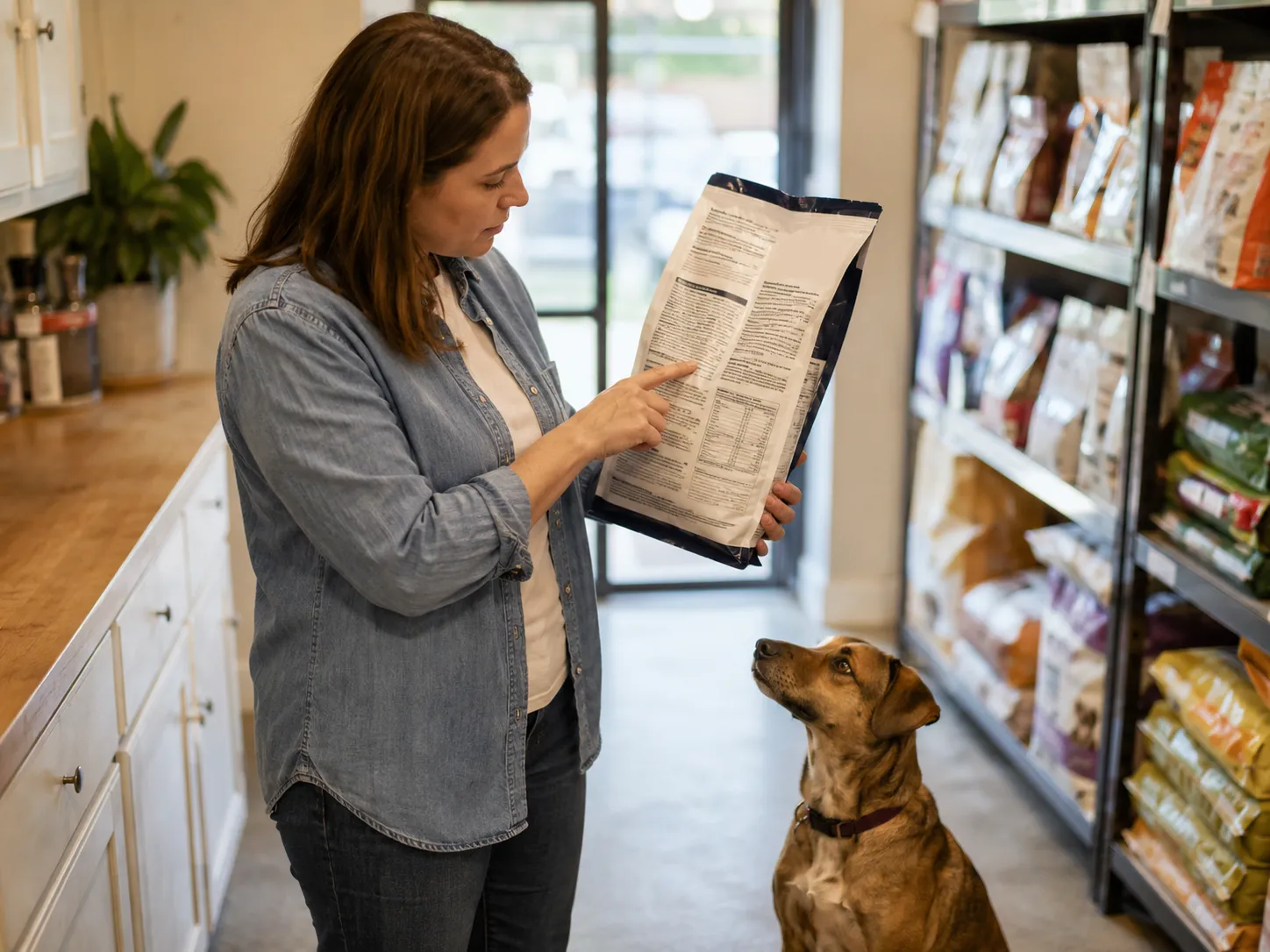
The ingredient itself matters less than the whole recipe. A chicken-and-rice formula with a long supplement list and high fat content may be harder on the stomach than a simpler fish-based food with five ingredients. Read the label, not just the front of the bag.
Store-bought sensitive stomach food vs. prescription diet: how to decide
This is where most owners get stuck. The bag says "sensitive stomach" and the price is reasonable, but the symptoms keep coming back. Understanding when OTC is enough, and when it isn't, saves weeks of trial-and-error and a lot of unnecessary food switching.
The lens I use for this decision is what I call DIGEST, six criteria that separate a food that actually fits the problem from one that just sounds right on the bag.
- Digestibility: How easily can the dog's GI tract process this formula without irritation?
- Ingredient simplicity: How many variables are in the recipe? Fewer is better when you're trying to isolate a trigger.
- Goal fit: Does this formula actually match the symptom pattern, mild upset, recurrent GI, or suspected allergy?
- Ease of transition: Can the dog move to this food without a rough adjustment period?
- Symptom tracking: Is the diet change structured enough that you'll get meaningful data from the trial?
- Trial length: Are you giving the food enough time for a real result, not just a few days?
Four scenarios cover the decisions most owners face:
Scenario 1, One-time soft stool after a dietary mistake, otherwise normal. DIGEST score: high on Ease of transition, low urgency everywhere else. Action: bland diet reset or gentle OTC formula; no vet needed unless it recurs.
Scenario 2, Recurring loose stool, gas, or occasional vomiting with no skin signs. DIGEST score: moderate; Goal fit matters most here. Action: simple retail GI formula or canned GI diet; book a routine vet visit if symptoms don't improve within 2-4 weeks.
Scenario 3, Itching, paw licking, ear infections appearing alongside GI symptoms. DIGEST score: Goal fit is low for any OTC option. Action: prescription hydrolyzed diet with a full elimination trial; vet guidance is required, not optional.
Scenario 4, Weight loss, blood in stool, repeated vomiting, or refusal to eat. DIGEST score: this is not a food selection question. Action: vet visit before any diet change; these signs need investigation, not a food trial.
I've seen the pattern Scenario 2 describes more than any other in the questions Froqel readers send. Someone picks up a premium bag labeled "sensitive stomach," feeds it for a week, sees no change, and switches again. The problem is rarely the formula, it's that a week isn't enough data and the trial wasn't clean.
How the main food options compare
| Food type | Digestibility | Ingredient control | Allergy utility | Convenience | When NOT to use |
|---|---|---|---|---|---|
| OTC gentle/sensitive formula | Moderate to high | Moderate | Useful for mild sensitivity only | Easy to find and rotate | Not enough for recurring vomiting, weight loss, or skin signs |
| Limited ingredient diet (retail) | Varies by brand | Can be good if truly limited | Helpful for reducing variables, not a definitive allergy test | Easy to buy | Poor choice if the label still has hidden extras |
| Canned GI diet | Often very high | Usually simple | Good for recovery, not a food allergy diagnostic | Highly palatable; good for picky or nauseous dogs | May be too rich if overfed; not a substitute for a proper elimination trial |
| Veterinary GI diet | High by design | High | Stomach support, not a full allergy investigation | Requires vet visit, practical for ongoing GI management | Not the first choice when skin signs strongly suggest allergy |
| Hydrolyzed prescription diet | High by design | Very high | Best option for suspected food allergy | Requires prescription and strict feeding discipline | Not appropriate for simple one-off GI upset |
| Raw or fresh options | Variable | Appears simple; real formula may be complex | Not a reliable allergy management strategy | Expensive and hard to standardize | Poor fit for controlled elimination trials |
Grain-free is not on this list as a category because removing grains is not a reliable solution for sensitive stomachs. If the issue is protein sensitivity, fat intolerance, or an additive reaction, a grain-free label will not fix it.
How to choose and transition to a sensitive stomach diet without making things worse
This section is about execution, choosing the right food is step one, but how you make the change determines whether the trial gives you real information.
- Start with the symptom pattern, not the bag. Mild and intermittent points to OTC. Recurring, multi-system, or worsening points to a vet conversation before you buy anything. Buying a bag before you know what you're dealing with is how most owners end up cycling through five formulas in two months.
- Choose one food and commit to it. Switching every few days produces noise, not data. Pick the category that fits the pattern and give it a fair run. When Barnaby had a sensitive patch after I changed his food too quickly, the thing that helped most wasn't a different protein, it was staying consistent and cutting all extras for two weeks.
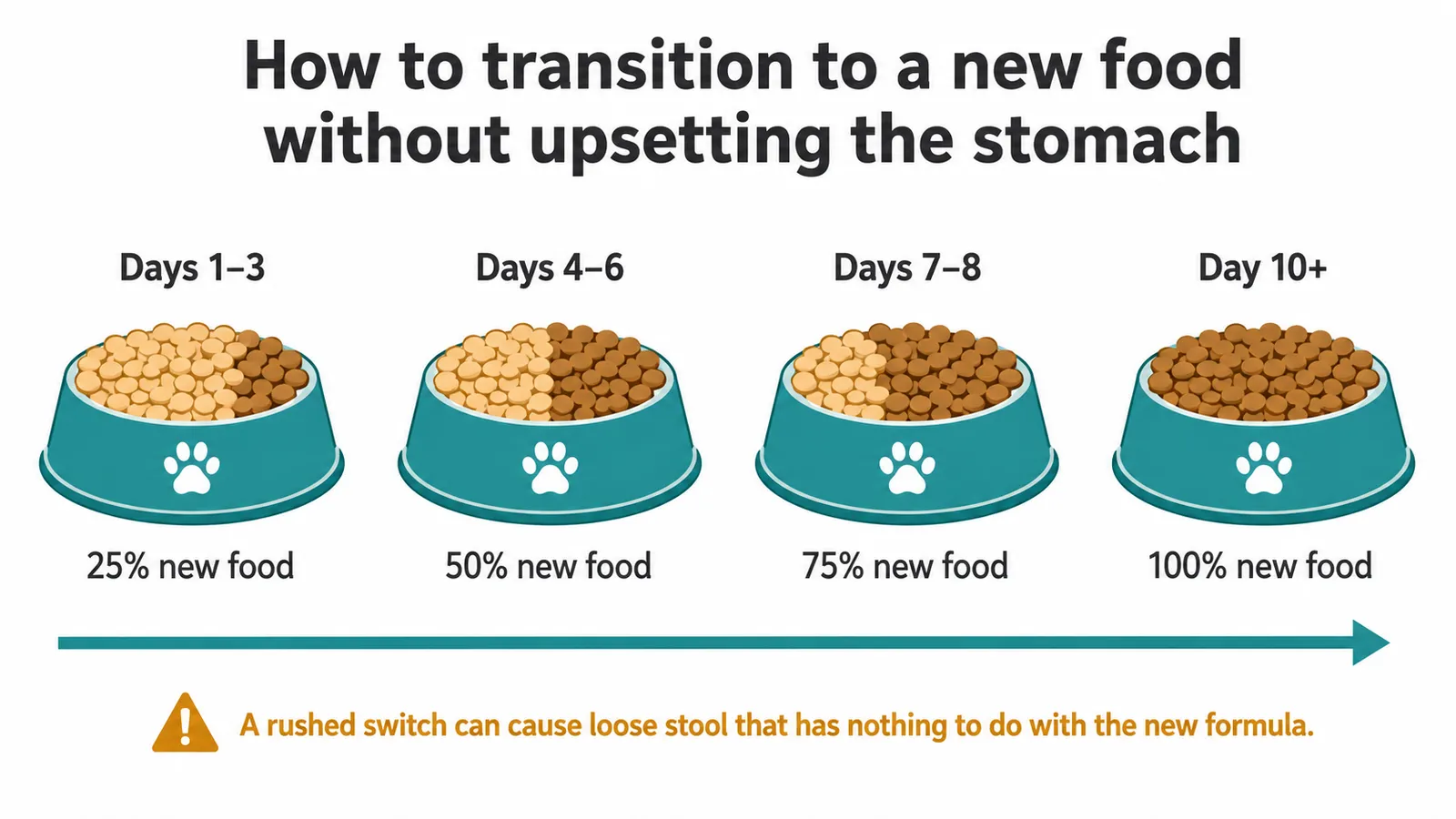
- Transition gradually over 7-10 days. Mix increasing amounts of the new food with the old: roughly 25% new on days 1-3, 50% on days 4-6, 75% on days 7-8, 100% by day 10. A rushed switch can trigger loose stool that has nothing to do with the new formula.
- Track symptoms every day. Stool quality, vomiting frequency, appetite, itching, licking, energy level. One bad day and one good day tell you nothing. A week of consistent data tells you something useful.
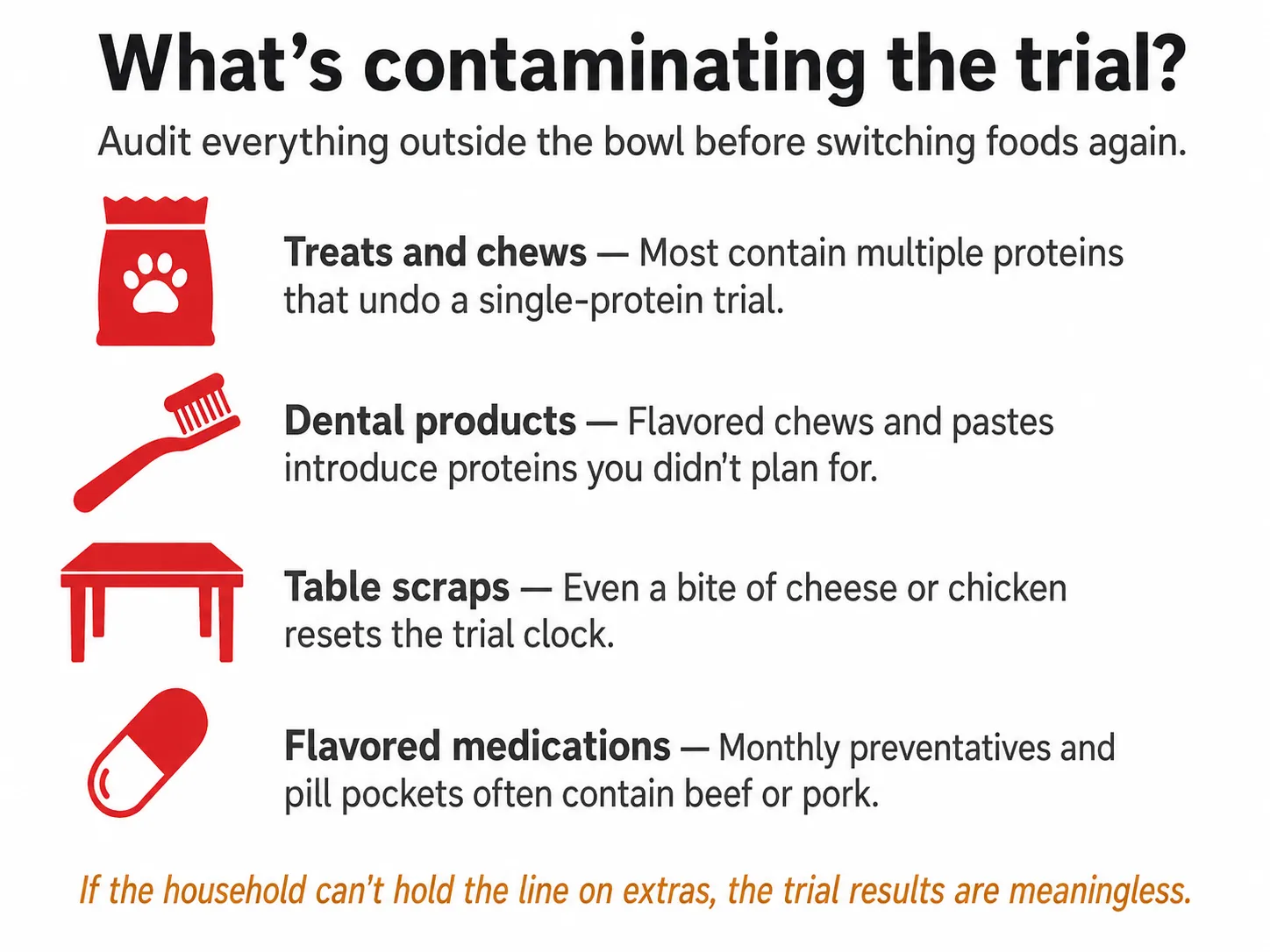
- Lock down everything outside the bowl. Treats, chews, dental products, pill pockets, table scraps, and flavored medications can undo a clean diet trial completely. If the household can't hold the line on extras, the trial results are meaningless.
- Give the trial enough time, but don't wait too long if symptoms worsen. For mild cases, 2-4 weeks on a new OTC food is a fair window. Hydrolyzed elimination trials typically require 6-8 weeks of consistent feeding before results are meaningful (Tufts Veterinary Nutrition). If symptoms escalate at any point, stop the trial and call your vet.
What to do if your dog still has symptoms on a sensitive stomach food
If the food looks right on paper but symptoms persist, the first place to investigate is everything that isn't the main meal. This is where most clean diet trials quietly fall apart.
The outside-the-bowl checklist:
- Treats and chews. Most commercial treats contain multiple proteins, flavor enhancers, and additives. A dog eating a single-protein hydrolyzed diet who also gets a beef jerky treat is not on an elimination diet. Switch to same-protein treats or cut treats entirely during a trial.
- Dental chews and rawhide. These often contain beef, chicken, or flavoring agents that bypass the careful protein selection in the main food. They count.
- Table scraps. Even small amounts of human food, a bite of cheese, a piece of cooked chicken, introduce variables that contaminate a controlled trial. The whole household needs to be on the same page.
- Flavored medications and pill pockets. Many monthly preventatives are beef- or pork-flavored, and flavored pill pockets contain ingredients that wouldn't survive scrutiny on a GI diet label. Ask your vet about unflavored alternatives or plain pill-hiding methods during an elimination trial.
- Water bowl contamination. Less common, but shared water sources in multi-pet homes can introduce food particles from another pet's meal. Worth ruling out if everything else is clean.
If all of the above are genuinely locked down and symptoms persist after a full trial period, the problem may not be food at all. Parasites, inflammatory bowel disease, exocrine pancreatic insufficiency, and other GI conditions produce symptoms that look exactly like diet sensitivity and don't respond to food changes (PetMD). That's the moment for a vet visit, not another bag.
When to see a vet
Not every loose stool is an emergency, but some symptom combinations should not wait. Here is a practical tiered guide.
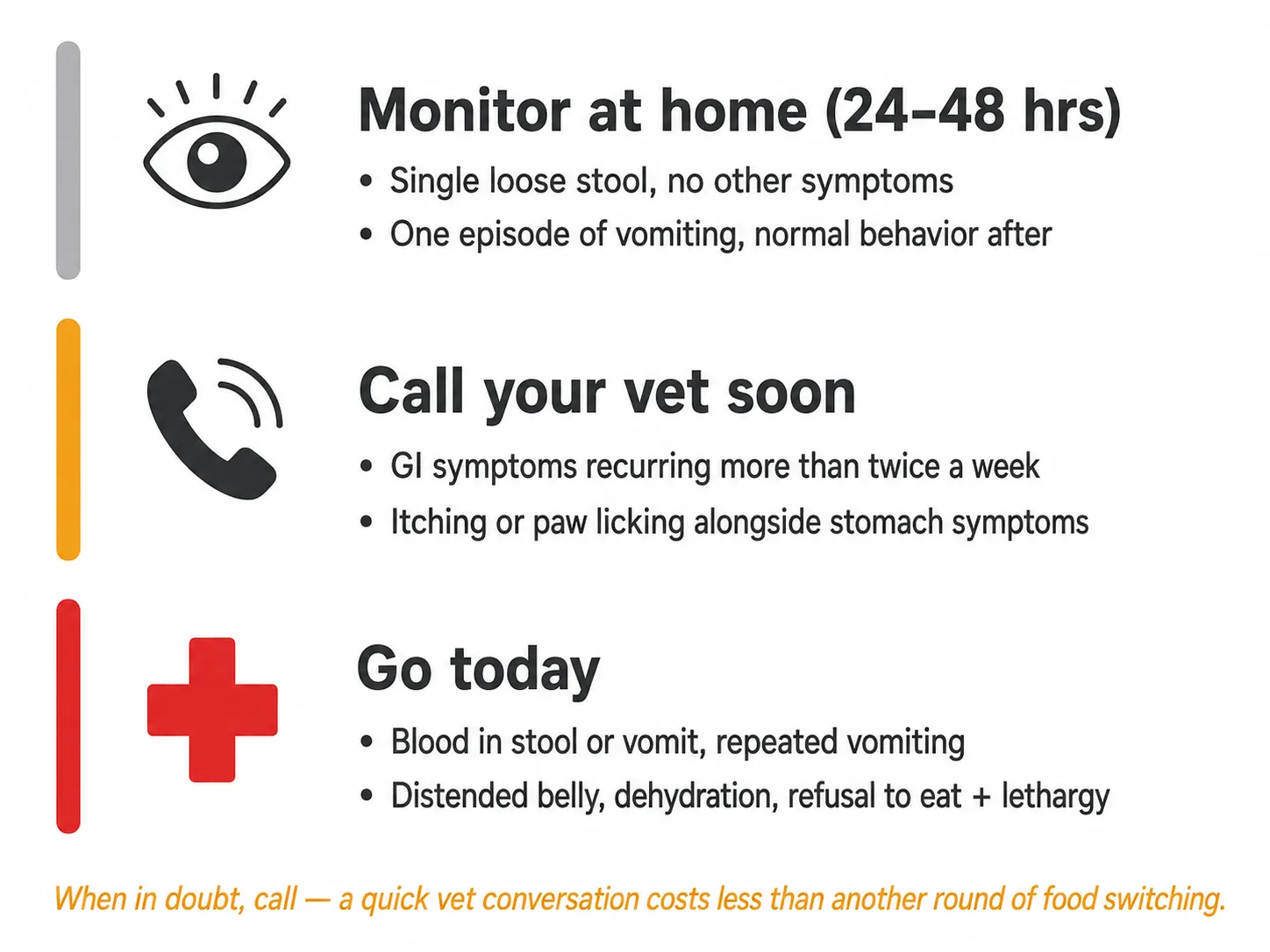
Monitor at home (watch for 24-48 hours):
- Single episode of loose stool or soft stool with no other symptoms
- Mild gas without vomiting, weight loss, or appetite change
- One episode of vomiting with normal behavior and appetite before and after
Call your vet soon (within a few days, or sooner if worsening):
- Loose stool or vomiting recurring more than once or twice a week
- Symptoms that haven't resolved after 5-7 days on a new, appropriate diet
- GI symptoms appearing alongside itching, paw licking, or recurring ear infections
- Noticeable drop in appetite or energy that isn't bouncing back
Go today:
- Blood in stool or vomit
- Signs of dehydration, dry gums, skin tenting, lethargy
- Repeated vomiting over several hours
- Distended or painful abdomen
- Refusal to eat for more than 24 hours, especially combined with lethargy
- Significant or rapid weight loss
Questions owners ask
What is the best food for dogs with sensitive stomachs?
For mild or occasional GI upset, a simple highly digestible formula with a short ingredient list, typically built around chicken, turkey, fish, or lamb with rice or oatmeal, is usually the right starting point. For recurring symptoms or suspected food allergy, a prescription hydrolyzed or veterinary GI diet is the stronger choice. The "best" food is the one that matches the actual symptom pattern, not the one with the most impressive label. When in doubt about which category applies to your dog, a vet conversation before you buy anything saves weeks of guessing (WSAVA Nutrition Guidelines).
Is grain-free dog food better for sensitive stomachs?
Generally no. Grain-free is not automatically gentler on the stomach, and for dogs whose problem is protein sensitivity or fat intolerance, removing grains does not address the actual cause. Grains like rice and oatmeal are among the most easily digestible carbohydrate sources available in commercial dog food. A grain-free formula that swaps rice for legumes or potatoes introduces different variables without solving the underlying problem. The FDA has also noted an association between grain-free diets and dilated cardiomyopathy in dogs, though the research is ongoing (AKC Canine Health Foundation).
Should I choose a limited ingredient diet for my dog?
A limited ingredient diet (LID) can help when your goal is to reduce variables and identify a trigger, but only if the entire household keeps the trial clean, including treats, chews, and table scraps. A retail LID is not the same as a veterinary elimination diet; it can still contain proteins the dog has been exposed to, and cross-contamination in manufacturing facilities is common. LIDs are a practical middle step between a standard sensitive stomach formula and a full prescription hydrolyzed trial. They work best for dogs with moderate, recurring GI symptoms who haven't yet shown skin signs (Tufts Veterinary Nutrition).
When should I use a hydrolyzed protein diet?
A hydrolyzed diet is the right move when your dog has recurring GI symptoms alongside skin signs like itching or paw licking, or when simpler diets have failed to settle the problem. It requires a vet prescription and strict feeding discipline to be useful, "strict" meaning no off-plan treats, no shared bowls, no flavored medications that haven't been vetted. Hydrolyzed diets work by breaking proteins into fragments too small for the immune system to recognize, which removes the allergic trigger even when the protein source is one the dog has reacted to before. Without complete adherence, a 6-8 week elimination trial tells you nothing (Tufts Veterinary Nutrition).
How long does it take for a sensitive stomach diet to work?
Most dogs show some improvement within 1-2 weeks on a well-matched OTC formula. A full hydrolyzed elimination trial typically needs 6-8 weeks of consistent feeding before results are meaningful. Expect the first week of any food transition to produce some variability in stool quality regardless of the formula, that's the transition, not a failure signal. If there is no improvement by week 3-4 on an OTC diet with a clean trial, the symptom pattern likely warrants a vet conversation rather than another food switch (Hunterdon Hills Animal Hospital).
Sources and further reading
- Tufts Veterinary Nutrition, Clinical Nutrition Service
- WSAVA Global Nutrition Committee Guidelines
- AKC Canine Health Foundation
- PetMD, Dog Digestive Health
- Hunterdon Hills Animal Hospital
- EGA Vets